HomeDiagramsDatabaseMapsForum About
     

Go Back   SkyscraperPage Forum > Regional Sections > Canada


Closed Thread

 
Thread Tools Display Modes
     
     
  #7461  
Old Posted Nov 23, 2015, 3:42 AM
ssiguy ssiguy is offline
Registered User
 
Join Date: Mar 2006
Location: White Rock BC
Posts: 11,939
London doesn't sprawl for 20km in all directions. From the downtown to the edge of the city is at max 10km in any direction.

Also Calgary and Edmonton had large swaths of undeveloped land in the inner cities and London has none. London has a very constant and continual urban form and unlike those other cities London doesn't have an abandoned rail corridors to take advantage of.
     
     
  #7462  
Old Posted Nov 23, 2015, 3:47 PM
MalcolmTucker MalcolmTucker is offline
Registered User
 
Join Date: May 2007
Posts: 11,596
^Calgary and Edmonton's rail corridors weren't/aren't abandoned. They may have had wider ROWs as they were all post confederation however.
     
     
  #7463  
Old Posted Nov 23, 2015, 4:22 PM
TorontoDrew's Avatar
TorontoDrew TorontoDrew is offline
Registered User
 
Join Date: Nov 2014
Posts: 10,691
Quote:
Originally Posted by manny_santos View Post
I'm not sure how exactly London plans to separate the LRT from the other lanes, but if it's like what I've seen in Toronto with Spadina Ave or The Queensway, I don't think an ambulance or fire truck could easily move into the LRT lane.

I see emergency vehicles use the dedicated streetcar lane all the time on Spadina. Doesn't seem to be an issue at all.
     
     
  #7464  
Old Posted Nov 23, 2015, 4:39 PM
DizzyEdge's Avatar
DizzyEdge DizzyEdge is offline
My Spoon Is Too Big
 
Join Date: Oct 2006
Location: Calgary
Posts: 9,162
Quote:
Originally Posted by GlassCity View Post
I think Calgary's (and Edmonton's for that matter) LRTs are a bad example when discussing LRT because it's so different from what most people have in mind. Most of the system is in large medians or rail right of ways, which allows for higher speed but is pretty atypical of most LRT systems. The sort of LRT that is all the rage to build right now–street-running with dedicated lanes serving dense neighbourhoods–can really not be compared to the systems in Alberta, which when I rode them seemed to almost have more of a commuter rail feel.
Yes most of the Calgary LRT system is more of a commuter train, only the last few stops before downtown are more of a neighbourhood scale, and then downtown it acts like a street car stopping every couple of blocks, for example stops are around 350m apart downtown, whereas out in the burbs there's one section where stops are 4.5 km apart.
__________________
Concerned about protecting Calgary's built heritage?
www.CalgaryHeritage.org
News - Heritage Watch - Forums
     
     
  #7465  
Old Posted Nov 23, 2015, 5:18 PM
haljackey's Avatar
haljackey haljackey is offline
User Registered
 
Join Date: Apr 2010
Location: London, Ontario
Posts: 3,467
__________________
My Twitter

My Simcity Stuff
     
     
  #7466  
Old Posted Nov 23, 2015, 5:44 PM
Beedok Beedok is offline
Exiled Hamiltonian Gal
 
Join Date: Jun 2012
Posts: 6,795
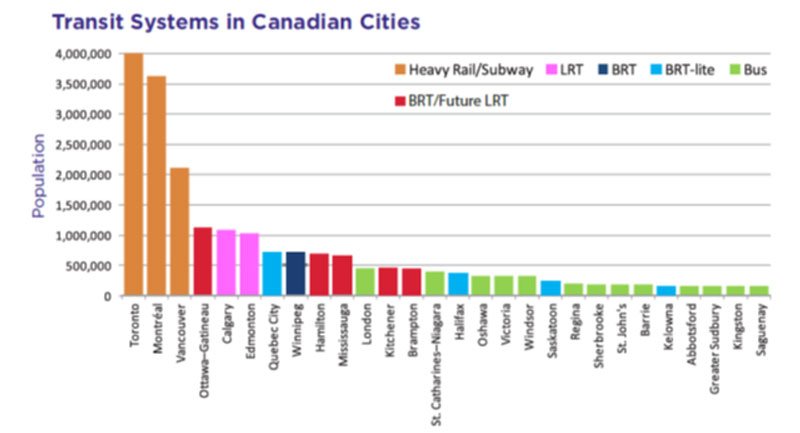
Did Toronto lose a million people?
     
     
  #7467  
Old Posted Nov 23, 2015, 5:58 PM
Nouvellecosse's Avatar
Nouvellecosse Nouvellecosse is online now
Volatile Pacivist
 
Join Date: Aug 2005
Location: Nova Scotia
Posts: 11,272
They simply cut the y axis off because having the scale necessary to accurately reflect the one largest entry would have diminished the details for the couple dozen smaller entries.
__________________
"The reasonable man adapts himself to the world; the unreasonable one persists in trying to adapt the world to himself. Therefore all progress depends on the unreasonable man." - George Bernard Shaw
Don't ask people not to debate a topic. Just stop making debatable assertions. Problem solved.
     
     
  #7468  
Old Posted Nov 24, 2015, 12:44 AM
miketoronto miketoronto is offline
Registered User
 
Join Date: Jul 2001
Location: Toronto, Ontario, Canada
Posts: 9,932
Quote:
Originally Posted by GlassCity View Post
I think Calgary's (and Edmonton's for that matter) LRTs are a bad example when discussing LRT because it's so different from what most people have in mind. Most of the system is in large medians or rail right of ways, which allows for higher speed but is pretty atypical of most LRT systems. The sort of LRT that is all the rage to build right now–street-running with dedicated lanes serving dense neighbourhoods–can really not be compared to the systems in Alberta, which when I rode them seemed to almost have more of a commuter rail feel.
It may be the rage, but it is not attracting people. Calgary and Edmonton's LRT's still attract way more people, because they do something most people want in transit, and that is offer a competitive ride to the automobile.

Calgary and Edmonton are actually what LRT was originally planned to operate as. True LRT is supposed to utilize railway corridors, and other fast moving sections, to provide a metro style service.
__________________
Miketoronto
     
     
  #7469  
Old Posted Nov 24, 2015, 12:58 AM
WhipperSnapper's Avatar
WhipperSnapper WhipperSnapper is offline
I am the law!
 
Join Date: Sep 2002
Location: Toronto+
Posts: 22,892
Quote:
Originally Posted by Nouvellecosse View Post
They simply cut the y axis off because having the scale necessary to accurately reflect the one largest entry would have diminished the details for the couple dozen smaller entries.
Strange to list Toronto at whatever million and also Mississauga and Brampton.
     
     
  #7470  
Old Posted Nov 24, 2015, 1:20 AM
Nouvellecosse's Avatar
Nouvellecosse Nouvellecosse is online now
Volatile Pacivist
 
Join Date: Aug 2005
Location: Nova Scotia
Posts: 11,272
Quote:
Originally Posted by miketoronto View Post
It may be the rage, but it is not attracting people. Calgary and Edmonton's LRT's still attract way more people, because they do something most people want in transit, and that is offer a competitive ride to the automobile.

Calgary and Edmonton are actually what LRT was originally planned to operate as. True LRT is supposed to utilize railway corridors, and other fast moving sections, to provide a metro style service.
Actually, the original LRT were the stadbahn and premetro services of Europe which use a variety of ROWs including both centre median of streets and rail corridors.

I just don't think it's healthy to generalize about LRT (or any other form of transit really). It should be based on the need (passenger volume and distances involved) and the available ROW. Not every city has super wide streets or railway corridors available and when they are available, they aren't necessarily in the most useful place to serve the needs of the ridership. Just because a specific format seems to have worked in the local conditions a specific region such as Alberta, that doesn't mean the same conditions exist elsewhere.
__________________
"The reasonable man adapts himself to the world; the unreasonable one persists in trying to adapt the world to himself. Therefore all progress depends on the unreasonable man." - George Bernard Shaw
Don't ask people not to debate a topic. Just stop making debatable assertions. Problem solved.
     
     
  #7471  
Old Posted Nov 24, 2015, 2:56 AM
Chadillaccc's Avatar
Chadillaccc Chadillaccc is offline
ARTchitecture
 
Join Date: Feb 2011
Location: Cala Ghearraidh
Posts: 22,842
Quote:
Originally Posted by DizzyEdge View Post
Yes most of the Calgary LRT system is more of a commuter train, only the last few stops before downtown are more of a neighbourhood scale, and then downtown it acts like a street car stopping every couple of blocks, for example stops are around 350m apart downtown, whereas out in the burbs there's one section where stops are 4.5 km apart.
True, but the average station spacing of the C-train is only 1.3 km. This is pretty comparable to Toronto's 0.9 km spacing, Montreal's 1 km spacing, and Vancouver's 1.4 km spacing. However, by the mid-2020s, Calgary will be adding another 40 km of track in the Green Line, plus another 3 to 4 km in the Red Line Subway to our current 60 km network. Only around 32 stations will be added in these expansions though, so with that in mind, Calgary is set to eventually have a station spacing of a whopping... edit: okay it'll still be 1.3 km spacing Nevermind! 77 stations along 103 km of track.
__________________
Strong & Free

Mohkínstsis — 1.6 million people at the Foothills of the Rocky Mountains, 400 high-rises, a 300-metre SE to NW climb, over 1000 kilometres of pathways, with 20% of the urban area as parkland.

Last edited by Chadillaccc; Nov 24, 2015 at 3:07 AM.
     
     
  #7472  
Old Posted Nov 24, 2015, 3:14 AM
miketoronto miketoronto is offline
Registered User
 
Join Date: Jul 2001
Location: Toronto, Ontario, Canada
Posts: 9,932
Quote:
Originally Posted by Nouvellecosse View Post
I just don't think it's healthy to generalize about LRT (or any other form of transit really). It should be based on the need (passenger volume and distances involved) and the available ROW. Not every city has super wide streets or railway corridors available and when they are available, they aren't necessarily in the most useful place to serve the needs of the ridership. Just because a specific format seems to have worked in the local conditions a specific region such as Alberta, that doesn't mean the same conditions exist elsewhere.
True. Which means you go underground or elevated, when there is no fast surface route available.

I want to hear statistics on what the planned LRT and BRT lines in London are going to accomplish. How much time savings over the current bus option? Mode share? Number of car drivers attracted?
The results are not that great, then why spend billions on a plan that is really no better than the buses it replaces? If we are going to spend a billion or two, lets spend in a way that brings true rapid transit.
Again, lets see the stats, and then decide if this is a good project or not. But sadly, all these new LRT projects never tell us any of the stats.

__________________
Miketoronto
     
     
  #7473  
Old Posted Nov 24, 2015, 3:43 AM
Nouvellecosse's Avatar
Nouvellecosse Nouvellecosse is online now
Volatile Pacivist
 
Join Date: Aug 2005
Location: Nova Scotia
Posts: 11,272
I agree that it's important to see the stats and look at a detailed cost/benefit analysis that takes into account not only how much service and projected ridership improved based on each level of investment, but also how much transit improvement you could get elsewhere for that doubled or tripled price. The cost of putting a transit line underground is a good 3 times the cost of having it on the surface in street median. One must think long and hard about whether having one underground line is really worth three on the surface given the ridership.

I think the main thing that I'd be concerned about is whether there is traffic signal priority. If it's in its own dedicated lane, which with LRT is possible in narrower corridors than with BRT, and has signal priority then it will be plenty fast enough.
__________________
"The reasonable man adapts himself to the world; the unreasonable one persists in trying to adapt the world to himself. Therefore all progress depends on the unreasonable man." - George Bernard Shaw
Don't ask people not to debate a topic. Just stop making debatable assertions. Problem solved.
     
     
  #7474  
Old Posted Nov 24, 2015, 12:16 PM
Aylmer's Avatar
Aylmer Aylmer is offline
Still optimistic
 
Join Date: Nov 2007
Location: Montreal (C-D-N) / Ottawa (Aylmer)
Posts: 5,407
And also how many intersections there are:
If there's a whole mess of them like you'll usually find in inner cities (think Toronto's King Street or any Montréal east-west Streets), the number of potential conflicts is enormous and will slow down transit even if it has its own lane. Coordinating signals also becomes very tricky.
If, however, there are very few vehicular intersections, you can more easily insure speed and priority. This is why surface LRT is a very attractive option in postwar suburbs: the dendritic street pattern is meant to reduce intersections on arterials to a minimum, meaning that you don't need much grade separation to reduce conflicts.

I maintain that transportation technologies are tools, not ends. And just like you wouldn't use a screwdriver to hammer a nail, different contexts and goals require different types of transit.
__________________
I've always struggled with reality. And I'm pleased to say that I won.
     
     
  #7475  
Old Posted Nov 24, 2015, 12:34 PM
Metro-One's Avatar
Metro-One Metro-One is online now
Registered User
 
Join Date: Sep 2008
Location: Japan
Posts: 17,947
Quote:
Originally Posted by Beedok View Post
Did Toronto lose a million people?
Metro-Van is also missing about 500 000 people being posted at 2 million.

I wouldn't worry too much about the accuracy of the population on this graph.
__________________
Bridging the Gap
Check out my Flickr: https://www.flickr.com/photos/30634635@N03/with/29495547810/ and Youtube channel https://www.youtube.com/channel/UCV0_0h9qKlhxXFxuAey_q6Q
     
     
  #7476  
Old Posted Nov 24, 2015, 2:08 PM
begratto's Avatar
begratto begratto is offline
Explorateur urbain
 
Join Date: Jun 2005
Location: Verdun > Montréal > Québec > Canada
Posts: 1,072
Quote:
Originally Posted by Metro-One View Post
Metro-Van is also missing about 500 000 people being posted at 2 million.
So is Montreal, which should be at 4.1M
__________________
Venit ad oppidum!
     
     
  #7477  
Old Posted Nov 24, 2015, 2:19 PM
Beedok Beedok is offline
Exiled Hamiltonian Gal
 
Join Date: Jun 2012
Posts: 6,795
Quote:
Originally Posted by Metro-One View Post
Metro-Van is also missing about 500 000 people being posted at 2 million.

I wouldn't worry too much about the accuracy of the population on this graph.
Quote:
Originally Posted by begratto View Post
So is Montreal, which should be at 4.1M
Those two line up with 2011 urban area populations fairly well. I think they took a bunch of different rankings and slopped them together.
     
     
  #7478  
Old Posted Nov 24, 2015, 4:38 PM
MalcolmTucker MalcolmTucker is offline
Registered User
 
Join Date: May 2007
Posts: 11,596
Quote:
Originally Posted by miketoronto View Post
True. Which means you go underground or elevated, when there is no fast surface route available.

I want to hear statistics on what the planned LRT and BRT lines in London are going to accomplish. How much time savings over the current bus option? Mode share? Number of car drivers attracted?
The results are not that great, then why spend billions on a plan that is really no better than the buses it replaces? If we are going to spend a billion or two, lets spend in a way that brings true rapid transit.
Again, lets see the stats, and then decide if this is a good project or not. But sadly, all these new LRT projects never tell us any of the stats.

Here is London's:


It is better than Waterloo's which was neutral for travel time iirc, but not that great compared to an all BRT system that is way cheaper. The transit user benefit gains do not justify the higher capital costs.
     
     
  #7479  
Old Posted Nov 24, 2015, 7:19 PM
1overcosc's Avatar
1overcosc 1overcosc is offline
Registered User
 
Join Date: Jun 2013
Location: Eastern Ontario
Posts: 12,377
It's not just travel time improvements here and now.

Say the LRT will only be 4 minutes faster than today's regular buses.

In 20 years once the city grows and congestion gets worse, the LRT travel time will remain the same. But the travel time by regular bus will increase. So that 4 minutes will become 10 minutes or more over time.
__________________
"It is only because the control of the means of production is divided among many people acting independently that nobody has complete power over us, that we as individuals can decide what to do with ourselves." - Friedrich Hayek
     
     
  #7480  
Old Posted Nov 24, 2015, 7:20 PM
1overcosc's Avatar
1overcosc 1overcosc is offline
Registered User
 
Join Date: Jun 2013
Location: Eastern Ontario
Posts: 12,377
Congestion is a big factor. London has bad congestion so rapid transit to separate transit from auto traffic is huge.

By contrast, in a city like Kingston where congestion is minimal, there's not much point to separating transit. If Kingston ever grows to the point where it is required, we're pretty fucked, actually. The roads even in the suburbs are all too narrow to accommodate LRT without tunneling and the city is too full of continuous urban form for rail to be punched through surface corridors. We'd basically have to go straight to tunneling once bus lanes aren't good enough.
__________________
"It is only because the control of the means of production is divided among many people acting independently that nobody has complete power over us, that we as individuals can decide what to do with ourselves." - Friedrich Hayek
     
     
This discussion thread continues

Use the page links to the lower-right to go to the next page for additional posts
 
 
Closed Thread

Go Back   SkyscraperPage Forum > Regional Sections > Canada
Forum Jump


Thread Tools
Display Modes

Forum Jump


All times are GMT. The time now is 12:44 AM.


Powered by vBulletin® Version 3.8.7
Copyright ©2000 - 2026, vBulletin Solutions, Inc.