HomeDiagramsDatabaseMapsForum About
     

Go Back   SkyscraperPage Forum > Global Projects & Construction > City Compilations


Reply

 
Thread Tools Display Modes
     
     
  #1661  
Old Posted Feb 15, 2013, 11:06 PM
Syndic's Avatar
Syndic Syndic is offline
Registered User
 
Join Date: Jun 2010
Location: Cedar Park, TX
Posts: 1,962
I didn't realize that it will have restaurant space and will butt right up against the height limit. So, yeah, other than having more retail space or being residential, it's about as good as it gets for that lot. Consider me converted into a believer.
Reply With Quote
     
     
  #1662  
Old Posted Feb 15, 2013, 11:54 PM
Komeht Komeht is offline
Registered User
 
Join Date: Sep 2012
Posts: 294
Quote:
Originally Posted by wwmiv View Post
Another good bit of news today:

http://www.austintowers.net/Austin_D...ndbreaking.php

And a new rendering, which honestly makes this look like a great project:


Also:


I don't think this has been brought up before, but it's great they're using the space to the max.
That is decent and way better than what's there. . .I still can't stand the CVCs that make redevelopment of CBD so much more difficult than need be.

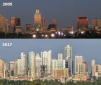
Love the before and after pic.

I also note that between this and Hotel ZaZa there is some faint hope yet for Republic Square - despite the 1-2-3 punch from the Feds and State on killing three surrounding blocks.
Reply With Quote
     
     
  #1663  
Old Posted Feb 16, 2013, 12:14 AM
Jdawgboy's Avatar
Jdawgboy Jdawgboy is offline
Representing the ATX!!!
 
Join Date: Jan 2003
Location: Austin
Posts: 5,838
Quote:
Originally Posted by Komeht View Post
That is decent and way better than what's there. . .I still can't stand the CVCs that make redevelopment of CBD so much more difficult than need be.

Love the before and after pic.

I also note that between this and Hotel ZaZa there is some faint hope yet for Republic Square - despite the 1-2-3 punch from the Feds and State on killing three surrounding blocks.
The CVCs have actually helped us get taller buildings than I think would not have if there were no CVCs. Great example is 360. The lot its built is partly in a CVC corridoor hence why it has a setback on the 17th floor. Had the CVC not been there, that building would have not been 44 storys. Similar designed buildings in other cities are in the 20 story range.
__________________
"GOOD TIMES!!!" Jerri Blank (Strangers With Candy)
Reply With Quote
     
     
  #1664  
Old Posted Feb 16, 2013, 3:24 AM
KevinFromTexas's Avatar
KevinFromTexas KevinFromTexas is offline
Meh
 
Join Date: Jul 2001
Location: Austin,TX<-->Dripping Springs,TX<-->Birmingham, AL<-->Warm Springs,GA
Posts: 57,205
^Yeah, the CVCs actually encourage height and density since they create unique situations on some blocks where they reduce the allowable height on those blocks, and all of it on others. On the blocks where all of it is restricted by the CVC, it forces the developer to build to the maximum allowed height to achieve the amount of space they're planning. That might mean a building that covers the entire block with a lot of potential for street level retail since the building might need a large footprint to achieve the amount of space they're planning. On the blocks where part of them are restricted by the CVC, it requires the developer to put some of the space under the CVC while putting the rest of the space on the area of the block that isn't restricted. On the unrestricted portion they have to go vertical to get there. On the blocks that aren't restricted by a CVC at all, it encourages developers to utilize them better and not waste a block that could potentially support a lot of height and density. The Travis County Courthouse block is a good example of that. Half the block will go to a private developer who will be allowed to build to the maximum limit with no restriction that might end up being one of the tallest buildings in Texas. So it sort of gives them some incentive to not waste it. The CVCs also create some unique building designs, and they can be perfect for residential neighborhoods since they create planned view corridors for residents to enjoy that are guaranteed to stay put.
__________________
My girlfriend has a poodle named Kevin.
Reply With Quote
     
     
  #1665  
Old Posted Feb 16, 2013, 5:15 AM
wwmiv wwmiv is offline
Registered User
 
Join Date: Sep 2009
Location: Austin -> San Antonio -> Columbia -> San Antonio -> Chicago -> Austin -> Denver -> Austin
Posts: 5,710
Quote:
Originally Posted by KevinFromTexas View Post
^Yeah, the CVCs actually encourage height and density since they create unique situations on some blocks where they reduce the allowable height on those blocks, and all of it on others. On the blocks where all of it is restricted by the CVC, it forces the developer to build to the maximum allowed height to achieve the amount of space they're planning. That might mean a building that covers the entire block with a lot of potential for street level retail since the building might need a large footprint to achieve the amount of space they're planning. On the blocks where part of them are restricted by the CVC, it requires the developer to put some of the space under the CVC while putting the rest of the space on the area of the block that isn't restricted. On the unrestricted portion they have to go vertical to get there. On the blocks that aren't restricted by a CVC at all, it encourages developers to utilize them better and not waste a block that could potentially support a lot of height and density. The Travis County Courthouse block is a good example of that. Half the block will go to a private developer who will be allowed to build to the maximum limit with no restriction that might end up being one of the tallest buildings in Texas. So it sort of gives them some incentive to not waste it. The CVCs also create some unique building designs, and they can be perfect for residential neighborhoods since they create planned view corridors for residents to enjoy that are guaranteed to stay put.
CVCs also have another great aspect because of what they do (all of which you mentioned): they increase, often, the value of the buildings because many projects will have protected unencumbered views from all sides.
Reply With Quote
     
     
  #1666  
Old Posted Feb 16, 2013, 5:36 AM
Komeht Komeht is offline
Registered User
 
Join Date: Sep 2012
Posts: 294
Quote:
Originally Posted by wwmiv View Post
CVCs also have another great aspect because of what they do (all of which you mentioned): they increase, often, the value of the buildings because many projects will have protected unencumbered views from all sides.
Completely disagree with the notion that CVCs cause buildings to go higher. And in any case, if that was the goal of the city - there are tons more efficient and equitable ways to accomplish it.

But the goal is not just to create height - it's to create a vibrant, interesting, dense, livable downtown. The thing that gets the way in the most in Austin is whole swaths of downtown are surface parking lots or super low intensity single story lots that have been that way and will remain that way for decades to come because the economics of developing them are prohibitive. There are enough roadblocks to development in this city as it is.

Also, this idea that somehow it's a benefit to the protect blocks is horrible - you would never purposefully blight blocks in a CBD in order to protect other blocks - but that's exactly what the CVCs in effect do.

Last edited by Komeht; Feb 16, 2013 at 3:28 PM.
Reply With Quote
     
     
  #1667  
Old Posted Feb 16, 2013, 5:39 AM
Komeht Komeht is offline
Registered User
 
Join Date: Sep 2012
Posts: 294
Quote:
Originally Posted by KevinFromTexas View Post
^Yeah, the CVCs actually encourage height and density since they create unique situations on some blocks where they reduce the allowable height on those blocks, and all of it on others. On the blocks where all of it is restricted by the CVC, it forces the developer to build to the maximum allowed height to achieve the amount of space they're planning. That might mean a building that covers the entire block with a lot of potential for street level retail since the building might need a large footprint to achieve the amount of space they're planning. On the blocks where part of them are restricted by the CVC, it requires the developer to put some of the space under the CVC while putting the rest of the space on the area of the block that isn't restricted. On the unrestricted portion they have to go vertical to get there. On the blocks that aren't restricted by a CVC at all, it encourages developers to utilize them better and not waste a block that could potentially support a lot of height and density. The Travis County Courthouse block is a good example of that. Half the block will go to a private developer who will be allowed to build to the maximum limit with no restriction that might end up being one of the tallest buildings in Texas. So it sort of gives them some incentive to not waste it. The CVCs also create some unique building designs, and they can be perfect for residential neighborhoods since they create planned view corridors for residents to enjoy that are guaranteed to stay put.
100% disagree - it means whole and partial blocks sometimes do not get built for decades and some areas of the CBD are all but un-developable because of the CVCs. There are far too many of them and in a city that is already blighted by the State of Texas office park/parking garage ghetto, the CVCs (at least the city ones) are a self inflicted wound.
Reply With Quote
     
     
  #1668  
Old Posted Feb 16, 2013, 7:16 AM
LoneStarMike's Avatar
LoneStarMike LoneStarMike is offline
Registered User
 
Join Date: Aug 2006
Location: Austin -> Tyler, TX
Posts: 2,317
Quote:
Originally Posted by wwmiv View Post

And a new rendering, which honestly makes this look like a great project:

I don't think that's a new rendering. Mopacs posted that same rendering about 6 months ago in this post

Good to see that it's finally going to break ground, though.
Reply With Quote
     
     
  #1669  
Old Posted Feb 16, 2013, 7:30 AM
NYC2ATX's Avatar
NYC2ATX NYC2ATX is offline
Everywhere all at once
 
Join Date: Aug 2006
Location: SI NYC
Posts: 2,458
Quote:
Originally Posted by wwmiv View Post
I expect that Manchester and 3rd&Co will break ground this year. I'm less solid with Seaholm, but I do think that it will break ground either this year or next.
Jeeez what a year this is going to be. I plan on moving to Austin before the year is out, and what an environment I'll be heading into. CANNOT WAIT

TBH, I'm far more excited about Green Water than I am about Seaholm based on the renderings I've seen for both projects, but I definitely want both with shovels in the ground, since Seaholm is going to house the new Central Library. Tell me, what's the word around town down there on GW? ...if there is a word I suppose.
__________________
BUILD IT. BUILD EVERYTHING. BUILD IT ALL.
Reply With Quote
     
     
  #1670  
Old Posted Feb 16, 2013, 7:43 AM
The ATX's Avatar
The ATX The ATX is offline
Moderator
 
Join Date: May 2006
Location: Right here, right now
Posts: 12,729
Quote:
Originally Posted by StatenIslander237 View Post
Jeeez what a year this is going to be. I plan on moving to Austin before the year is out, and what an environment I'll be heading into. CANNOT WAIT

TBH, I'm far more excited about Green Water than I am about Seaholm based on the renderings I've seen for both projects, but I definitely want both with shovels in the ground, since Seaholm is going to house the new Central Library. Tell me, what's the word around town down there on GW? ...if there is a word I suppose.
There's not much word on the GW. With Trammell Crow behind it, I would have thought it would be moving along much faster than the snail's pace that it's on now.
__________________
Follow The ATX on X:
https://x.com/TheATX1

Things will be great when you're downtown.
Reply With Quote
     
     
  #1671  
Old Posted Feb 16, 2013, 10:47 AM
Syndic's Avatar
Syndic Syndic is offline
Registered User
 
Join Date: Jun 2010
Location: Cedar Park, TX
Posts: 1,962
I actually love view corridors for all of the reasons mentioned here and because it makes cities develop in different ways. The last thing I want is for Austin to look like every other city with just a forest of skyscrapers and nothing to look at. To me, it's worth whatever challenges and slowdowns that may come with it, because in the end it adds value to the city by adding beauty, uniqueness, and character. The capitol is central to not just the city, but also our identity as a city. I would hate for that to get lost in a forest of buildings. We have to keep in mind what's important. Development now at the expense of all else is not worth it in the end. There has to be direction to the development. I don't want to be Houston.
Reply With Quote
     
     
  #1672  
Old Posted Feb 16, 2013, 11:54 AM
Komeht Komeht is offline
Registered User
 
Join Date: Sep 2012
Posts: 294
Quote:
Originally Posted by Syndic View Post
I actually love view corridors for all of the reasons mentioned here and because it makes cities develop in different ways. The last thing I want is for Austin to look like every other city with just a forest of skyscrapers and nothing to look at. To me, it's worth whatever challenges and slowdowns that may come with it, because in the end it adds value to the city by adding beauty, uniqueness, and character. The capitol is central to not just the city, but also our identity as a city. I would hate for that to get lost in a forest of buildings. We have to keep in mind what's important. Development now at the expense of all else is not worth it in the end. There has to be direction to the development. I don't want to be Houston.
CVCs promote a less dense, less contiguous, less vibrant, less interesting down town and contribute to Austin being more sprawling and more Houston-like. Two things I will say about Houston:


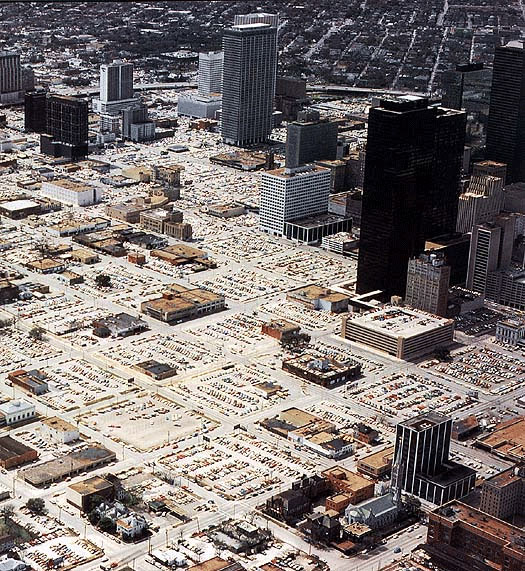
1. The problem with Houston's CBD isn't tall buildings, its that they used to do this:


(And even Houston has realized that that is deadly growth and is remedying this wrong)

That's the same kind of contiguous downtown promoted by CVCs, and

2. Austinites love to say how they don't want to be Houston and then implement landuse policies that make Austin more like Houston.

View corridors are incredibly pricey propositions encumbering dozens of properties and condemning large amounts of the city to low intensity auto-oriented business like drive though banks (seen a few of those blighting the CBD?). Austin already has a huge area blighted by the state. Some of the CVCs protect views so remote you have to use a pair of binoculars to get a meaningful view, or so site specific you have to stand on a single square meter to see them around billboards. We have a view corridor that protects views from a cemetery...that's right, we protect the views of people no longer alive to enjoy them. Some even protect views which no longer exist. If there were a reasonable number down a few selected corridors it would be fine. There are 35. The entire north east quadrant of the CBD is virtually off limits with predictably grim results. Much of the NW corridor is equally off limits (and they already have to fight OWANA on EVERYTHING). WWs very modest goal of putting 25K people downtown seems nearly out of reach because there are so few parcels available for dense development. There is an enormous cost to CVCs that the city just absorbs.

Finally, for me this is not about skylines, its about creating the best possible city experience at the level of the street. And you cannot achieve the critical mass and the consistency people need by blighting large parcels of the city. Look at the areas that have come alive in recent years: they're the areas largely unaffected by the CVCs.

Last edited by Komeht; Feb 16, 2013 at 3:31 PM.
Reply With Quote
     
     
  #1673  
Old Posted Feb 16, 2013, 2:10 PM
The ATX's Avatar
The ATX The ATX is offline
Moderator
 
Join Date: May 2006
Location: Right here, right now
Posts: 12,729
Quote:
Originally Posted by Syndic View Post
...just a forest of skyscrapers and nothing to look at...
The forest is what you look at.
__________________
Follow The ATX on X:
https://x.com/TheATX1

Things will be great when you're downtown.
Reply With Quote
     
     
  #1674  
Old Posted Feb 16, 2013, 7:05 PM
Syndic's Avatar
Syndic Syndic is offline
Registered User
 
Join Date: Jun 2010
Location: Cedar Park, TX
Posts: 1,962
Austin's land use policies don't make Austin more like Houston. I don't know if you can tell, but the amount of development happening in both cities isn't even comparable. We have ~20 downtown projects that should be underway this year while they have 5? Or fewer? It's not just about density. That alone doesn't make a city interesting. It's diversity; different areas having different characters. I don't know about you, but sometimes when I'm downtown I just hate the fact that there's so many people making you feel rushed, and it's getting worse. The infusion of residents in downtown -- as opposed to just visitors -- gives these (rich) people, many of them not even from here, a sense of ownership over the streets and people not from downtown Austin, who just want to enjoy the city, are seen as nuisances, tourists, slowpokes. So urban areas with less busyness can be nice. Enjoying being downtown without some exasperated yuppie muttering under their breath about you would be nice, considering I was born and raised in this city. That's also not who we are as a city. We're not people who are go-go-go all the time and not able to relax and enjoy things. I get that we can expect more of this, with more highrises going up, but hopefully they assimilate to Austin's character, rather than determine it.

You're afraid of sprawl, but sprawl is not always bad. As Andres Duany and Elizabeth Plater-Zyberk say in their book Suburban Nation: The Rise of Sprawl and the Decline of the American Dream, it's about "sprawling the right way"; meaning: sprawling urbanism. You're worried about downtown not being dense enough while I'm concerned with turning the whole of Austin into downtown, so to speak.

The thing about the CVC is that it can catch you off guard, surprise you when you least expect it, and you think "Wow, this is a really amazing view!" But it's not an accident. So it kind of creates a positive impression of our city as something with subtlety and serendipity, two hallmarks of civilization.

Further, the CVC allows for zoning changes and increased building heights if the developer provides added benefits to the city in some way. So this is a way of taking advantage of largely self-interested parties and turning it into something that benefits the city as a whole.

Regarding that picture of Houston, I posted that on tumblr over a year ago and it got reblogged hundreds of times, so I'm a big reason why people know it exists. My point still stands: regulation like the CVC adds to the value of a city more than it detracts from it and this can be seen in the fact that Houston is shit while Austin isn't. And I don't expect that to change anytime soon.
Reply With Quote
     
     
  #1675  
Old Posted Feb 16, 2013, 8:08 PM
MichaelB MichaelB is offline
Registered User
 
Join Date: May 2006
Location: North edge of Downtown
Posts: 3,266
CVC's yes. THey are useful to the character of the city and they have shaped a unique skyline.
Revist CVC's : needed. They were an over-reaction at a point in time. What frighten me aout the re-vist is that it would be in the hands of a legislature that, not only has no interest in Austin, but often seem to act in spite of Austin.

The parts of town that are inhibited by CVC will evolve as the city evolves. Those low compact parts of town will be a wonderful relief in time to an ever increasing skyline.
I am glad that the city is developing over time.

I am happy being here at this point. If I wanted to live in the "larger/taller" town, perhaps I would move there.
Reply With Quote
     
     
  #1676  
Old Posted Feb 16, 2013, 11:09 PM
Komeht Komeht is offline
Registered User
 
Join Date: Sep 2012
Posts: 294
Quote:
Originally Posted by Syndic View Post
Austin's land use policies don't make Austin more like Houston. I don't know if you can tell, but the amount of development happening in both cities isn't even comparable. We have ~20 downtown projects that should be underway this year while they have 5? Or fewer? It's not just about density. That alone doesn't make a city interesting. It's diversity; different areas having different characters. I don't know about you, but sometimes when I'm downtown I just hate the fact that there's so many people making you feel rushed, and it's getting worse. The infusion of residents in downtown -- as opposed to just visitors -- gives these (rich) people, many of them not even from here, a sense of ownership over the streets and people not from downtown Austin, who just want to enjoy the city, are seen as nuisances, tourists, slowpokes. So urban areas with less busyness can be nice. Enjoying being downtown without some exasperated yuppie muttering under their breath about you would be nice, considering I was born and raised in this city. That's also not who we are as a city. We're not people who are go-go-go all the time and not able to relax and enjoy things. I get that we can expect more of this, with more highrises going up, but hopefully they assimilate to Austin's character, rather than determine it.

You're afraid of sprawl, but sprawl is not always bad. As Andres Duany and Elizabeth Plater-Zyberk say in their book Suburban Nation: The Rise of Sprawl and the Decline of the American Dream, it's about "sprawling the right way"; meaning: sprawling urbanism. You're worried about downtown not being dense enough while I'm concerned with turning the whole of Austin into downtown, so to speak.

The thing about the CVC is that it can catch you off guard, surprise you when you least expect it, and you think "Wow, this is a really amazing view!" But it's not an accident. So it kind of creates a positive impression of our city as something with subtlety and serendipity, two hallmarks of civilization.

Further, the CVC allows for zoning changes and increased building heights if the developer provides added benefits to the city in some way. So this is a way of taking advantage of largely self-interested parties and turning it into something that benefits the city as a whole.

Regarding that picture of Houston, I posted that on tumblr over a year ago and it got reblogged hundreds of times, so I'm a big reason why people know it exists. My point still stands: regulation like the CVC adds to the value of a city more than it detracts from it and this can be seen in the fact that Houston is shit while Austin isn't. And I don't expect that to change anytime soon.
There's a lot to disagree with the above post, so don't take a lack of a comment below to be an endorsement - but I do want to call attention to a couple of things you have flat wrong.

1. I'm well acquainted with Duany and Plater-Zyberk and seen many of lectures and even met Andres Duany and I've read Suburban Nation cover to cover a few times and I can tell you categorically that it is not a prescription "sprawling the right way". It is an absolute unapologetic indictment of sprawl. Duany's entire career to date has been focused on designing urbanism and resisting sprawl. There are multiple town vs sprawl lectures available on youtube, they are excellent and I highly recommend them to anyone interested in urbanism - I would gladly provide links if you like. I am not aware of any time or any point in any of his materials where he says something to the effect of "sprawling the right way". If you can site something, please provide a link or page site, I'd like to read that. However, I suspect you fundamentally misunderstand what he means by sprawl.

2. The CVCs are not negotiable and there is no zoning change available to developers to get out of them, they are categorical. You mistake these for general density caps such as 8-1 FAR that can be avoided through density bonuses. You cannot give developer concessions to get density bonuses on a lot capped under a CVC. Most of the existing CVCs are implemented by both the state legislature and to get around them would, quite literally, take an act of state legislature.

3. Austin land use policies indeed do make Austin much more akin to Houston than to any truly urban city. We are kissing cousins. Austin has hills and not very distinguished architecture, Houston is bigger, flatter with better architecture. But the densities are remarkably similar Houston being a bit denser. Houston is also much larger of course and has about 30 years worth of growth on Austin, but give us time. . .we're growing in a very similar fashion.

Austin CBD has come a long way, but it ain't there yet. We have a few interesting pockets and some promising development on the way, but the distance between where it is today and what it could be someday is still great.

And if you want Austin to be more like that picture and less like what Austin could be, then yes, things like CVCs and enforcing parking requirements and flat out making development in the CBD less attractive to developers is the way to ensure we continue to have large sections of the devoted to drive-through banks and surface parking lots.

Finally, while I kind of get the people who over-value view corridors generally, at least they are overvaluing something. I find the argument that somehow the CVCs are good independently of the view corridors to be strange. Why would we purposefully blight whole swaths of land in the CBD for no reasonable purpose whatsoever? If you wanted to have height caps there are far more rational, equitable and (most importantly in a city that is not a museum) flexible ways to do that.
Reply With Quote
     
     
  #1677  
Old Posted Feb 17, 2013, 12:01 AM
Syndic's Avatar
Syndic Syndic is offline
Registered User
 
Join Date: Jun 2010
Location: Cedar Park, TX
Posts: 1,962
1. I'm reasonably certain "sprawl the right way" is a direct quote from Suburban Nation. You misunderstand what it means. It means URBAN sprawl instead of suburban sprawl. If you look at DPZ's method, it's mostly holding charrettes to revitalize blighted areas and/or building new places (that's the key part) that are urban, like Seaside, Florida.

2. Maybe I was mistaken about the CVC being negotiable, but I assume your critique of density caps/bonuses is similar. You just seem to be pretty much against all governmental regulation. This isn't the developers' city, it's ours. So, IMO, we should make the rules, and they should have to comply with them if they want to get into this market (and they will, because they do).

3. I don't care about being a big city. People think that just because we build upwards that we want a huge population. We don't.

It's hyperbole to say that regulations are going to result in widespread surface-level parking lots and blight. We're about to work out a comprehensive zoning code that's expressly against what you describe. There's been some talk of banning drive-throughs on Riverside Dr. But somehow you seem to think the opposite is going on. Look at London or D.C or San Francisco. They're very urban, but not full of huge buildings. You'll say that's because they're historic cities, but I'd respond with the fact that similar forces are at work in today's world, including in Austin. Our urban housing market is hot. There's plenty of room to build upward. And just because you can't in some place doesn't mean it can't still be urban. You just build mid-rises or low-rises. Just because it's not tall doesn't mean it's blight. You don't seem to understand that. The IBC Bank Tower is not blight.

I value view corridors for the views and because it gives cities different urban fabrics, rather than them all being just a monotonous wall/forest of buildings, i.e. a city with an array of building heights is prettier to look at than a city with buildings that are all of a similar height.

Sorry so long-winded.
Reply With Quote
     
     
  #1678  
Old Posted Feb 17, 2013, 1:19 AM
Komeht Komeht is offline
Registered User
 
Join Date: Sep 2012
Posts: 294
Quote:
Originally Posted by Syndic View Post
1. I'm reasonably certain "sprawl the right way" is a direct quote from Suburban Nation. You misunderstand what it means. It means URBAN sprawl instead of suburban sprawl. If you look at DPZ's method, it's mostly holding charrettes to revitalize blighted areas and/or building new places (that's the key part) that are urban, like Seaside, Florida.

2. Maybe I was mistaken about the CVC being negotiable, but I assume your critique of density caps/bonuses is similar. You just seem to be pretty much against all governmental regulation. This isn't the developers' city, it's ours. So, IMO, we should make the rules, and they should have to comply with them if they want to get into this market (and they will, because they do).

3. I don't care about being a big city. People think that just because we build upwards that we want a huge population. We don't.

It's hyperbole to say that regulations are going to result in widespread surface-level parking lots and blight. We're about to work out a comprehensive zoning code that's expressly against what you describe. There's been some talk of banning drive-throughs on Riverside Dr. But somehow you seem to think the opposite is going on. Look at London or D.C or San Francisco. They're very urban, but not full of huge buildings. You'll say that's because they're historic cities, but I'd respond with the fact that similar forces are at work in today's world, including in Austin. Our urban housing market is hot. There's plenty of room to build upward. And just because you can't in some place doesn't mean it can't still be urban. You just build mid-rises or low-rises. Just because it's not tall doesn't mean it's blight. You don't seem to understand that. The IBC Bank Tower is not blight.

I value view corridors for the views and because it gives cities different urban fabrics, rather than them all being just a monotonous wall/forest of buildings, i.e. a city with an array of building heights is prettier to look at than a city with buildings that are all of a similar height.

Sorry so long-winded.

1. I'm near positive "sprawl the right way" not a quote of Duany and dead positive you cannot find the sentiment in Suburban Nation. However, if you want to provide a chapter site, please do so, I've got my well worn copy near by - I'd be interested in reading that.

2. My critique of density caps/bonuses is not similar. At least FAR caps provide for flexibility and the possibility of offering concessions to be height bonuses. CVCs offer no such path - it is mandate without possible compromise. As to this being our city - ok, but developers build it and it's their ass on the line and things get built or not built based on whether the risk to reward ratio is such that it makes sense. I don't want to see our regulations become counterproductive.

3. I don't care whether Austin is a big city or stays a mid-sized one (it will be what it will be). However, I care deeply about urbanity and I am rather dogmatic on this . Urbanity can exist in small cities (see Charleston, Santa Fe) or large cities (NY, SF, Paris) - it matters not to me what size Austin is. But a livable, workable, vibrant, lively downtown is something I think we all would benefit greatly from. The good news is Austin is hit a growth spurt at a time that co-incided with renewed interest and market reward/demand for more urban projects. The city has greatly benefited from the last 10 or 15 years of central development - but I still see Austin as having a ton of unfulfilled possibilities.

4. I never stated all regulations result in surface-level parking lots and blight. But, empirically you can do a lot by lot comparison of the downtown and look at which lots are subject to a CVC and which ones are not and score them for use and you will see quite clearly that the dead and blighted blocks correspond pretty high with being afflicted by CVCs.

Again, wrt your point about London, D.C. and SF - I absolutely agree they are urban - and if we implemented similar land use policies that they had when they assumed that form then Austin too would grow to be urban. But you don't recognize the forces at work - so again, I refer you to a lot-by-lot comparison.

If you value view corridors that is an entirely subjective thing that I can't argue with other than it's important to recognize that those view corridors do come with a price - both an economic price in terms taxes and services the city can produce and price in not being able to create the kind of world class downtown that we deserve.

Last edited by Komeht; Feb 17, 2013 at 3:01 AM.
Reply With Quote
     
     
  #1679  
Old Posted Feb 17, 2013, 3:20 AM
wwmiv wwmiv is offline
Registered User
 
Join Date: Sep 2009
Location: Austin -> San Antonio -> Columbia -> San Antonio -> Chicago -> Austin -> Denver -> Austin
Posts: 5,710
Komeht,

You realize that the argument you make is in no way mutually exclusive from the argument that Kevin and I made and other are continuing to make here.

You're saying that CVCs blight certain parts of downtown, where the CVC overlays are so close to the ground that they prohibit anything to be built at all or, if something can, a single or perhaps a few stories at max. In other words, making those blocks undesirable for developers.

Yes, that's true (at least in the short term, which I address below).

We aren't saying that CVCs are all good, just that they do have good impacts in a few ways. Such being that on some blocks they force developers to build higher if they want to get the bang for their buck (these are the blocks where a CVC overlay is partial) that they originally wanted. Most here are also arguing, quite rightly, that this happens to make for interesting development patterns. My addendum to this was that the overlays happen to increase unit values because they can offer their residents protected views, which actually makes development more likely on some parcels.

But going even deeper, both sides are having completely different arguments here (we're talking past each other). We are arguing primarily a fact based "this is what CVCs have happened to contribute in a positive way, though there may be negatives" whereas you, Komeht, seem to be arguing a straight "this is why we should get rid of CVCs" (as I think became evident when you tipped your hand on your "dogmatic urbanist only attitude") instead of what would logically be the opposite of our position: "CVCs are all bad and the good outcomes don't actually exist" (which would be a problem for you, given that they do and there's pretty clear empirical evidence that they do).

And I'd actually argue that in the long-term, though certain CVCs should be removed and there are current major efforts to do reform, CVCs actually do not end up with the bad that you suggest they do:

1. The lots where CVCs would prohibit more than a story or two will eventually become prime developable land, when other parcels are off the market because they've already been developed. In fact, adjacent development (especially residential) would make redevelopment of these blocks more likely for retail or what-have-you. They may not be built to their full potential, but they certainly will not be maintained as urban blight.

2. The lots where CVCs prohibit anything taller than a parking lot (and there are a few, though not more than a handful) should and can be bought by the city and turned into parkland.

3. The height limits that CVCs institute actually create an interesting incentive to develop a diversity of projects in downtown. A grocery store here, a small museum there, a four story VMU residential project elsewhere. And actually also create a very organic urban atmosphere that many cities lack. And they do all this while also protecting legacy views.

And I do have a single note on something you said:

Quote:
both an economic price in terms [of, sic] taxes and services the city can produce and price [sic, you mean provide right?] in not being able to create the kind of world class downtown that we deserve.
You stand alone on this. Local economists have actually said that the CVCs, because of the increase in land value that they give to many parcels and because of the value of units that they result in due to unfettered views, actually increase the total amount of taxes that downtown pays, especially with regard to property taxes. On this you are just simply and completely factually wrong.

Reply With Quote
     
     
  #1680  
Old Posted Feb 17, 2013, 3:26 AM
KevinFromTexas's Avatar
KevinFromTexas KevinFromTexas is offline
Meh
 
Join Date: Jul 2001
Location: Austin,TX<-->Dripping Springs,TX<-->Birmingham, AL<-->Warm Springs,GA
Posts: 57,205
Quote:
Originally Posted by Komeht View Post
100% disagree - it means whole and partial blocks sometimes do not get built for decades and some areas of the CBD are all but un-developable because of the CVCs. There are far too many of them and in a city that is already blighted by the State of Texas office park/parking garage ghetto, the CVCs (at least the city ones) are a self inflicted wound.
I get what you're saying, but if the developer of the IBC Bank Plaza needed more space (and height), they could have picked a different lot for their building. That development is company specific. It's not speculative office space like say, 3rd & Colorado will be.

Besides, I suspect that in the future as downtown starts to fill in more to a critical point, the CVCs will be re-evaluated. We'll probably see some of them removed. Some of them are already blocked from view because of tree growth. Also if I-35 is ever reconstructed with buried lanes it'll mean some of the views will go away then.

I don't think we've reached a critical point yet. We're still getting shorter projects, buildings with relatively small amounts of space, and we aren't seeing a huge demand for office space to the point that developers are responding by building new office buildings. At least, not like the residential market is doing. The office market right now is still absorbing space. And another thing is we're kind of getting ahead of ourselves here. Until we get some proper public transportation into downtown from outlying areas, downtown will not be the sole office hub in the city. We need to increase commuter capacity into downtown by public transportation and decrease the need for doing it by car. When that happens and developers are able to ease up on building parking garages, we'll see demand for space shoot up, and developers will respond by building.

I agree that some of the CVCs are unnecessary and redundant, but they do actually have an unintended result that can actually encourage density and height.

Quote:
Originally Posted by Syndic
Development now at the expense of all else is not worth it in the end. There has to be direction to the development. I don't want to be Houston.
Development (from population growth) is going to happen with or without a focus on density and height, but it won't be the kind of development we want.

I love the Capitol. I grew up running around the Capitol grounds as a kid and walking through the halls of it. I want it to stay relevant on the skyline, but there has to be a reasonable compromise and balance to what views are protected and which are allowed to go away.

Anyway, I really don't see how CVCs contribute to auto-centric development. It's not like there are CVCs outside of downtown or in the suburbs. The kind of development rules Austin should be setting are development standards that promote more of what we'd like to see such as requiring retail in downtown and along major corridors in new developments. There should also be more focus on better civil engineering with pedestrians in mind. And lastly, setting guidelines for better building materials.

Also the CVCs really only affect downtown. Only a couple of them stretch outside of downtown.
__________________
My girlfriend has a poodle named Kevin.
Reply With Quote
     
     
This discussion thread continues

Use the page links to the lower-right to go to the next page for additional posts
 
 
Reply

Go Back   SkyscraperPage Forum > Global Projects & Construction > City Compilations
Forum Jump


Forum Jump


All times are GMT. The time now is 3:49 PM.

     
SkyscraperPage.com - Privacy Statement - Top

Powered by vBulletin® Version 3.8.7
Copyright ©2000 - 2026, vBulletin Solutions, Inc.