HomeDiagramsDatabaseMapsForum About
     

Go Back   SkyscraperPage Forum > Regional Sections > Europe


Reply

 
Thread Tools Display Modes
     
     
  #1  
Old Posted Jan 11, 2026, 10:53 AM
ana ana is offline
Registered User
 
Join Date: Apr 2004
Posts: 458
Castles and Fortresses of Portugal

This thread aims to share images/information about Portuguese castles and fortresses.
Reply With Quote
     
     
  #2  
Old Posted Jan 11, 2026, 10:57 AM
ana ana is offline
Registered User
 
Join Date: Apr 2004
Posts: 458
Castelo de Terena (Terena Castle)


History

Terena Castle is located in the village and parish of the same name. In a dominant position on top of a hill, it was part of the defense line of the Guadiana river, together with the castles of Juromenha, Alandroal, Monsaraz and Mourão.
Although the primitive human occupation of the region goes back to prehistory, there is no information about the primitive settlement or fortification of the current Terena.

The oldest documentary information about the village dates back to the reign of D. Afonso III (1248-1279), when the royal knight Gil Martins and his wife, D. Maria João, granted it a charter, in 1262. needed for the start of construction work on the castle, it is believed that it took place during this period, since the Alto Guadiana border was of strategic importance for the Portuguese Crown, and given the interest shown by King D. Dinis ( 1279-1325) in the consolidation of this line, also ensured by the castles of Elvas, Juromenha and Alandroal.
Under the reign of D. Fernando (1367-1387) the castle and its barbican are referred to (1380), which denotes that the fortification work was in progress.
After the 1383-1385 crisis, D. João I (1385-1433) donated the village's domains to the Order of Avis, which some authors understand as an indication of works to recover and modernize its defence.

D. João II (1481-1495) appointed Nuno Martins da Silveira (1482) as Mayor of the village, a name associated with reconstruction work on the castle. This broad campaign of works continued in the first decades of the 16th century, under the reign of King Manuel I (1495-1521), with works being completed on the keep and on the palace of mayors. In this phase, the castle is figured by Duarte de Armas (Book of Fortresses, c. 1509). The design of the keep is attributed to the architects of the kingdom, Diogo and Francisco de Arruda.

In the context of the War of Restoration of Portuguese independence, the castle's defensive position was neglected to the detriment of the fortification of the stronghold of Elvas, which concentrated the efforts of military architects. Although for this reason it did not undergo modernization works in the period, but only reinforcement, as shown by the Porta das Sortidas, facing Spain, its defense came to suffer damage under attack by troops under the command of the Duke of São Germano.
In the 18th century, it suffered further damage caused by the 1755 earthquake.
The castle is classified as a National Monument by Decree published on June 2, 1946.

https://www.castelosdeportugal.pt/castelos/CastelosSECXIII/terena.html


Video Link

Last edited by ana; Jan 18, 2026 at 7:08 PM.
Reply With Quote
     
     
  #3  
Old Posted Jan 16, 2026, 5:00 PM
ana ana is offline
Registered User
 
Join Date: Apr 2004
Posts: 458
Castelo de Noudar (Noudar Castle)


History
According to archaeological testimonies, the first human incursions in the place date back to prehistoric times, being a territory later successively occupied by Romans, Visigoths and Muslims.
It was the latter who were responsible for the original fortification on the site, around the 10th or 11th century, when a small tower or castle was built to control the path that connected Beja. Of course, what is on display today is much more recent: there is very little of Arabs, much more of Christians, a good part of which has been reconstructed.

At the time of the Christian Reconquest of the Iberian Peninsula, namely since 1167, the region was conquered by the forces commanded by Gonçalo Mendes da Maia, "o Lidador". Later, in 1253, the town received a charter from King Alfonso X of Castile, along with other towns on the left bank of the Guadiana River, including Moura and Serpa.
The settlement would definitely pass to the Portuguese Crown through the Treaty of Guarda (1295), which established peace between D. Dinis (1279-1325) and Fernando IV of Castile.

Once the border with Castile was defined, D. Dinis sought to populate the territory. This need justified the creation of the first “Couto de Homiziados”, that is, a place where people persecuted by justice could live in peace as long as they did not leave. In the 15th century, outside the village of Noudar, some family-oriented settlements began to settle in small hills with agricultural and livestock activities.

Throughout the Middle Ages, Barrancos evolved and the number of inhabitants of the village very quickly surpassed that of the village of Noudar. Around Barrancos are concentrated most of the new settlers of the Noudar term. In 1493, the important concentration led to an inquiry by the Portuguese crown about the village of Barrancos that Castela intended to be its own, being in fact part of Portugal. Barrancos developed from the 14th century onwards, with the decline in the population of Noudar coinciding with its growth from the 16th century onwards. In 1774 Barrancos shared the county seat with Noudar but, in 1836, the county of Noudar ceased to exist.

The Legend of Noudar Castle
The longer version reports a Moorish woman who lived here. She had a friend who lived in a neighboring castle, who had fallen in love with a Christian knight. The love was such that the woman planned to be baptized in order to marry her beloved. The brother of the Moorish woman from Noudar, upon learning of the heresy that his sister's friend was preparing to commit, stabbed her. Repentant with his murderous impulse, he then hanged himself, and his sister, as if in an act of lamentation, took on a strange enchantment, exiling herself at the back of the fort.

https://www.portugalnummapa.com/castelo-de-noudar/
https://parquenoudar.com/castelo-de-noudar/
https://go.skimresources.com/?id=130832X...0cc&xjsf=other_click__auxclick%20%5B2%5D


Video Link
Reply With Quote
     
     
  #4  
Old Posted Jan 20, 2026, 4:37 PM
ana ana is offline
Registered User
 
Join Date: Apr 2004
Posts: 458
Castelo e Cidadela de Bragança (Bragança Castle and Citadel)


History
It is accepted that early human occupation of the site took place in a neighboring area of the current city, where a castro was built in the Neolithic period. After the Roman invasion of the Iberian Peninsula, this defense would have been reformulated, dominating the Roman road that would have crossed the region. During the barbarian invasions it was called Brigância and, later, occupied by the Muslims, coming to be razed during the fights of the Christian Reconquest of the peninsula.
There is little information about the primitive defensive fence built here, as the great military work in Bragança already took place towards the end of the Middle Ages.

In the middle of the 10th century, at the time of the repopulation of the region of Guimarães by Count Hermenegildo Gonçalves and his wife Mumadona Dias, the domains of Bragança were lorded over by a brother of Hermenegildo, Count Paio Gonçalves. Later, the landlord passed into the possession of a branch of the Mendes family, finding itself, as mentioned in a document dated July 7, 1128, in the domain of Fernão Mendes de Bragança II, brother-in-law of D. Afonso Henriques (1112-1185) . It is believed that, during this period, for reasons of defense, the village was transferred to its current site, on the hill of Benquerença, on the bank of the river Fervença, reusing the materials in the construction of new residences and a castle for the defense of the people.

The most reliable information, however, states that, due to the importance of its strategic position on the border with Galicia, in 1187 it received a charter from D. Sancho I (1185-1211). This sovereign endowed, at the time, the village with the first walled fence (March 1188). Conflicts between this sovereign and King Afonso IX of León led to this region being invaded by the Leonese forces (1199) until the reaction of the Portuguese sovereign.
Under the reign of D. Dinis (1279-1325), it was decided to build a second walled perimeter (1293), which indicates the prosperity of the village. His successor, D. Afonso IV (1325-1357), upon ascending the throne, confiscated the assets of his illegitimate brother, D. Afonso Sanches, who then resided in the town of Albuquerque. Defending his interests, D. Afonso Sanches declared war on the sovereign and invaded Portugal through the Bragança border, killing people, looting goods and destroying properties. Peace would be awakened, with difficulty, by the widow of D. Dinis, Queen Santa Isabel.

Later, under the reign of D. Fernando (1367-1383), it received improvement works. At this stage, with this sovereign involved in the succession dispute of Castile, Bragança was surrounded and conquered by Castilian troops, returning to Portuguese possession only after the signing of the Treaty of Alcoutim (1371). In the crisis of 1383-1385, opened by the succession of this sovereign, the loyalty of the mayor of Bragança, João Afonso Pimentel, oscillated between Portugal and Castile: supporter of the heiress D. Beatriz and her husband João I of Castile, only by diligence of the Constable D. Nuno Álvares Pereira, in 1386, came to recognize the sovereignty of D. João I (1385-1433). However, in 1398, as the new sovereign left the murderer of his daughter D. Brites unpunished, the mayor of Évora, Martim Afonso de Melo, as a reprisal, returned to the party of Castile, to which he had emigrated, making him a homage of his village and castle, which would only return to Portuguese possession, now by the Treaty of Segovia (1400). From 1409 onwards, D. João proceeded with the modernization and reinforcement of the defences, works inscribed in the greater task that he set himself, that of strengthening that frontier. The marriage of D. Afonso (1st Count of Bragança), bastard son of D. João I, with D. Beatriz, daughter of D. Nuno Álvares Pereira, inaugurated the House of Bragança. The construction of the imposing donjon dates from this period, with the works concluded around 1439, in the reign of his successor, D. Duarte (1433-1438). D. Afonso V (1438-1481) raised the town of Bragança to the status of a city (1466).

During the succession crisis of 1580, Bragança took sides with D. António, Prior of Crato. In the 17th century, at the end of the period of the Philippine Dynasty, during the War of Restoration of Portuguese independence, the fence of the old castle lost several battlements, due to the installation of artillery pieces in the space of the adarves. In 1762, the Spanish troops who invaded Trás-os-Montes under the command of the Duke of Sarria, assaulted the castle walls and the houses that were then attached to the walls, causing extensive damage. They were repelled by Portuguese forces under the command of the Count of Lippe.
On the eve of the Peninsular War, the eastern section of the walls was used for the construction of an infantry battalion. During this period, it repelled the Napoleonic troops, a phase in which the region experienced new waves of looting.
In the 20th century, the castle was classified as a National Monument by Decree published on June 23, 1910.

Legend of the Castle of Bragança or the Tower of the Princess
When the city of Bragança was still the village of Benquerença, there lived a beautiful and orphaned princess with her uncle, the lord of the Castle.
The princess had fallen in love with a noble and brave young man, although he was poor. The latter, who also loved her, had left to seek his fortune, promising not to return until he found himself worthy to ask her to marry him.
For many years the princess refused all marriage proposals, until her uncle decided to force her to marry a noble knight friend of his. When the young woman was introduced to the knight, she decided to tell him that her heart belonged to the man she had been waiting 10 years for. This fact aroused the anger of her uncle, who decided to take revenge.
That night, the lord of the castle disguised himself as a ghost and, entering through one of the two doors of the princess’ chambers, told her that she would be damned forever if she did not agree to marry the knight. Just as he was about to make her swear to Christ, the other door opened and, although it was night, a ray of sunlight entered and unmasked the false ghost.
From then on, the princess was no longer forced to break her promise, and lived in a tower that was forever remembered as the Princess Tower. The two doors became known as the Door of Betrayal and the Door of the Sun.

https://www.castelosdeportugal.pt/castelos/CastelosSECXIII/braganca.html

https://chavesandaround.wordpress.com/20...elo-de-braganca-ou-da-torre-da-princesa/


Video Link
Reply With Quote
     
     
  #5  
Old Posted Jan 23, 2026, 4:24 PM
ana ana is offline
Registered User
 
Join Date: Apr 2004
Posts: 458
Castelo de Vila Viçosa (Vila Viçosa Castle)


History
Although there is no reliable information, judging by the testimony of tombstones found in the region, it is believed that the primitive human occupation of this place dates back to the Roman Invasion of the Iberian Peninsula. Because it is close to the Roman road that connected Évora to Mérida, some authors believe that this occupation of its elevation was carried out by some small fortification.

The medieval castle of Vila Viçosa was built in the 13th century, but the complex has been subject to multiple works over time. A large part of the fence remains from the original fortification, divided by three gates defended harmoniously by pairs of cylindrical towers, as was usual in the Gothic period.
At the time of the Christian reconquest of the peninsula, when Portuguese nationality was asserted, the region was dominated after the conquest of Alcácer do Sal (1217).
Although it is not possible to state whether a primitive settlement was abandoned and reoccupied, or whether its Christian settlement was late, it is certain that Vila Viçosa received its Charter from D. Afonso III (1248-1279), passed on June 5 from 1270. The beginning of the construction of his castle dates from this time, which his son and successor, D. Dinis (1279-1325), gave an effective impetus, finishing its construction and having the village fence erected.
During the reign of King Fernando I (1367-1383), following the example of several castles in the kingdom, important improvements were made to the fortification of Vila Viçosa.

At the end of the 1383-1385 crisis, the domains of Vila Viçosa were part of the vast donation made by D. João I (1385-1433) to the Constable of the Kingdom, D. Nuno Álvares Pereira, in reward for services rendered.
The village, in turn, passed to his grandson, D. Fernando, Count of Arraiolos, by donation on April 4, 1422. As he became the 2nd Duke of Bragança and being accustomed to the Alentejo plains, he did not want to install up at Paço de Guimarães. Thus, he had a palace built in the Castle of Vila Viçosa, elevating this locality to the category of seat of the Duchy of Bragança.
His son, D. Fernando, 3rd Duke of Bragança, however, was accused by King D. João II of treason, for which he was beheaded in Évora. As a result, the family went into exile in Castile, leaving the castle of Vila Viçosa, where they resided.

Once back, the Duke D. Jaime de Bragança did not want to live in the palace linked to the tragic memory of his father and, having discussed his marriage to the Spanish noblewoman D. Leonor, daughter of the Duke of Medina Sidónia, he built, in 1501, the current Paço Ducal, where he resided since his marriage the following year. Still by his determination, several works were carried out in the castle, including the bastions / turrets in Manueline style and the defensive moat.

In the context of the War of Restoration, the castle received the reinforcement of a new belt of walls, erected between 1663 and 1664, with a plan in the shape of a starry polygon, adapted to the then modern artillery. Thus defended, the village victoriously resisted the assault of the Spanish troops under the command of the Marquis of Caracena, subsequently beaten, in a nearby location, by Portuguese troops under the command of the Marquis of Marialva, in the Battle of Montes Claros (1665).
It is classified as a National Monument by Decree published on June 23, 1910.

https://www.castelosdeportugal.pt/castelos/Castelos(pos)SECXIII/vilaVicosa.html


Reply With Quote
     
     
  #6  
Old Posted Jan 23, 2026, 4:40 PM
ana ana is offline
Registered User
 
Join Date: Apr 2004
Posts: 458
Castelo de Portel (Portel Castle)


History
The Castel of Portel, in Alentejo, is located in the village, parish and municipality of the same name, district of Évora. It rises in a dominant position over the medieval village, on one of the foothills of the Portel mountain range.
Although the region is rich in archaeological evidence, the primitive human occupation of the castle site is obscure. The toponymy Portel Mafomede, referred to at the time of King Afonso III (1248-1279), reveals a Muslim presence.

At the time of the Christian Reconquest of the Iberian Peninsula, the domains of Portel Mafomede were included in the primitive term of Évora, in the donation made by Afonso III of Portugal to João de Aboim, before 1257. This literate nobleman, who came to perform the functions of Chief Butler of the kingdom, was only a servant of the sovereign when, after the conflict that opposed D. Afonso III to his brother, Sancho II of Portugal (1223-1248), he was awarded this honor between the terms of Évora and Beja, roughly coinciding with the Portel range. In 1257, the monarch addressed letters to the good men of Évora asking them to accept João de Aboim as their neighbor. Having disputed the limits of this donation, it was only after the demarcation of its jurisdiction, in 1261, that the sovereign authorized the construction of a castle where it would best serve the interests of that nobleman (1261). Thus, on December 1, 1262, João de Aboim, accompanied by his wife and son, issued a charter to the inhabitants of the castle of Portel, in terms similar to those of Évora.

The construction works then started, will have continued under the reign of D. Dinis (1279-1325), when, after the nobleman's death, having arisen a dispute between the heirs for the possession of the honor, the castle reverted to the possession of the Crown, by barter between the sovereign and D. Marinha, widow of João de Aboim, dated January 9, 1289. This sovereign is also attributed with the erection of the village fence.

In the context of the 1383-1385 crisis, Fernão Gonçalves de Sousa, mayor of Portel, took the side of Castile, and fearing the residents, took all their weapons and put them in the castle. In November 1384, during the Alentejo campaign by the forces of the Constable, D. Nuno Álvares Pereira, a clergyman from Portel, named João Mateus, opened the town's gates to them, facilitating the conquest of the village and the surrender of the castle. His domains, after the battle of Aljubarrota, would be included in the wide donation of lands and rights that the sovereign made to that Constable, passing, by succession, to the domains of the House of Bragança.

Later, under the reign of King Manuel I, the town and its castle are depicted by Duarte de Armas (Livro das Fortalezas, c. 1509). At that time, the structure of the castle was remodeled, giving way to the palace of the Dukes of Bragança and a barbican (1510).
With its defensive function lost, away from the border line and the main access routes to the Alentejo territory, the castle was progressively abandoned until it became ruins in the 19th century.

https://pt.wikipedia.org/wiki/Castelo_de_Portel


Video Link
Reply With Quote
     
     
  #7  
Old Posted Jan 23, 2026, 9:08 PM
ana ana is offline
Registered User
 
Join Date: Apr 2004
Posts: 458
Castelo de Ourém (Ourém Castle)


History
Located in a region currently corresponding to the municipality of Ourém, the castle of the same name is strategically located in the center of the country, at the confluence of ancient roads, in an area endowed with a remarkable diversity of natural resources essential to the survival and establishment of human communities, like the numerous archaeological testimonies identified so far.
Although information about the primitive human occupation of its site is scarce, its location and particular characteristics (around a water source) lead scholars to believe that it has developed since prehistory, successively occupied by Romans, Visigoths and Muslims. The latter will have erected a fortification there.

At the time of the Christian Reconquest of the Iberian Peninsula, incorporating the region into the domains of Portugal, the toponymy Portus de Auren or Portum Ourens is mentioned as a term for Leiria, in the Letter of Charter passed to this town in 1142. This toponymy also appears in the document of the donation of Castelo de Cera to the Knights Templar (1159), and in a document from the Bishop of Lisbon to D. Afonso Henriques about a territorial dispute with the Knights Templar (1167). It is believed, therefore, that the primitive settlement was located in one of the fords of the Seiça stream, probably somewhere between the current Sabacheira and Seiça.
The old Muslim fortification must have been rebuilt in the early days of the monarchy, as the first reference to a triangular castle on top of the hill dates back to 1178.

The village and its domains were donated by D. Afonso Henriques (1112-1185) to his daughter, D. Teresa, on a date before 1180, since in that year the Infanta granted him a charter. In her will, in 1183, it is clarified that the place was formerly called Abdegas: "I was pleased to make the will of the ecclesiastic of Auren, which was formerly called Abdegas".

King D. Afonso II (1211-1223) confirmed the charter given by the Infanta to the town. In view of the marriage of D. Sancho II (1223-1248) to D. Mécia Lopes de Haro (prior to 1245), concerned about the illegitimate offspring that could arise from this union between cousins, supporters of Prince D. Afonso, headed by Raimundo Viegas Portocarrero, kidnapped her, taking her to the Castle of Ourém, which withstood the siege by the sovereign's forces (1246). D. Mécia retired shortly afterwards to Castile, having titled herself, until her death, queen of Portugal.

King D. Dinis (1279-1325) donated the village and its castle to his wife, Queen Santa Isabel (1282). In view of the poor population, however, these domains reverted to the Crown, being donated, in 1299, to Martim Lourenço da Cerveira, with the obligation to populate them.
Under the reign of D. Pedro I (1357-1367), the term of the town was elevated to a county, with the nobleman D. João Afonso Telo de Menezes being the 1st count of Ourém.

When the 1383-1385 crisis broke out, the town and its castle, governed by the Count of Barcelos, D. João Afonso Telo de Menezes, brother of the widowed queen D. Leonor Teles, took the side of D. Beatriz. They were conquered by the forces of the Master of Avis, in the early summer of 1384.
The period of great splendor of the town dates back to the 15th century, under the direction of D. Afonso, 4th count of Ourém, who carried out major renovations to the medieval castle as a whole, including the construction of the Palace building and the Collegiate Church.
The defensive set was the victim of the 1755 earthquake, which caused damage. Later, in the context of the Peninsular War, it suffered extensive damage caused when the town was occupied by Napoleonic troops under the command of General André Masséna (1810).

Classified as a National Monument by Decree published on June 23, 1910, the set was later restored by the Fundação da Casa de Bragança.

https://www.castelosdeportugal.pt/castelos/CastelosSECXII/ourem.html


Video Link
Reply With Quote
     
     
  #8  
Old Posted Jan 30, 2026, 4:55 PM
ana ana is offline
Registered User
 
Join Date: Apr 2004
Posts: 458
Castelo de Alter do Chão (Alter do Chão Castle)


History
The primitive castle of Alter-do-Chão was built during the Muslim period, probably during the government of Abd al-Rahmann III, as suggested by some rows of building apparatus, clearly caliphal. This fact ensures the town's status as an important post in the defense and organization of this upper section of al-Andaluz, both in the 10th century and in later times.

No wonder, therefore, that its castle was one of the most important Christian fortresses, integrating the reconquest movement of Alto Alentejo from the beginning. Conquered in the second decade of the 13th century, its settlement was immediately ordered by D. Afonso II (1216), with this process already in full swing in 1232, the year that the bishop of Guarda, holder of the territory, issued a settlement letter to the village. .

In the context of the Christian Reconquest of the Iberian Peninsula, this region was occupied by Portuguese forces from the second decade of the 13th century: Afonso II (1211–1223) ordered its repopulation in 1216. Under the reign of Sancho II (1223–1248), the castle is already mentioned in the Charter of Settlement given to Alter do Chão by the bishop of Guarda, Mestre Vicente Hispano (1232). Still aiming to increase its population, King Afonso III (r. 1248–1279) granted a charter to the village (1249), determining to rebuild its castle.

D. Dinis (r. 1279–1325), visited this town on several occasions, granting it a new Charter (August 26, 1292), reformed the following year, granting it, among the privileges, in particular, that it would never have any lord other than the sovereign himself. There is no information, however, that he was involved in the fortification of the village.

The current structure of the castle dates back to the reign of Pedro I (1357–1367), who ordered its reconstruction on September 22, 1357, according to the marble epigraphic plaque over the main gate. The sovereign reformed the town charter in 1359. Fernando I (1367–1383) donated the domains of the town to Nuno Álvares Pereira, who in turn donated them to Gonçalo Eanes de Abreu.

Under the reign of João I (r. 1385–1433), this monarch confirmed the domains of the town and its castle to Constable Nuno Álvares Pereira (1428). He bequeathed it, by death, to his daughter, who transferred it, by marriage to the Duke of Bragança, to the domains of this House. At this time of succession, there was a work campaign on the castle (1432).

At the time of the reign of João II (r. 1481–1495), the then Duke of Bragança, Fernando II, used this castle as a prison, an argument that would later be used against him when he was accused of rebellion and conspiracy against the sovereign and that condemned him to death (1483). Manuel I (r. 1495–1521) granted the new charter to the town (June 1, 1512), dating from this period the construction of the mayor's gate.

At the time of the War of Restoration, a barbette was erected on the Northeast wall, on which the battlements were rebuilt. In this period the existence of an urban fence is documented. The village and its castle were conquered and occupied by Spanish troops under the command of John of Austria (1662). The castle was acquired, sometime between 1830 and 1840, by José Barreto Castelino Cota Falcão, who sold it, in 1892, to José Barahona Caldeira de Castel-Branco Cordovil.

In the 20th century, it was classified as a National Monument by Decree published on June 23, 1910. During the celebrations of the 3rd Centenary of the Restoration of Portugal, it was the object of homage, as recorded in an epigraphic inscription (1940). Shortly afterwards, it would change ownership again, acquired by the Casa Agrícola of Francisco Manuel Pina & Irmãs (1942), to be finally acquired by the Fundação da Casa de Bragança, which preserves it to this day.

https://www.castelosdeportugal.pt/castelos/Castelos(pos)SECXIII/alterChao.html


Video Link
Reply With Quote
     
     
  #9  
Old Posted Jan 30, 2026, 5:09 PM
ana ana is offline
Registered User
 
Join Date: Apr 2004
Posts: 458
Castelo de Montalegre (Montalegre Castle)


History
It is believed that the human settlement of this site dates back to a prehistoric castro, successively occupied by the Romans (as evidenced by coins and tombstones recovered in the area), Suevi since 411 and annexed by the Visigoths in 585. Later, it was attacked by Muslims several times. At the time of the Christian Reconquest of the Iberian Peninsula, since the middle of the 8th century, it came to integrate the domains of the Gallaeciense Regnum until the independence of the Kingdom of Portugal. From that moment it is part of Portugal until today.

Territory included in the domains of the kingdom of Portugal since its independence, the village received a Charter from D. Afonso III (1248-1279), on June 9, 1273, becoming head of the so-called Terras de Barroso, a time in which construction of the castle must have begun during the reign of D. Dinis (1279-1325) – who granted the town substantial privileges in 1289 -, to be completed, in 1331, in the reign of D. Afonso IV (1325-1357), according to the epigraphic inscription at the foot of the south tower.

At the time of the 1383-1385 crisis, the town and its castle took sides with D. Beatriz, to be incorporated, after the battle of Aljubarrota, by the forces of D. João I (1385-1433) in the context of the campaign to Chaves and north of Portugal. In this context, the lands of Barroso were offered to the Constable, D. Nuno Álvares Pereira.

Under the reign of King Manuel I (1495-1521), the town and its castle are depicted by Duarte de Armas (Livro das Fortalezas, c. 1509), receiving New Charter in 1515. The epigraph on the south tower informs us that repair work was completed by the licensee Manuel Antunes de Viana in 1580.

In the context of the War of Restoration of Portuguese independence, regaining its strategic-defensive value in the border, the castle received modernization works aimed at adapting it to the then modern artillery shots.

The 1755 earthquake did not cause greater damage to the castle than the fall of one of the battlements, as stated in the Parish Memories of 1758. According to this source, response to the general inquiry made by Father Luís Cardoso to all parishes in the kingdom after the earthquake, the then parish priest of Montalegre, Father Baltazar Pereira Barroso, together with Fathers Bento Gonçalves dos Santos and José Pereira Carneiro, dated March 19, 1758, inform that the fortification, consisting of four towers connected by a wall, it was defended by an outer wall and a moated counter-wall. The walls had three gates (to the north, west and south) and a wicket (between the west and south gates). Over the walls, a defensive stake rose.

In the 20th century, the ensemble was classified as a National Monument, by Decree of June 23, 1910. From the 1980s onwards, public power action manifested itself in an intervention and restoration campaign, which culminated in the 1990.

https://www.castelosdeportugal.pt/castelos/CastelosSECXIII/montalegre.html


Video Link
Reply With Quote
     
     
  #10  
Old Posted Feb 1, 2026, 9:51 AM
ana ana is offline
Registered User
 
Join Date: Apr 2004
Posts: 458
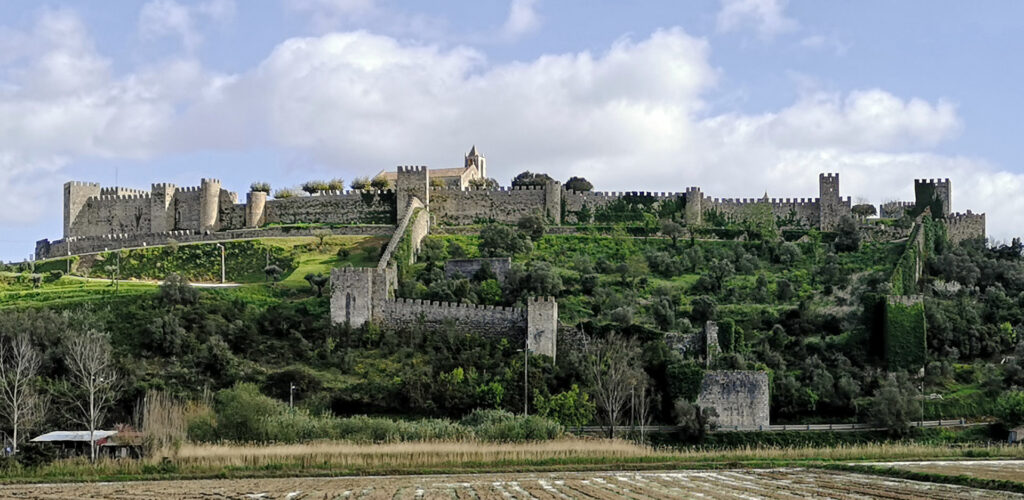
Castelo de Montemor-o-Velho (Montemor-o-Velho Castle)


History
The primitive settlement of the Montemor-o-Velho site dates back to prehistoric times, successively occupied by Romans, Visigoths and Muslims, attracted by the tin from Beira Alta, drained by the course of the Mondego. From Roman times, some of the stone ashlars built into the base of the medieval castle's keep bear witness.

The first documentary references to the town and its castle date back to the 9th century, when Ramiro I of Asturias and his uncle, Abbot João do Convento de Lorvão, conquered it (848). The sovereign transmitted these domains to his uncle, with the task of defending the castle, maintaining its garrison, whose mayorship João handed over to D. Bermudo, son of his sister, D. Urraca. That same year, he resisted the siege imposed on him by the Caliph of Córdoba, Abd-Rahman II.

Possession of the region between the Douro and Mondego rivers alternated between Christians and Muslims from the second half of the 10th century to the beginning of the 11th. According to the Crónica dos Godos, the primitive fortification of Montemor was conquered by the forces of Al-Mansur (2 December 990) – who rebuilt it, becoming its "tenens" Froila Gonçalves -, to be recovered by the Christians (Mendo Luz, 1006 or 1017, succeeded in governing the castle by Gonçalo Viegas), again conquered by the Muslims (1026), reconquered by Gonçalo Trastamariz (Crónica dos Godos, 1034), who became its governor and main frontier. Back to Muslim possession, definitive Christian possession, however, would only occur under Fernando Magno after the definitive conquest of Coimbra (1064), securing the frontier on the Mondego.

The military domain of the region of Coimbra was handed over by the sovereign to Count D. Sesnando Davides, who, in addition to pacifying and defending it, carried out a vast work of reorganization, including the construction or reconstruction of several castles, such as that of Coimbra, Lousã, Montemor-o-Velho, Penacova and Penela.

When the sovereign died, the work of repairing and reinforcing Montemor-o-Velho, ruined by successive campaigns and unguarded by the depopulation of the region, were carried out under the reign of his successor, Afonso VI of León and Castile, who would have determined them possibly in 1088, but before 1091, the year of Count Sesnando's death. By his order, since 1090 the construction of the church had begun by the presbyter Vermudo, with the condition that half of the rents would belong to the Cathedral of Coimbra. Concluded in 1095, the donation deed for that part was drawn up. That same year, the village received a charter. One of these sources from 1095, referring to the primitive fortification razed by the Moors, describes its abandonment and the vegetation that covered the ruins.

The charter of Montemor-o-Velho was confirmed, a few years later, by Count D. Henrique, on a date before 1111, possibly in 1109, when there is news of new works in his castle.

When the independence of Portugal was affirmed, in 1128, there is no news that the mayor of Montemor, Paio Midis, was against D. Afonso Henriques (1112-1185). The castle is mentioned by the Arab geographer Muhammad Al-Idrisi, in the middle of that century.

Montemor was, historically, land of infantados, first of D. Teresa (daughter of D. Sancho I, from 1211), then of D. Afonso IV (1322) and also of D. Pedro, Duke of Coimbra (1416) .

After the death of D. Sancho I, the mayor of Montemor refused to pay homage to D. Afonso II (1211-1223), due to a testamentary disagreement between this monarch and his sisters - D. Teresa and D. Mafalda - relative to the donation to these of the castle and its domains. Surrounded by the forces of the sovereign, with Infanta D. Teresa taking refuge here, the site ended up being raised and the question resolved thanks to the intervention of Pope Innocent III, already in 1216, who sentenced that both this and the Castle of Alenquer be handed over to the Order of the Templars. In this period, a new charter is mentioned, in 1212, passed by the sovereign.

The castle once again became a point of contention in the conflicts between D. Sancho II (1223-1248) and D. Afonso III (1248-1279) when, in 1245, faced with the deposition of the former, Bishop D. Tibúrcio and some canons from the Cathedral of Coimbra, feeling insecure in that city, sought refuge in the citadel of the Castle of Montemor-o-Velho, whose mayor had proclaimed himself in favor of D. Sancho II.

Later, in the context of the rebellion of the Infante D. Afonso, future D. Afonso IV, against his father, King D. Dinis (1279-1325), the castle - unguarded - was conquered without combat by the prince's forces (1st of January 1322). During this period, in the 14th century, it underwent extensive renovations, and it is believed that the construction of the barbican and the section of the fence to the north date from this phase. It was here, in his Alcazaba, on the 6th of January 1355 that D. Afonso IV met with his advisers to decide the fate of Inês de Castro, leaving here the following day to execute her.

The military and strategic importance of this castle remained throughout the following centuries, and it is said that its large dimensions allowed up to five thousand men-at-arms to be quartered inside. It is a fact that its command was always exercised by prominent figures of the nobility of Portugal. In 1472, D. Afonso V (1438-1481) made D. João de Portugal, later Duke of Bragança, marquis of Montemor-o-Velho.

In the context of the succession crisis of 1580, it is believed that the castle was visited by D. António, Prior do Crato, when he visited the village for five days, in September 1580, when he was trying to articulate the defense, in the Mondego line, from the independence of Portugal.

In the early 19th century, in the context of the Peninsular War, its dependencies were occupied by Napoleon's French troops, under the command of Jean-Andoche Junot, between 1807 and 1808. Three years later, on the way to the withdrawal of the defeated troops from André Masséna, was looted and vandalized, along with the village. With the extinction of the Religious Orders in Portugal (1834), its courtyard of arms started to be used as the town's cemetery. At this stage, the reuse of its stones by the local population was recorded. In 1877 one of its towers was adapted as a Clock Tower.

The Castle of Montemor-o-Velho and the Church of Santa Maria da Alcáçova are classified as a National Monument by Decree published on June 23, 1910.




Video Link

Last edited by ana; Feb 1, 2026 at 12:19 PM.
Reply With Quote
     
     
  #11  
Old Posted Feb 5, 2026, 7:32 PM
ana ana is offline
Registered User
 
Join Date: Apr 2004
Posts: 458
Castelos da Raia
Raia means border. The border castles in Portugal constitute a vast network of medieval and bastioned fortifications along the Portuguese-Spanish border, historically crucial for the defense of national sovereignty. Many of them are situated in elevated locations with strategic panoramic views.

Video Link
Reply With Quote
     
     
  #12  
Old Posted Feb 6, 2026, 12:25 PM
mousquet's Avatar
mousquet mousquet is offline
Moderator
 
Join Date: Jan 2011
Location: Greater Paris, France
Posts: 5,082
Fascinating. The site at Montemor-o-Velho seems to be really large by medieval standards indeed.
It may not be the happiest era of European History - you know, the Middle Ages is known to be rough - the heritage of that kind never fails to impress me anyway.
Thanks for showing it off on here.
Reply With Quote
     
     
  #13  
Old Posted Feb 6, 2026, 5:48 PM
ana ana is offline
Registered User
 
Join Date: Apr 2004
Posts: 458
Quote:
Originally Posted by mousquet View Post
Fascinating. The site at Montemor-o-Velho seems to be really large by medieval standards indeed.
It may not be the happiest era of European History - you know, the Middle Ages is known to be rough - the heritage of that kind never fails to impress me anyway.
Thanks for showing it off on here.
You're welcome. Thank you for the feedback . Portugal, despite being a small country, has "quite a few" castles. I'm fascinated by the Middle Ages. One of my favorite fortresses is the fortified city of Carcassonne; it's simply imposing in its magnitude.
Reply With Quote
     
     
  #14  
Old Posted Feb 6, 2026, 6:06 PM
mousquet's Avatar
mousquet mousquet is offline
Moderator
 
Join Date: Jan 2011
Location: Greater Paris, France
Posts: 5,082
Quote:
Originally Posted by ana View Post
One of my favorite fortresses is the fortified city of Carcassonne; it's simply imposing in its magnitude.
It's a bit different in my view, a walled village still lived-in, not literally a fortress that was mostly meant to defend the local territory. You know well a lot of towns had walls to defend themselves back in the Middle Ages, besides military fortresses.
But yeah, southern France, Spain and Italy have amazing medieval sites as well.
Reply With Quote
     
     
  #15  
Old Posted Feb 6, 2026, 6:18 PM
ana ana is offline
Registered User
 
Join Date: Apr 2004
Posts: 458
Quote:
Originally Posted by mousquet View Post
It's a bit different in my view, a walled village still lived-in, not literally a fortress that was mostly meant to defend the local territory. You know well a lot of towns had walls to defend themselves back in the Middle Ages, besides military fortresses.
But yeah, southern France, Spain and Italy have amazing medieval sites as well.
Thanks for the correction . I wish more people would open similar threads for other countries as well...
Reply With Quote
     
     
  #16  
Old Posted Feb 6, 2026, 6:21 PM
ana ana is offline
Registered User
 
Join Date: Apr 2004
Posts: 458
Castelo de Amieira do Tejo (Amieira do Tejo Castle)


History
In 1199 D. Sancho I donated the Herdade da Açafa to the Order of the Temple, this territory was delimited, in a very summary way, to the north by the Tagus River and to the south it held part of the territory of the current municipalities of Nisa, Castelo de Vide and part of the Spanish territory near the current border. These donations were aimed at settling residents in deserted and depopulated areas and consequently defending the territory. The Templars built a fortress that defended them from the infidels and signaled the ownership of these territories. At the same time, the monarch announced the arrival of French settlers, who arrived in stages, the last group destined to settle the territory of Açafa.

They settled next to the fortresses built by the warrior monks and built houses there, founded population clusters which they named after their lands of origin. It is in this sense that Nisa possibly arises, that is, being the first inhabitants from Nice, they built their “New Nice” here, or rather, Nisa a Nova, which we find in the documents, and when the term Nisa a Velha appears , this refers to their former homeland, French Nice.

The castle of Amieira is explained in this conjuncture that renewed the Order's role and action. Three years later, D. Pedro I visited the fortress, whose works must have been well advanced, despite having only been formally completed in 1362. Álvaro Gonçalves Pereira himself showed great care in the construction and evolution of this castle, dying here in 1375.

In the context of the struggles for the Christian reconquest of the Iberian Peninsula and the formation of the kingdom of Portugal, King D. Sancho II (1223-1248) made a significant donation of land to the Order of Saint John of the Hospital of Jerusalem, including the villages of Amieira , Belver (Gavião) and Crato (1232).

Of the three, the last to be fortified was Amieira, about a century later, under the reign of Afonso IV of Portugal (1325-1357). The construction of the castle is attributed to Prior D. Friar Álvaro Gonçalves Pereira, bastard son of the Prior of the Order of the Hospital in Portugal, Bishop D. Gonçalo Pereira, and father of the future Constable, D. Nuno Álvares Pereira. Some works must have been supervised by another son, D. Pedro Pereira, and were not completed in 1359, as can be seen from a royal letter sent that year to D. Álvaro, having been completed in 1362.

During the Crisis of 1383-1385, the then Prior of the Hospital, D. Pedro Pereira, at the beginning of 1384 recognized the authority of D. Beatriz, daughter of D. Fernando, and, as such, legitimate heir to the Portuguese throne. Amieira Castle, along with others of the Order, rendered obedience to the Queen, a situation changed a few months later, under the influence of Constable D. Nuno Álvares Pereira, the Prior's brother, who left for Castile.

The only military episode in which the castle was involved occurred in 1440. As D. Leonor, princess of Aragão, fell out with the Infante D. Pedro, he withdrew, with the complicity of the prior, D. Nuno de Góis, to the Crato, having invoked to his aid the forces of Castile, which surrounded Amieira. Faced with this insubordination, D. Pedro ordered the occupation of the castles of the Hospital priory in this border region, ordering D. Álvaro Vaz de Almada (Count of Abranches), to attack the Castle of Amieira. Without offering any resistance, the castles surrendered, the Prior of Crato and D. Leonor fled to Castile and peace was restored. Amieira Castle passed into the hands of Pedro Rodrigues de Castro as mayor at the end of the conflict.

In the following centuries, minor modernization works were carried out under the reigns of D. João II (1481-1495) and D. Manuel I (1495-1521), during which time it would have served as a prison. The construction of a chapel dates back to the 16th century, under the invocation of Saint John the Baptist (1556).

At the time of the Restoration of Independence war, residential buildings were erected inside the castle enclosure which, shaken by the 1755 earthquake, were already in ruins in 1747, according to a contemporary report by Father Luís Cardoso. At that time, attempts were made to partially recover the keep.

In the middle of the 19th century, possibly due to the decree that prohibited burials within the precincts of churches in Portugal (1846), the castle's main square began to be used as a cemetery by the town's population.

In the 20th century, in the 1920s, the castle's premises became the responsibility of the Ministry of War, with whom the Parish Council signed a lease that allowed it to enjoy the monument. Classified as a National Monument by Decree No. 8,447, published on November 10, 1922, in the 1940s it was the subject of consolidation and restoration intervention by the Directorate-General for National Buildings and Monuments (DGEMN), remaining in good conditions until today.

https://www.castelosdeportugal.pt/castelos/Castelos%28pos%29SECXIII/amieira.html


Video Link
Reply With Quote
     
     
  #17  
Old Posted Feb 13, 2026, 4:53 PM
ana ana is offline
Registered User
 
Join Date: Apr 2004
Posts: 458
Castelo de Aljezur (Aljezur Castle)


History
The castle was built in a place that allowed good visual control over the Ribeira de Aljezur and its plain, and part of the coastal strip.

The Ribeira de Aljezur passes through the valley of D. Sancho and then flows into the ocean, next to Praia da Amoreira, having been an important axis of communication between the coast of Alentejo and the western Algarve. It had good navigability conditions until the 16th century, with traces of a river port being found on the riverside, in the village of Aljezur.

During the Roman period, the site where the castle was later built may have been occupied by a castro of the Lusitanian peoples, while the Romans themselves installed a lookout post there. This role as a watch post was taken over by the Visigoths, between the 7th and 8th centuries.

The foundation of the castle itself only took place in the 10th century, during the Islamic medieval period, during which the village of Aljezur was also created. Indeed, the castle's fortified structures were identified as belonging to this period, as were some buildings inside. The traces of Muslim chronology can be separated into two distinct phases, the first corresponding to various structures, probably for residential use, of which the walls, topped with rammed earth, and the floors, some of them with flagstones, remain. The walls belong to a second phase, having probably been erected during the beginning of the second period of the Almohad Caliphate, between the 12th and 13th centuries, a period in which the silos inside the castle were also excavated. This fortress would form part of the defensive complex of the region under the control of Silves, which at that time comprised the region from Aljezur and the south of the Alentejo coast to the modern municipalities of Lagoa and Albufeira. The village of Aljezur itself may have an Islamic origin, with its foundation being attributed to the beginning of the 10th century.

According to tradition, the village was reconquered by Christian forces in 1242 or 1246, on June 16, by a detachment of the Order of Santiago, under the command of Paio Peres Correia. Indeed, the village of Alvor was taken in 1240, and Tavira in 1242, although the reconquest only ended in 1249, with the liberation of Silves, Faro, Albufeira and Porches. In reward for his role in the reconquest of the Algarve, King D. Afonso III offered Aljezur and other locations to the Order of Santiago. After the reconquest, that monarch will have ordered works to be carried out in the castle, which may have included the construction of compartments next to the walls. At this time, the castle may have had functions mainly from a military point of view.

The castle was abandoned in the period between the end of the 15th century and the beginning of the 16th century, as it lost importance as a defensive post, due to the silting up of the Ribeira de Aljezur, which reduced its navigability. Another reason that contributed to the abandonment of the castle was a reduction in the strategic importance of the village of Aljezur, and a need to defend more important points in the Algarve region. Indeed, the pottery fragments that were discovered in the upper part of the filling of the structures, used as a rubbish bin, are typical of the transition period from the 15th to the 16th century.

In the 15th century, the castle was already in an advanced state of abandonment, as reported by a visit by the Order of Santiago to the village of Aljezur, in 1448 or 1482.

After several centuries of abandonment, the first significant interventions in the castle were only carried out between 1940 and 1941, as part of the commemorations of the centenary of Infante D. Henrique, during which important restoration works were carried out on monuments in the Western Algarve, including the Fortress of Sagres and in the city of Lagos. In the case of Aljezur Castle, its importance was highlighted, mainly due to the tradition that it would be one of the fortresses of the Algarve included in the national flag, with repair works being carried out mainly on the walls, although some sections were significantly modified during the process.

https://www.castelosdeportugal.pt/castelos/Castelos%28pre%29SECXII/aljezur.html


Video Link
Reply With Quote
     
     
  #18  
Old Posted Feb 13, 2026, 5:06 PM
ana ana is offline
Registered User
 
Join Date: Apr 2004
Posts: 458
Castelo de Belmonte (Belmonte Castle)


History
In a dominant position on an elevation on the left bank of the river Zêzere, in the Serra da Estrela region, this medieval castle has its history linked to that of the Portuguese discoveries and that of Brazil, since its Mayors belonged to the family of the navigator Pedro Álvares Cabral.

The primitive human occupation of its site is obscure, it seems certain that, after the Roman invasion of the Iberian Peninsula, it would have coexisted with the Roman road that connected the village of Bracara Augusta (Braga) to Emerita Augusta (Mérida), today in Spain .

The first historical news about these domains date from the reign of D. Afonso Henriques (1112-1185), when the lordship of the lands of Centum Cellas would have been donated to the Bishop of Coimbra (May 6, 1168). Later, D. Sancho I (1185-1211), granted the Town Charter (1199), which was then part of the lordship. Later, Afonso III of Portugal (1248-1279) ordered the Bishop of Coimbra, D. Egas Fafes, to build a tower and castle. During this period, the bishop of Guarda bought and sold houses in the castle grounds (1253) and, three years later, on April 27, Pope Alexandre IV donated the Castle of Belmonte and the villages of Inguias and Olas de Godim to the Cathedral of Guarda, with all episcopal rights, leaving the Cathedral of Coimbra to maintain lay possessions. The tower and castle were possibly completed under the reign of D. Dinis (1279-1325). These references are confirmed by archaeological remains from the end of the 12th century and the beginning of the 13th century from the demolition of houses inside the village for the construction of the castle and the keep.

After the establishment of the Treaty of Alcanises (1297), with the consequent expansion of the borders to the west, the Castle of Belmonte lost strategic importance, while the town developed outside the walls.

In the context of the 1383-1385 crisis, the castle lost part of its walls. A little later, the Bishopric of Coimbra exchanged the town of Belmonte, together with the couto de São Romão, for the town of Arganil with Antão Martim Vasques da Cunha (1392). In the reign of D. João I (1385-1433), with the mayor of Belmonte, between 1397 and 1398, having joined the party of Prince Dinis, the sovereign confiscated the village and the castle, donating them as mayor to Luís Álvares Cabral, with the Cabral family residing in the castle. The new lord proceeded with the reconstruction of the wall to the north, where a new Porta da Traição was opened, adding a turret for reinforcement.

In the 15th century, the village and its castle were donated by D. Afonso V (1438-1481) to Fernão Cabral (1466), father of Pedro Álvares Cabral, who proceeded with adapting this military building to a manor house.

In the context of the War of Restoration of Portuguese independence, its defense would have been modernized by the construction of some bulwarks. At the end of the 17th century, the interior of the castle was damaged by a fire (1694). In the following century, the building was erected next to the main gate, with the last lord of Belmonte, Caetano Francisco Cabral, dying in 1762.

The building next to the main door functioned, at the beginning of the 20th century, as a prison. Between the 1940s and the 1960s, several conservation and restoration interventions were carried out by the Directorate-General for National Buildings and Monuments (DGEMN).

In 1992, it was transferred to IPPAR, and an amphitheater was built inside, intended for the presentation of shows. Between 1992 and 1994, archaeological prospecting work was carried out inside the castle, proving the Roman presence and, between 1994 and 1995, inside the keep.

https://pt.wikipedia.org/wiki/Castelo_de_Belmonte


Video Link
Reply With Quote
     
     
  #19  
Old Posted Feb 13, 2026, 7:15 PM
Triple_Sim Triple_Sim is offline
Registered User
 
Join Date: Jan 2023
Posts: 103
Really nice and interesting thread! Didn't expect that. Thanks for the work
Reply With Quote
     
     
  #20  
Old Posted Feb 13, 2026, 7:57 PM
ana ana is offline
Registered User
 
Join Date: Apr 2004
Posts: 458
Quote:
Originally Posted by Triple_Sim View Post
Really nice and interesting thread! Didn't expect that. Thanks for the work
You're welcome . It takes a lot of time and patience to gather all the images. Thank you for the feedback.

Last edited by ana; Feb 15, 2026 at 5:19 PM.
Reply With Quote
     
     
This discussion thread continues

Use the page links to the lower-right to go to the next page for additional posts
 
 
Reply

Go Back   SkyscraperPage Forum > Regional Sections > Europe
Forum Jump


Forum Jump


All times are GMT. The time now is 8:22 PM.

     
SkyscraperPage.com - Privacy Statement - Top

Powered by vBulletin® Version 3.8.7
Copyright ©2000 - 2026, vBulletin Solutions, Inc.