I seem to have been interpreted as being against adding cycle tracks to St. Laurent. I am not against adding them. I am against using the guise of a transit project to install them. The City needs to be clear and transparent about what it is doing. This is not principally a 5-kilometre long transit project.
That said, I think that the plan does make cycling better; I think that there are places in this ‘Transit Plan’ that actually make transit worse; and I think that there are things that make it worse for other vehicles.
As I have brought up before, the intersection at McArthur, for example, is poorly designed, in my opinion.
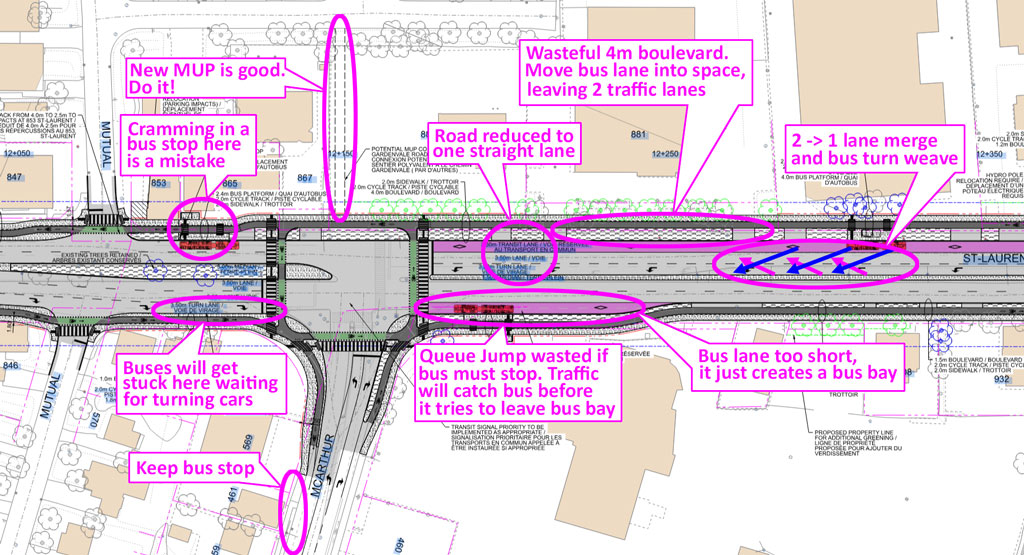
There are better designs that will actually improve transit, while still adding cycle tracks. One suggestion is to add a right-turn channel and pull the south-bound bus stop back to that island on the north (near-side) of the intersection. Once that is done, a queue-jump becomes useful.
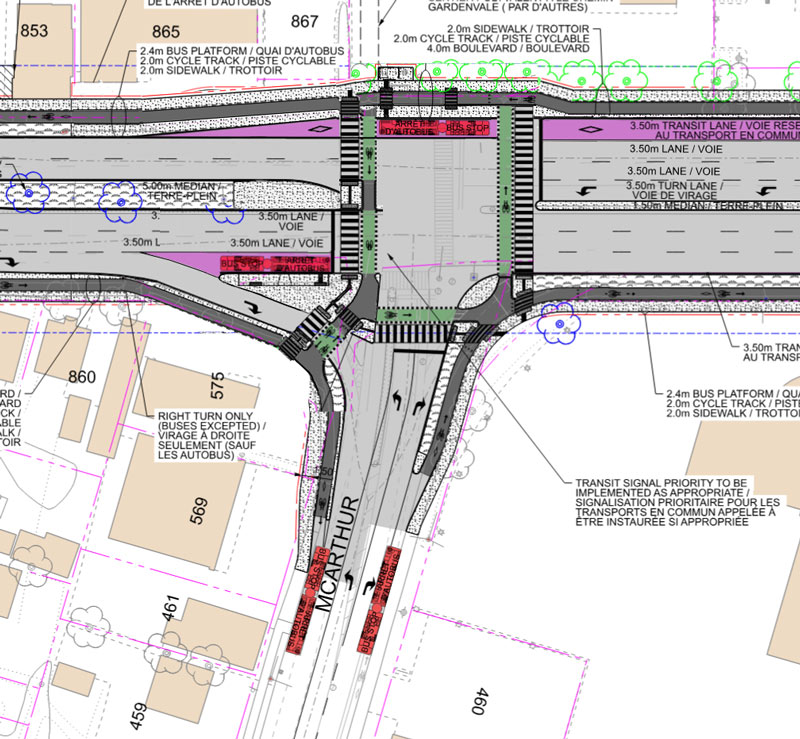
As designed, south-bound vehicles turning right onto McArthur can flow freely while they have a green signal. However, they will be moving slower than the straight-through lanes beside them. The bus will be within the slower stream of right-turning vehicles. (Currently, the bus moves in the straight-through traffic lane.)
Once the signal goes red, the vehicles turning left from north-bound St. Laurent have priority over those turning right. Based on the lengthened left-turn lane, the City is expecting a lot of vehicles to be turning onto McArthur. This will restrict the flow of those turning right to just a trickle. If the bus is lucky, it will creep up to the head of the line, at the stop-line. There it will wait – blocking any more people from turning right – until it gets a queue-jump signal.
The queue-jump will allow the bus to cross the intersection before other vehicles. This is normally done to allow the bus to merge into, or cross, the travel lane without conflict. It works well in places like east-bound Heron at Riverside, and west-bound Baseline at Prince of Wales. (Both of those two examples have near-side stops.) However, placing a bus stop immediately across the intersection, within a short bus-only lane nullifies the benefit of a queue-jump.
The bus crosses the intersection first - only to stop. By the time the bus is ready to pull out into the travel lane, the traffic has caught up and is blocking the bus’ movement. The short bus-only lane that the bus is trapped in is too short to get up to speed for a ‘zipper’ merge, so the bus must try to ‘muscle’ its way out, into traffic. This is precisely why OC Transpo has argued for the removal of existing bus bays – because leaving them can be difficult.
Overall, with the new plan, south-bound buses will have a better chance of getting trapped in a slow lane of right-turning vehicles, and they will still get dumped into a bus bay after the intersection.
But that is just one example of how this plan could potentially make transit less reliable, while not fixing a known issue. The north-bound lanes actually increase the danger level.
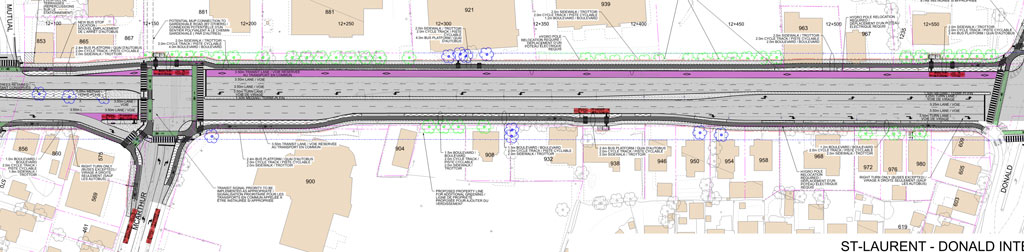
North-bound, the left general traffic lane becomes the left-turn lane. Prior to there, and north of McArthur there are two straight-through lanes – but it inexplicably necks down to a single through lane for this short section. This will catch many drivers off-guard, resulting in a good number of cars quickly trying to merge into the right lane. This is the exact place where a bus will be trying to merge the other direction, to get to the left-turn lane. This weave is dangerous and should never be designed that way on purpose.
The north-bound bus-only lane should be moved to where the 4m-wide boulevard is, immediately beside it, so that two traffic lanes can be maintained. A left-turning bus will have a safer time crossing two non-turbulent lanes over crossing through a weave.
Also, the west-bound bus stop on McArthur, immediately after the left-turn should be maintained. The turning bus should not need to stop on St. Laurent north of Donald. That gives the driver ample opportunity to merge left. And, it gives riders an easy ‘out’ is they are on the wrong bus. Many times, I have seen riders suddenly realize that they are on the wrong bus – usually when it makes an unexpected turn. Having the stop just after the turn allows those riders to exit without having to wait, and then walk several blocks back.





 Prev
Prev








 Linear Mode
