HomeDiagramsDatabaseMapsForum About
     

Go Back   SkyscraperPage Forum > Regional Sections > Canada > Ontario > Ottawa-Gatineau > Transportation


Closed Thread

 
Thread Tools Display Modes
     
     
  #16761  
Old Posted Jul 20, 2023, 12:54 PM
VANRIDERFAN's Avatar
VANRIDERFAN VANRIDERFAN is offline
Registered User
 
Join Date: Jan 2007
Location: Regina
Posts: 5,478
How many examples of "your get what you pay for" do we need. Not saying that we have to go the "Tiffany" route everytime, but jesus christ how much is this thing going to cost to fix the "economic option"?
     
     
  #16762  
Old Posted Jul 20, 2023, 3:02 PM
DTcrawler DTcrawler is offline
Registered User
 
Join Date: Feb 2019
Location: Ottawa
Posts: 998
Quote:
Originally Posted by OTownandDown View Post
What if the entire issue is the non-turning bogies? Can we just switch them out and see how it goes? Newly delivered Citadis trainsets elsewhere have articulating bogies.

I remember riding the DLR in London, and it's the curviest thing ever. Its a 'high floor light rail'. Their reliability was sh*t in the beginning, but over 30 years has become very reliable and has expanded several times.
I would be surprised if that hasn't already been considered... but you never know with these people
     
     
  #16763  
Old Posted Jul 20, 2023, 3:49 PM
RogueNacho RogueNacho is offline
Registered User
 
Join Date: Jun 2018
Location: Ottawa
Posts: 273
Let's say we pull the nuclear option and decide to go forward with realigning sections of the track and purchasing a new set of trains. Could the existing vehicles be repurposed for a Carling or Baseline LRT streetcar line? That way there's not really any major money lost, as we would already have a fleet of low-floor streetcars ready to go for it.
     
     
  #16764  
Old Posted Jul 20, 2023, 3:51 PM
DTcrawler DTcrawler is offline
Registered User
 
Join Date: Feb 2019
Location: Ottawa
Posts: 998
Quote:
Originally Posted by RogueNacho View Post
Let's say we pull the nuclear option and decide to go forward with realigning sections of the track and purchasing a new set of trains. Could the existing vehicles be repurposed for a Carling or Baseline LRT streetcar line? That way there's not really any major money lost, as we would already have a fleet of low-floor streetcars ready to go for it.
I think if we ended up getting new trains or tearing up track and realigning it, our current trains would be considered antiques by the time we'd ever get funding for another rail project...
     
     
  #16765  
Old Posted Jul 20, 2023, 4:11 PM
J.OT13's Avatar
J.OT13 J.OT13 is offline
Moderator
 
Join Date: Mar 2012
Location: Ottawa
Posts: 28,793
Quote:
Originally Posted by DTcrawler View Post
I would be surprised if that hasn't already been considered... but you never know with these people
Seems like a reasonable enough solution if the curves are the problem. Could be that the wheel bearings used can't support the weight (which would be oh so ridiculous).

At this stage, I think they are trying to find a fix using the current equipment. Having to replace all the bogies would be a time consuming, expensive and tedious undertaking, but it would be better than replacing the fleet.
     
     
  #16766  
Old Posted Jul 20, 2023, 4:13 PM
swimmer_spe swimmer_spe is offline
BANNED
 
Join Date: Apr 2014
Posts: 10,743
Quote:
Originally Posted by RogueNacho View Post
Let's say we pull the nuclear option and decide to go forward with realigning sections of the track and purchasing a new set of trains. Could the existing vehicles be repurposed for a Carling or Baseline LRT streetcar line? That way there's not really any major money lost, as we would already have a fleet of low-floor streetcars ready to go for it.
Since the city has all but said no to street running, there is no value in keeping these cars if they are replaced.
     
     
  #16767  
Old Posted Jul 20, 2023, 4:53 PM
Richard Eade Richard Eade is offline
Registered User
 
Join Date: Mar 2008
Location: Nepean
Posts: 2,616
Pulling the plug on the Confederation Line was a severe over-reaction to finding one bad bearing – especially since that bad bearing was found during an inspection, before it caused any major problem. There will always be part failures in any mechanical system. The trick is to have adequate procedures in place to catch imminent problems before they escalate.

Reading the Transportation Safety Board (TSB) letter to the city, dated 3 February 2023, we can get some insight into scale of the wheel-bearing problem. [The letter: https://www.tsb.gc.ca/eng/securite-safety/rail/2022/r22h0037/r22h0037-01-23.html]

Just after the August 8, 2021 derailment – which was caused by a failed wheel-bearing leading to so much heat that a wheel detached from the axle – regular, frequent, inspections of wheel-bearings commenced. Before that, it was expected that the wheel-bearings would have a life of about 1.2 million kilometres, on average. In the year following that derailment, over 11,000 bearing free-play measurements were done, revealing 68 bad bearing units. The distance that those wheel-bearings had traveled varied between 64,140 km and 233,042 km, with an average of 140,219 km.

During that year, the Confederation Line was not shut down 68 times; once for each bad bearing found. The process was preemptively catching the problems.

So why stop the LRT for this particular wheel-bearing? Was it because the bearing had gone less than 50,000 km; despite the ‘Slow Orders’ in place?

I think that it is a way for OC Transpo to force action on the file. I think that OC Transpo is tired of the ‘Slow Orders’ and not knowing what the big problem is. All they have been hearing is ‘We are working on it.” But they have seen no real movement on the file for almost two years.

Mme. Amilcar has pledged to rebuild trust in OC Transpo, but that can’t happen without answers. I believe that this is her way of lighting a fire under those that she doesn’t think have been working enough on the issue; hoping to get them moving.
     
     
  #16768  
Old Posted Jul 20, 2023, 6:43 PM
Fading Isle Fading Isle is offline
Registered User
 
Join Date: Aug 2022
Posts: 149
Quote:
Originally Posted by Richard Eade View Post
I think that it is a way for OC Transpo to force action on the file. I think that OC Transpo is tired of the ‘Slow Orders’ and not knowing what the big problem is. All they have been hearing is ‘We are working on it.” But they have seen no real movement on the file for almost two years.

Mme. Amilcar has pledged to rebuild trust in OC Transpo, but that can’t happen without answers. I believe that this is her way of lighting a fire under those that she doesn’t think have been working enough on the issue; hoping to get them moving.
I sure hope so. Two years to determine the cause is ridiculous. I think most people would interpret that as incompetence.

Today Ford made it clear that the province wouldn’t be funding stage 3 until stage 1 is fixed. Obviously this suggests the province would also be reluctant to fund any other transit project in Ottawa until the current system is functioning as intended.
     
     
  #16769  
Old Posted Jul 20, 2023, 7:46 PM
J.OT13's Avatar
J.OT13 J.OT13 is offline
Moderator
 
Join Date: Mar 2012
Location: Ottawa
Posts: 28,793
I was under that impression as well, that it seemed like an overreaction. I would have thought, at the very least, that they would put trains back into service as they were inspected and cleared.

If this is a game of 3D Chess, it better work, otherwise we're just losing more confidence in the system.

And Ford, no chance he would fund Stage 3 anyway. It's just an excuse.
     
     
  #16770  
Old Posted Jul 20, 2023, 8:41 PM
Richard Eade Richard Eade is offline
Registered User
 
Join Date: Mar 2008
Location: Nepean
Posts: 2,616
According to the Transportation Safety Board (TSB), wheel-bearings on LRT vehicles (LRVs) should run about 1.2 million kilometres. That, of course, is an average; some will fail before then, and others will last longer. According to inspections done on the Confederation Line LRVs, a small number of wheel-bearings are failing far before that average. In one year, out of over 11,000 tests, there were 68 bad bearings found. The average distance traveled by those failed bearings was just over 140,000 km. Alas, the TSB did not publish the average distance traveled by all wheel-bearings before they fail. It is possible that a small number of wheel-bearings fail early, but the majority could last over a million kilometres. We do not have that information.

What we do know, from the TSB, however, is that even good bearings (i.e., ones that have not been tagged as having failed) show wear that is much accelerated over what would be expected. Thus, it is unlikely that the majority of bearings travel anywhere near a million kilometres. This is the reason that the leading and trailing axles (the first and last axles of each train) are automatically replaced at 175,000 km. That is about 15% of the normal distance that the wheel-bearings should last.

We also don’t know where the longest-surviving of those failed wheel-bearings were mounted. According to the TSB, the longest-lived of the failed bearings ran for more than 233,000 km before being found as bad. (For reference, the failed wheel bearing where the wheel actually broke off, on Aug. 8, 2021, had traveled 197,967 km.) We also know that, of the 68 failed bearings found, only 5 were found on ‘Trailer Bogies’ – those bogies that do not include a motor, only disk brakes on the wheels. That detached wheel had a disk brake, but the opposite end of the axle was connected to a motor. On the ‘Motor Bogies’, each of the two axles has a motor on one end and a disk brake on the other. It might be possible that the motor is trying to turn one end of the axle, while the disk brake is trying to stop the other end. We do not know this, but we do know that 63 of 68 failed bearings were on one side or the other of this type of axle on ‘Motor Bogies’. (57% on motor end; 43% on disk brake end of the axle)

Is it possible that power on one end of the axle and braking on the other can happen at the same time, causing twisting forces that load the bearings to excess? Maybe. But that would not explain the 5 failures that were on un-powered axles. Also, the Ixège bogie, first introduced in Europe in 2009, is used successfully in other LRVs around the world. The Iponam bogie that is used in Ottawa’s Citadis Spirit LRVs is simply the Ixège POur North AMerica, since it was an Ixège that was modified to have stronger motors.

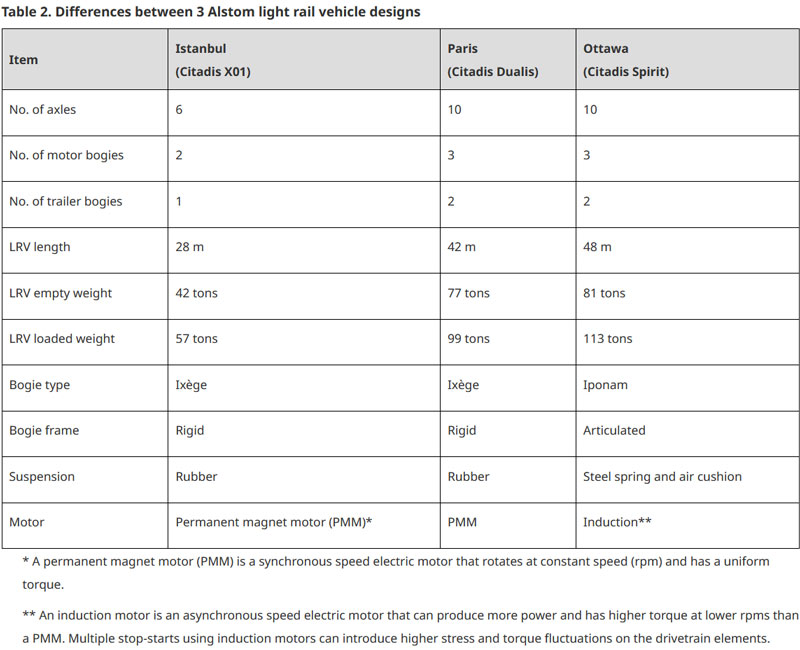
However, that is not the only way that Ottawa’s LRVs differ from, say, their European cousins. In the letter that I referenced earlier, the TSB gave us a table of differences:

[The letter: https://www.tsb.gc.ca/eng/securite-s...37-01-23.html]

Although the Ixège is said to be “rigid” in the table, it has been referred to as a pivoting bogie since its introduction. Assuming that ‘pivoting’ and ‘articulated’ are synonyms for bogies that can turn, relative to the car body, the table may not be accurate.

Perhaps something that the TSB didn’t mention is also important. That the Ixège bogie in Europe is rated for 80 km/h. Whether the wheel-bearings were improved to handle the increased speed (100 km/h) here, is unknown. What I can say is that our LRVs would very rarely exceed 80 km/h, and the ‘Slow Orders’ should make this a moot point, with regard to the premature wheel-bearing failures.

This leaves the weight as a primary factor. It would affect all of the wheel-bearings, powered or not. But would a 5% (empty) to 14% (max-load) increase in weight make that much difference in wheel-bearing wear? Maybe.

The other noted difference is the suspension. Is it possible that the steel springs set up an oscillation that damages the wheel-bearings (and creates rail corrugation)?

There is a collection of experts working to figure out what the problem might be. It appears to not be an easy problem to solve. Indeed, it might turn out to be a combination of factors. Hopefully, we will get some answers soon.

     
     
  #16771  
Old Posted Jul 20, 2023, 8:58 PM
roger1818's Avatar
roger1818 roger1818 is offline
Registered User
 
Join Date: Feb 2016
Location: Stittsville, ON
Posts: 6,610
Assuming the issue is the curves between Lees and Tremblay, the completion of Stage 2 will help mitigate the problem, by reducing the number of times each vehicle travels through those curves relative to the total distance travelled.
__________________
Pronouns: He/Him/His
     
     
  #16772  
Old Posted Jul 20, 2023, 9:18 PM
MalcolmTucker MalcolmTucker is offline
Registered User
 
Join Date: May 2007
Posts: 11,596
Quote:
Originally Posted by roger1818 View Post
Assuming the issue is the curves between Lees and Tremblay, the completion of Stage 2 will help mitigate the problem, by reducing the number of times each vehicle travels through those curves relative to the total distance travelled.
Thinking more about this and randomness, given the vehicles aren't symmetrical front to back, I wonder if there is some bias on how the vehicles are assembled into trains in the yard, and then which direction they leave the yard for service. If there is, certain wheels and axles could be experiencing way more stress and wear than others if they're passing through the curves going the same direction most times, and that different wheels have different stresses due to the different distances to the next axle. Added to the differential stress from breaks and motors being on the outside of the bogie at 1 per axle.


Seems like a less than elegant solution to stretching the vehicle.
     
     
  #16773  
Old Posted Jul 20, 2023, 9:23 PM
swimmer_spe swimmer_spe is offline
BANNED
 
Join Date: Apr 2014
Posts: 10,743
Quote:
Originally Posted by roger1818 View Post
Assuming the issue is the curves between Lees and Tremblay, the completion of Stage 2 will help mitigate the problem, by reducing the number of times each vehicle travels through those curves relative to the total distance travelled.
It is not the curves. The reason? Because had the bearings been designed properly, they would take the forces generated from those curves.
     
     
  #16774  
Old Posted Jul 20, 2023, 10:37 PM
OCCheetos OCCheetos is offline
Registered User
 
Join Date: Aug 2017
Posts: 2,110
Quote:
Originally Posted by Richard Eade View Post
Although the Ixège is said to be “rigid” in the table, it has been referred to as a pivoting bogie since its introduction. Assuming that ‘pivoting’ and ‘articulated’ are synonyms for bogies that can turn, relative to the car body, the table may not be accurate.
Articulated bogies are a bit different than a "rigid" pivoting bogie.

In an articulated bogie, each axle is able to rotate relative to the truck. In a rigid bogie, the axles remain fixed relative to the truck.
     
     
  #16775  
Old Posted Jul 21, 2023, 2:25 PM
OTownandDown OTownandDown is offline
Registered User
 
Join Date: Jul 2018
Posts: 1,618
I immediately noted the double-weight of our train in the table, however per axle the loaded Istanbul train has 9.5 tons per axle, and ours is 11.3 tons per axle. Is this difference really major? Doesn't seem so.

So then the other difference is the bogie type, suspension and motors.

And I go back to radius. What is the tightest turn radius in Istanbul and Paris?


Quote:
Originally Posted by Richard Eade View Post
According to the Transportation Safety Board (TSB), wheel-bearings on LRT vehicles (LRVs) should run about 1.2 million kilometres. That, of course, is an average; some will fail before then, and others will last longer. According to inspections done on the Confederation Line LRVs, a small number of wheel-bearings are failing far before that average. In one year, out of over 11,000 tests, there were 68 bad bearings found. The average distance traveled by those failed bearings was just over 140,000 km. Alas, the TSB did not publish the average distance traveled by all wheel-bearings before they fail. It is possible that a small number of wheel-bearings fail early, but the majority could last over a million kilometres. We do not have that information.

What we do know, from the TSB, however, is that even good bearings (i.e., ones that have not been tagged as having failed) show wear that is much accelerated over what would be expected. Thus, it is unlikely that the majority of bearings travel anywhere near a million kilometres. This is the reason that the leading and trailing axles (the first and last axles of each train) are automatically replaced at 175,000 km. That is about 15% of the normal distance that the wheel-bearings should last.

We also don’t know where the longest-surviving of those failed wheel-bearings were mounted. According to the TSB, the longest-lived of the failed bearings ran for more than 233,000 km before being found as bad. (For reference, the failed wheel bearing where the wheel actually broke off, on Aug. 8, 2021, had traveled 197,967 km.) We also know that, of the 68 failed bearings found, only 5 were found on ‘Trailer Bogies’ – those bogies that do not include a motor, only disk brakes on the wheels. That detached wheel had a disk brake, but the opposite end of the axle was connected to a motor. On the ‘Motor Bogies’, each of the two axles has a motor on one end and a disk brake on the other. It might be possible that the motor is trying to turn one end of the axle, while the disk brake is trying to stop the other end. We do not know this, but we do know that 63 of 68 failed bearings were on one side or the other of this type of axle on ‘Motor Bogies’. (57% on motor end; 43% on disk brake end of the axle)

Is it possible that power on one end of the axle and braking on the other can happen at the same time, causing twisting forces that load the bearings to excess? Maybe. But that would not explain the 5 failures that were on un-powered axles. Also, the Ixège bogie, first introduced in Europe in 2009, is used successfully in other LRVs around the world. The Iponam bogie that is used in Ottawa’s Citadis Spirit LRVs is simply the Ixège POur North AMerica, since it was an Ixège that was modified to have stronger motors.

However, that is not the only way that Ottawa’s LRVs differ from, say, their European cousins. In the letter that I referenced earlier, the TSB gave us a table of differences:


[The letter: https://www.tsb.gc.ca/eng/securite-s...37-01-23.html]

Although the Ixège is said to be “rigid” in the table, it has been referred to as a pivoting bogie since its introduction. Assuming that ‘pivoting’ and ‘articulated’ are synonyms for bogies that can turn, relative to the car body, the table may not be accurate.

Perhaps something that the TSB didn’t mention is also important. That the Ixège bogie in Europe is rated for 80 km/h. Whether the wheel-bearings were improved to handle the increased speed (100 km/h) here, is unknown. What I can say is that our LRVs would very rarely exceed 80 km/h, and the ‘Slow Orders’ should make this a moot point, with regard to the premature wheel-bearing failures.

This leaves the weight as a primary factor. It would affect all of the wheel-bearings, powered or not. But would a 5% (empty) to 14% (max-load) increase in weight make that much difference in wheel-bearing wear? Maybe.

The other noted difference is the suspension. Is it possible that the steel springs set up an oscillation that damages the wheel-bearings (and creates rail corrugation)?

There is a collection of experts working to figure out what the problem might be. It appears to not be an easy problem to solve. Indeed, it might turn out to be a combination of factors. Hopefully, we will get some answers soon.

     
     
  #16776  
Old Posted Jul 21, 2023, 5:50 PM
Richard Eade Richard Eade is offline
Registered User
 
Join Date: Mar 2008
Location: Nepean
Posts: 2,616
Quote:
Originally Posted by OTownandDown View Post
I immediately noted the double-weight of our train in the table, however per axle the loaded Istanbul train has 9.5 tons per axle, and ours is 11.3 tons per axle. Is this difference really major? Doesn't seem so.

So then the other difference is the bogie type, suspension and motors.

And I go back to radius. What is the tightest turn radius in Istanbul and Paris?
Well, the difference between 9.5 tons per axle and 11.3 tons per axle is 1.8 tons per axle. 1.8 tons represents an increase, from 9.5 tons, of about 19%. So, Yes, that increase IS significant.

The increase in loaded weight per axle, compared to the Dualis is 'only' 11.3 - 9.9 = 1.4 tons per axle. That is still a significant 14% increase.
     
     
  #16777  
Old Posted Jul 21, 2023, 6:23 PM
OTownandDown OTownandDown is offline
Registered User
 
Join Date: Jul 2018
Posts: 1,618
Quote:
Originally Posted by Richard Eade View Post
Well, the difference between 9.5 tons per axle and 11.3 tons per axle is 1.8 tons per axle. 1.8 tons represents an increase, from 9.5 tons, of about 19%. So, Yes, that increase IS significant.

The increase in loaded weight per axle, compared to the Dualis is 'only' 11.3 - 9.9 = 1.4 tons per axle. That is still a significant 14% increase.
HOW could something like a train axle and bearing unit not have a safety factor of at least two built in? How could a 20% increase cause a catastrophic failure. Crazy town. And 19% shouldn't be that much. I call ALL the bearings as a catastrophic failure, whether they have actively physically failed or not, having to change them at 150,000km is a failure.
     
     
  #16778  
Old Posted Jul 21, 2023, 6:49 PM
swimmer_spe swimmer_spe is offline
BANNED
 
Join Date: Apr 2014
Posts: 10,743
Quote:
Originally Posted by OTownandDown View Post
HOW could something like a train axle and bearing unit not have a safety factor of at least two built in? How could a 20% increase cause a catastrophic failure. Crazy town. And 19% shouldn't be that much. I call ALL the bearings as a catastrophic failure, whether they have actively physically failed or not, having to change them at 150,000km is a failure.
Just because something has a safety factor,does not mean you should constantly run within it.
     
     
  #16779  
Old Posted Jul 21, 2023, 7:39 PM
MalcolmTucker MalcolmTucker is offline
Registered User
 
Join Date: May 2007
Posts: 11,596
Quote:
Originally Posted by OTownandDown View Post
HOW could something like a train axle and bearing unit not have a safety factor of at least two built in? How could a 20% increase cause a catastrophic failure. Crazy town. And 19% shouldn't be that much. I call ALL the bearings as a catastrophic failure, whether they have actively physically failed or not, having to change them at 150,000km is a failure.
Not just weight that is the issue. Add additional speed, and the force experienced could be much much larger. Static vs dynamic force.
     
     
  #16780  
Old Posted Jul 23, 2023, 9:33 PM
kmcamp kmcamp is offline
Registered User
 
Join Date: Sep 2016
Posts: 1,401
Quote:
Originally Posted by Richard Eade View Post
Well, the difference between 9.5 tons per axle and 11.3 tons per axle is 1.8 tons per axle. 1.8 tons represents an increase, from 9.5 tons, of about 19%. So, Yes, that increase IS significant.

The increase in loaded weight per axle, compared to the Dualis is 'only' 11.3 - 9.9 = 1.4 tons per axle. That is still a significant 14% increase.
Having ridden a Citadis tram in Istanbul, they were packed full and definitely handled some far sharper curves then lees/hurdman. They weren't going very fast though in general. Maybe it's not the curve but the high speed straight parts. The tram in Istanbul probably maxed out around 40kph due to congestion
     
     
This discussion thread continues

Use the page links to the lower-right to go to the next page for additional posts
 
 
Closed Thread

Go Back   SkyscraperPage Forum > Regional Sections > Canada > Ontario > Ottawa-Gatineau > Transportation
Forum Jump


Forum Jump


All times are GMT. The time now is 10:04 AM.


Powered by vBulletin® Version 3.8.7
Copyright ©2000 - 2026, vBulletin Solutions, Inc.