Gas Prices


Crown corporations aren't even remotely close to communism. Try your troll again.

Government takeover of the means of production isn't communism? Try your weak analysis again.

Supply and demand. And taxes. That's why gas is more expensive in BC. It's completely obvious and what voters voted for.
 
Government takeover of the means of production isn't communism? Try your weak analysis again.

I guess the LDB must be communism too? Unless you're implying that BC would nationalize oil production. :???:

I personally doubt that would be an effective solution, but it's hardly communism.
 
I guess the LDB must be communism too?

Yes, the government pointlessly owning a business that should be in the private sector, adding inefficiency and pushing up costs for consumers. Obviously it's not on the same scale as running the entire economy in such a way, but it is of the same kind as communism. Shall we nationalize the grocery stores too? Once we remove those nasty businessmen with their profit motives, prices are sure to go down!
 
Yes, the government pointlessly owning a business that should be in the private sector, adding inefficiency and pushing up costs for consumers. Obviously it's not on the same scale as running the entire economy in such a way, but it is of the same kind as communism. Shall we nationalize the grocery stores too? Once we remove those nasty businessmen with their profit motives, prices are sure to go down!

My goodness you're right, we'd best privatize the communist BC Hydro and BC Transit too! Hopefully that will be as successful as when we kicked out the Stalinists corrupting BC Rail!

Governments owning/doing stuff does not communism make. Take that rhetoric elsewhere.

However, I definitely do not agree that forming a BC Fuel Distribution Branch would somehow magically reduce the cost of fuel; Unless of course you believe that there is a massive conspiracy of price gouging.
 
There are some things that are better left in the government's hands, like infrastructure and natural monopolies. Running gas stations and liquor stores are not examples of those things. Yes, I'm being hyperbolic, but it is useful to point out the absurdity of some people's suggestions.
 
The main point is that nationalizing the gasoline suppliers will not reduce cost, it will increase them. BC residents seem to treat this issue in the same wrong headed way they treat housing - something is expensive? Let's make increasing supply more expensive and difficult! Then get even more mad when the price goes up more!
 
Your communism hypothesis would be news to Norway and Equinor.

We can debate all day about whether or not nationalization of Canada's energy sector would benefit Canadians, but it's very unlikely that it would result in lower gas prices. Norway consistently has some of the highest fuel prices in Europe, but then again it also has the highest plug-in electric vehicle ownership on the planet by far.
 
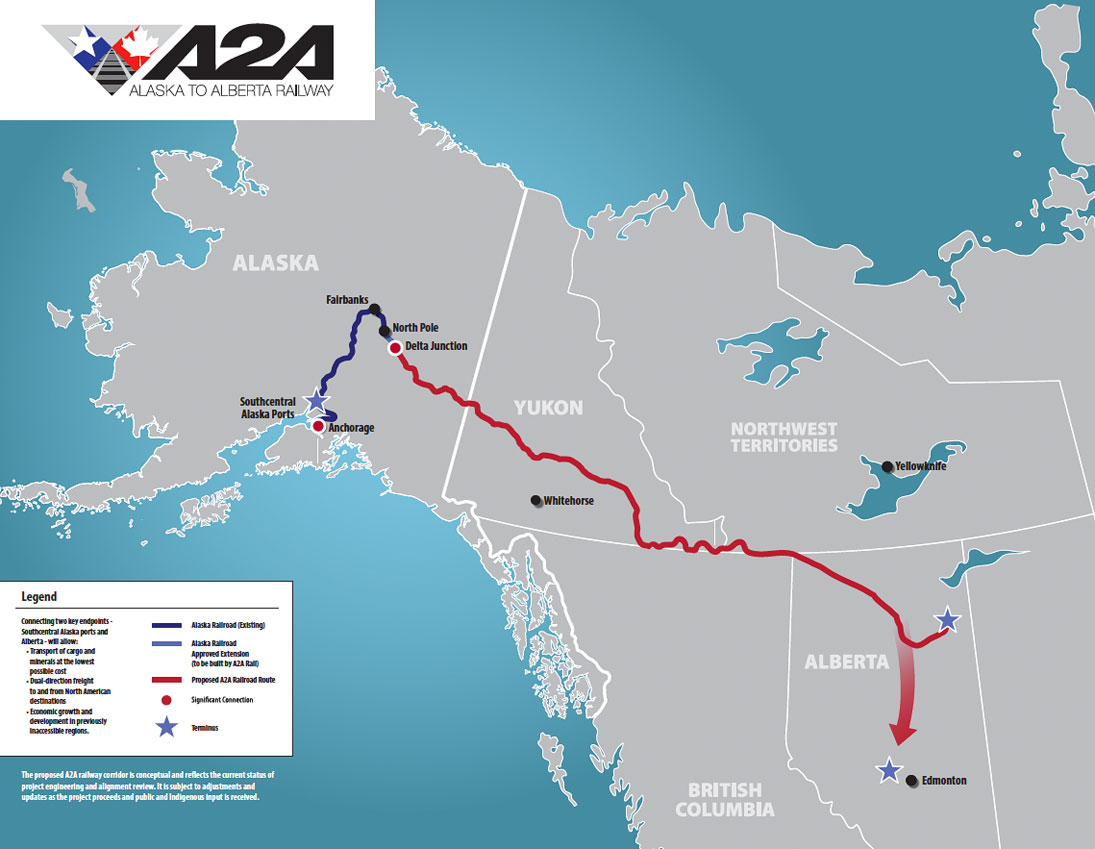
Another option to the pipeline:

U.S. President Donald Trump announced on Friday that he was issuing a presidential permit for the A2A Cross-Border Rail project.

The project — which would see a 2,570-kilometre rail track running from near Anchorage, Alaska, through Yukon and the Northwest Territories into northern Alberta — will cost about C$22 billion.

Trump’s approval is just the first step in the regulatory process on the U.S. side.

...

The Alberta government paid for a feasibility study on the concept of a rail line running between the province and Alaska in 2015 — which said while a railway would be challenging to build through the area, it would provide an alternative to pipeline transportation for oil.

The A2A line would transport oil, as well as grain, ore, and other containerized goods.

A2A, which first began work on the line in 2015, is one of two companies that have pitched similar projects over the past several years. Another company, G7G, has also pitched a similar project.

alberta-railway.jpg
 
Not sure why they'd try to build a brand new line direct to Alberta when there's already a graded railway ROW to Dease Lake, only 200 km from the Yukon border. It connects to the former BC Rail, now CN network which goes right through Edmonton.

In B. C. the partially completed route from Dease Lake to Minaret, B. C. was judged to have significantly higher construction and operating costs than the alternatives.

https://www.hainesalaska.gov/sites/...98/ak-ca_rail_link_ph_1_feasibility_study.pdf

Might be less congestion to cut off from Edmonton than go through that line as well.
 
I've posted about the Columbia River Treaty in the thread earlier, but it appears the treaty is back in the news, with growing calls in the US to terminate the treaty:

https://www.cbc.ca/news/canada/british-columbia/american-calls-kill-columbia-river-treaty-1.5836726

A cross-border treaty that has regulated the flow of the Columbia River for over 50 years could be in jeopardy as a group of American politicians calls on the president to invoke his executive authority and terminate the treaty.

The Columbia River Treaty was ratified by the United States and Canada in 1964 and resulted in the construction of four huge hydro-electric dams — three in Canada and one in the U.S. — to reduce the risk of flooding and generate billions of dollars worth of electricity.

According to the Canadian government, the treaty is considered a model of international cooperation on hydropower development.

Certain provisions of the treaty are set to expire in 2024 and negotiators in Canada and the U.S. have been working on a new deal for more than two years.
 
How is that related to gas prices?

It's going throw a major monkey wrench into BC's plans to decarbonize our transportation grid.

Basically, BC Hydro is going to have to compensate for the loss of revenue and generating power from our power entitlements in the US under the treaty, by both increasing the generating capacity up in BC, AND increase Hydro rates.

As this would slow down electrification, it would mean an increased likelihood that a carbon tax increase would be increasingly necessary. Hence the impact on gas prices.
As an offset though, generation on the Columbia in BC could follow demand directly, instead of in coordination. The loss would at least be partially offset with being able to sell to the USA and Alberta electricity markets without consideration for flooding, seasonality, or even weekly or daily load following in the USA.


The loss of coordination might even raise the Columbia hub prices enough that BC hydro ends up ahead!


Oh, and the carbon price is going to go up to $170 according to the feds. How the BC government wants to allocate that is up to them.


Back
Top