
You are using an out of date browser. It may not display this or other websites correctly.
You should upgrade or use an alternative browser.
You should upgrade or use an alternative browser.
NEW YORK | Empire Station District | 9 Towers (18-20 msf)| FT | FLOORS


This is asinine. I like Andrew Cuomo, but he needs to get the Dolan's out. Redeveloping a world-class train station there is essential, and it would ignite massive development and economic stimulus in that forlorn area.
That’s on the City - it keeps renewing the permit for MSG to operate there. It has a few more years left.
https://gothamist.com/news/what-if-nyc-evicted-madison-square-garden
But evicting MSG would still leave us in the same situation with the same amount of tracks.

The most interesting part of this announcement is the larger rezoning of the neighborhood. We could be getting a number of giant supertalls, given the rezoning will pay for the expanded station. And, yeah, the MSG issue still hasn't been dealt with. They need to move. But exciting news, nonetheless.
Regarding Penn Station (or Empire Station), there are really four separate, but interconnected expansions here:
1. Penn Station is getting rebuilt
2. Moynihan Station is nearing completion
3. Amtrak and the Port Authority are heading the Penn South (new tunnel and station SW of existing complex) effort
4. NYS is heading the effort at expanding Penn to adjacent block (the Cuomo announcement).
And two entire blocks of Midtown will be razed (7th & 8th Ave between 30th and 31st Streets for Penn expansion and 8th and 9th Ave between 30th and 31st Streets for Amtrak/new tunnel expansion). Once those two blocks are razed for new stations, the blocks will likely be filled with towers paying for the expansion.
And I guess the entire complex will eventually be named Empire Station, at some point.

Sky88
New member


JMKeynes
New member
That’s on the City - it keeps renewing the permit for MSG to operate there. It has a few more years left.
https://gothamist.com/news/what-if-nyc-evicted-madison-square-garden
But evicting MSG would still leave us in the same situation with the same amount of tracks.
Hasn't the City's position been that they're not renewing it? I think that the Governor can override the City, and the Dolans are counting on it. MSG should move to the area near Yankee Stadium.

hammersklavier
Philly -> Osaka -> Tokyo
I'm pretty sure NYP's problem is one of inadequate throughput, not inadequate track capacity. Or as Pedestrian Observations puts it:
The problem is the feuding users. Penn Station does have inadequate platform capacity (i.e. the platforms are too narrow), but that is a different problem entirely from inadequate track capacity. Worse, efforts to expand track capacity worsen throughput capacity:
After assessing the implications of these options, he goes on to argue:
The problems all stem from three agencies wishing to use Penn as a terminal. However, if we instead value throughput, then it becomes clear that the track approaches are the bigger problem limiting capacity, and there is relatively little return to adding more platforms: instead, the best solution to Penn Station's transportation problems (not its aesthetic ones) is:
1. Adding the two new Hudson River tunnels that have been talked about since forever
2. Consolidating LIRR and NJT operations, so that trains that originate in New Jersey can run through to Long Island and vice versa.
This second element has its own problems, and these are not cheap problems (in particular, NJT and LIRR have different electrification schemes). However, they are cheaper problems to solve than digging a large new station box under Manhattan Island!
You can argue that Alon Levy's critique was aimed at Gateway and Penn South; I, on the other hand, will argue that this critique is just as valid for this project and testament to how immensely assbackward American passenger rail planning is. After all:
No: the feuding users of Penn Station all think it needs more tracks.
The problem is the feuding users. Penn Station does have inadequate platform capacity (i.e. the platforms are too narrow), but that is a different problem entirely from inadequate track capacity. Worse, efforts to expand track capacity worsen throughput capacity:
Trains using the preexisting tunnels would have to go to the preexisting Penn Station tracks, which I will call Penn Classic; trains using the new tunnels could go to either Penn Classic or Penn South, but the junction is planned to be flat.
As a result of this proposed track arrangement, train services would initially suffer from the capacity limitations of flat junctions. Like Penn Station’s tracks 1-4, Penn South would be terminal tracks. This means that the only service possibilities are as follows:
1. Schedule all through-trains, such as Amtrak trains, through the preexisting tunnels.
2. Do not schedule any westbound trains from Penn South or any eastbound trains entering the preexisting Penn Station tracks: for example, no westbound trains from Penn South in the morning peak, and no eastbound trains entering Penn Classic in the afternoon peak.
3. Schedule around at-grade conflicts between opposing traffic.
After assessing the implications of these options, he goes on to argue:
Penn South has negative transportation value relative to just building new tunnels to Penn Classic’s tracks 1-4 (the transportation value relative to doing nothing is of course positive).
The same infrastructure, used by passenger rail agencies that were more interested in providing high-quality public transportation than in turf wars, would have positive transportation value. However, this positive transportation value is low, and does not justify even the cost of real estate acquisition, let alone that of digging the station.
The problems all stem from three agencies wishing to use Penn as a terminal. However, if we instead value throughput, then it becomes clear that the track approaches are the bigger problem limiting capacity, and there is relatively little return to adding more platforms: instead, the best solution to Penn Station's transportation problems (not its aesthetic ones) is:
1. Adding the two new Hudson River tunnels that have been talked about since forever
2. Consolidating LIRR and NJT operations, so that trains that originate in New Jersey can run through to Long Island and vice versa.
This second element has its own problems, and these are not cheap problems (in particular, NJT and LIRR have different electrification schemes). However, they are cheaper problems to solve than digging a large new station box under Manhattan Island!
You can argue that Alon Levy's critique was aimed at Gateway and Penn South; I, on the other hand, will argue that this critique is just as valid for this project and testament to how immensely assbackward American passenger rail planning is. After all:
Avoiding large crunches like this at urban terminals a benefit of through-running. This is hard to realize initially unless the new tunnel is what I call ARC-North. It’s still possible to through-run trains, pairing the new tunnels with the southern pair of East River Tunnels and the old tunnels with the northern pair, but it requires a lot of diverging moves at interlockings, limiting speed. Penn Station plans should be built with a long-term goal of simple moves at interlockings, to (slightly) increase speed and capacity and reduce maintenance needs.
The most interesting part of this announcement is the larger rezoning of the neighborhood. We could be getting a number of giant supertalls, given the rezoning will pay for the expanded station. And, yeah, the MSG issue still hasn't been dealt with. They need to move. But exciting news, nonetheless.
And I guess the entire complex will eventually be named Empire Station, at some point.
I believe the're already calling it that.
Hasn't the City's position been that they're not renewing it? I think that the Governor can override the City, and the Dolans are counting on it. MSG should move to the area near Yankee Stadium.
NO, they're going to renew it, sames as they did the last time. If the City had been serious about moving the Garden, plans would have been fully afoot by now. It's a talking point that comes up every time a renewal nears, but that's just it.
But this plan in NOW WAY would preclude MSG from moving. And maybe the talk of moving the theater would open up that conversation anyway.
I'm pretty sure NYP's problem is one of inadequate throughput, not inadequate track capacity. Or as Pedestrian Observations puts it:
It's all of the above. But trust me, I come into the city through Penn Station every morning, and nothing infuriates me more that getting all the way into the tunnel or almost into the station, and having to be stuck there because of "congestion" or not enough room for the capacity the city actually needs to get an adequate number of trains into the city. We NEED those extra platforms as much as we need the new tunnels. And the situation is only going to get worse, with the growing Hudson Yards, and this new district of office towers.
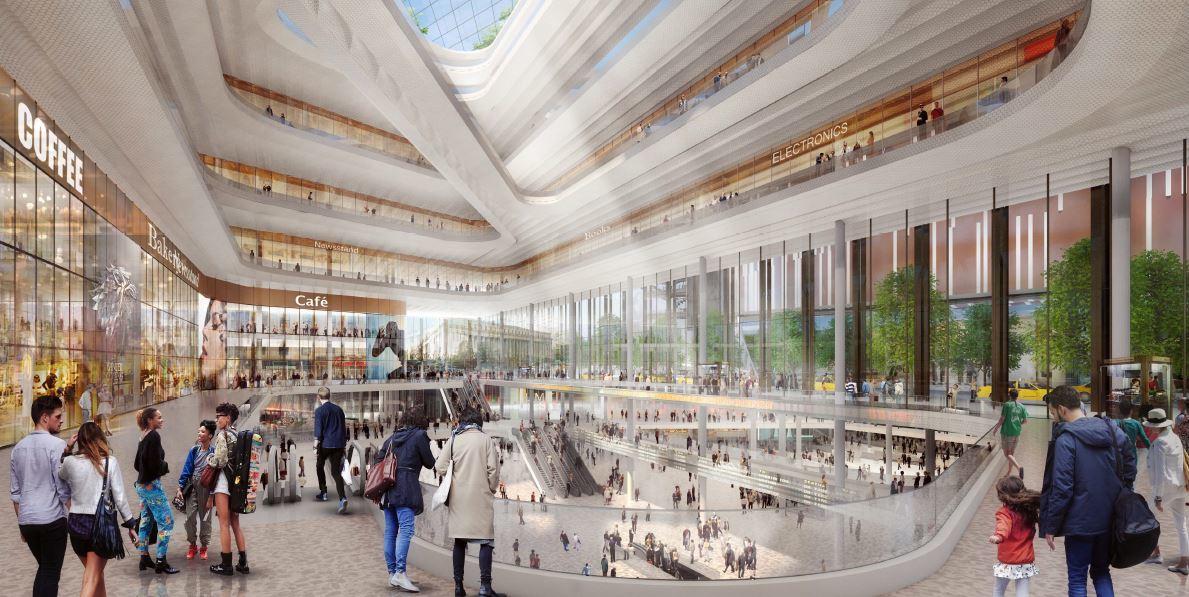
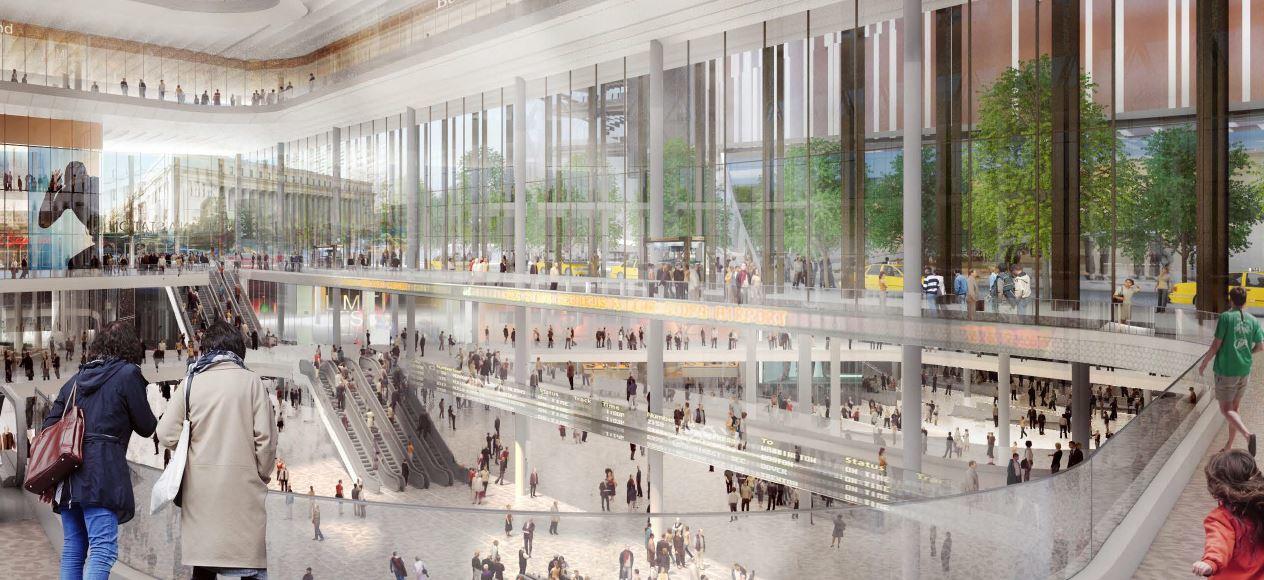
This plan is pretty much the same as that JDS bid, though on a broader scale (the JDS proposal was mostly for the southern portion of the redevelopment).
A look back at more of those renderings from JDS/SHoP Architects/FXFowle...
1.

2.

3.

4.

5.

6.

7.

8.

9.

10.

11.
12.
13.

14.

15.

16.

17.

No, it's inadequate track capacity. Penn has too few tracks. There are many other issues with Penn, but track capacity is one of the biggies.I'm pretty sure NYP's problem is one of inadequate throughput, not inadequate track capacity. Or as Pedestrian Observations puts it:
This isn't a problem; it's an advantage. It's great that there's finally a developing central hub, but the hub desperately needs work.The problems all stem from three agencies wishing to use Penn as a terminal.
Again, it's not either/or, it's both. Penn needs a new tunnel, and it needs additional tracks. But Cuomo can't do anything about the tunnel, and the tunnel isn't relevant to LIRR's (and soon to be Metro North's) space constraints at Penn. The tunnel will only benefit Amtrak and NJT.1. Adding the two new Hudson River tunnels that have been talked about since forever
I don't understand the constant complaints when a specific project doesn't solve every issue simultaneously. It's like going to the cardiologist for heart problems and then complaining it's a waste of time because he didn't also give you a needed root canal.
Probably impossible, and not relevant to Penn. Even if NJT merged with the MTA (highly questionable given politics, equipment, union differences, and both agencies are hopelessly dysfunctional) you would still have the same need for a new tunnel, new tracks, and new terminal at Penn. And bigger isn't better or more efficient, as we see with the MTA and PA gobbling up formerly independent systems like the until-recently independent Queens bus lines.2. Consolidating LIRR and NJT operations, so that trains that originate in New Jersey can run through to Long Island and vice versa.
Merging agencies would not reduce rush hour pressures from LI or NJ, nor could you re-use the trains, since they're needed in either direction simultaneously.
I don't see any obvious efficiencies. There are actually no issues with train storage. LIRR built a huge (now) underground storage facility at Penn in the 1980's and has a huge (soon to be underground) facility in LIC. NJT has large yards in the Meadowlands. Metro North has yards in the Bronx.
16.
Wow, what height is that tallest tower?
It’s tall, but not an actual proposed design.
https://therealdeal.com/2020/01/08/...&utm_medium=widget&utm_campaign=feature_posts
Recycled ideas? Penn Station plan similar to JDS 2016 proposal
The plan called for acquisition of the block south of Penn Station

TRD New York
Jan. 08, 2020
Nearly four years ago, a team led by JDS Development recommended that the state buy properties surrounding Penn Station to make way for a new terminal. On Monday, Gov. Andrew Cuomo proposed a similar plan.
JDS was among a group of developers, including Vornado Realty Trust and Brookfield Properties, who had responded to a 2016 request for expressions of interest (RFEI) for the redevelopment of Penn Station. The developer’s proposal, dubbed Empire Crossing, called on the state to acquire properties south of Penn Station to build six new tracks and three mixed-use towers — and soon.
The governor’s office indicated that it’s in discussions with property owners and that eminent domain would be a last resort. In a press release, the administration said the latest iteration of Empire Station Complex would “create opportunities for redevelopment on the blocks surrounding Penn Station, setting the stage to transform antiquated and underutilized buildings into a new economic engine for New York.” The state has tapped FXCollaborative, one of the architecture firms that had collaborated on JDS’ proposal, to lead a consultant design team on a portion of the project.
On Monday, Cuomo repeated other concepts in the 2016 RFEI, including a new entrance to Penn Station at Eighth Avenue. That would require removing Madison Square Garden’s theater, something that JDS included in its proposal. The RFEI described Penn South as a future project that developers would need to keep in mind with their Penn Station overhaul.
It’s unclear whether the state will issue another RFP or RFEI. Representatives for the Empire State Development Corporation indicated that discussions with Metropolitan Transportation Authority, Amtrak, New Jersey Transit, private property owners and community stakeholders would determine the structure of Penn Station’s redevelopment.
hammersklavier
Philly -> Osaka -> Tokyo
To be honest though, these issues all sound like they stem from a combination of (1) inadequate platform capacity -- NYP's antiquated platforms increasing dwell times -- and (2) inadequate throughput capacity, in particular caused by too many movements trying to negotiate the station approaches (with the worst problems being on the west side). Basically, you're getting stuck in the approach because some other train is fouling your train's path.It's all of the above. But trust me, I come into the city through Penn Station every morning, and nothing infuriates me more that getting all the way into the tunnel or almost into the station, and having to be stuck there because of "congestion" or not enough room for the capacity the city actually needs to get an adequate number of trains into the city. We NEED those extra platforms as much as we need the new tunnels. And the situation is only going to get worse, with the growing Hudson Yards, and this new district of office towers.
If this is the case, then more track capacity actually worsens the problem of approach delays, because more track capacity = bigger, more complex (and necessarily flat) approaches = more opportunity for conflicting movements. A countersolution -- one Alon Levy has long posed -- is to do the exact opposite: eliminate several NYP tracks in order to widen its inadequately-narrow platforms, which also streamlines and simplifies the approaches, reducing potential opportunities for fouling them.
Of course one could also argue that this expansion could be done with the long-term goal of widening NYP's existing platforms, which will necessitate a reduction in track capacity of the existing station, but if that were the case, then this project would also need to be properly coordinated with Amtrak's effort in order to facilitate through-running through the station expansions (as well as making sure that the approaches make sense, of course.)
Tokyo's central station handles more than double the movements on essentially the same track capacity. You're talking out of your ass.No, it's inadequate track capacity. Penn has too few tracks. There are many other issues with Penn, but track capacity is one of the biggies.
The problem is that it is three agencies. In nearly every other city in the developed world, the central station is served by two agencies: the intercity rail provider (i.e. Amtrak) and a single commuter rail provider. The point here is that NJT, the LIRR, and the MNRR should all be unified into a single commuter rail system under MTA aegis.This isn't a problem; it's an advantage. It's great that there's finally a developing central hub, but the hub desperately needs work.
We just falsified the claim that it needs additional tracks, and we just discussed the problem with one too many agencies competing for space at NYP. Incidentally, you will also notice that there are only two agencies at nearly every other central station in North America: Boston, Philadelphia, Chicago, Toronto, Montréal, Los Angeles all come to mind here.Again, it's not either/or, it's both. Penn needs a new tunnel, and it needs additional tracks. But Cuomo can't do anything about the tunnel, and the tunnel isn't relevant to LIRR's (and soon to be Metro North's) space constraints at Penn. The tunnel will only benefit Amtrak and NJT.
No, this is complaining that your "cardiologist" actually has a DFA in Theater from, I don't know, Swarthmore University or something. In other words, the complaints are that the powers-that-be have no fucking clue whatsoever what the real problems are and how to resolve them. Clearly, neither do you.I don't understand the constant complaints when a specific project doesn't solve every issue simultaneously. It's like going to the cardiologist for heart problems and then complaining it's a waste of time because he didn't also give you a needed root canal.
Given that both agencies share a main terminal at Penn, I don't see how it could be more relevant. Also your excuses are just that ... excuses. And finally reiterating a false thing does not magically make it more true.Probably impossible, and not relevant to Penn. Even if NJT merged with the MTA (highly questionable given politics, equipment, union differences, and both agencies are hopelessly dysfunctional) you would still have the same need for a new tunnel, new tracks, and new terminal at Penn. And bigger isn't better or more efficient, as we see with the MTA and PA gobbling up formerly independent systems like the until-recently independent Queens bus lines.
Organisation vor Elektronik vor Beton. Organization before electronics before concrete. Digging an entirely new station box because Penn Station's tenants can't work together is the concrete. Making them work together is the organization. You need to fix Penn Station's (and New York's mass transit's in general) organizational problems before you start digging, because it's only after you've implemented bureaucratic and technical fixes that you know where the physical infrastructure problems really lay.
Do you need to be sent back to remedial school or something? This flies in the face of the most basic reason why German cities have S-Bahnen, Madrid its Cercanías, Paris the RER, London built Crossrail and is already planning Crossrail 2, and Melbourne is even building its own Crossrail scheme, namely that through-running allows for superior equipment optimization, especially at rush hour.Merging agencies would not reduce rush hour pressures from LI or NJ, nor could you re-use the trains, since they're needed in either direction simultaneously.
We've already established that a ten-year-old brimful of questions probably knows more about the issues at hand than you do, so what's the point of comparing large coach yards a well-designed through-running scheme would render obsolete at a stroke?I don't see any obvious efficiencies. There are actually no issues with train storage. LIRR built a huge (now) underground storage facility at Penn in the 1980's and has a huge (soon to be underground) facility in LIC. NJT has large yards in the Meadowlands. Metro North has yards in the Bronx.
Maybe

Ugh god, factor out the back towers (which unfortunately are the real proposals I believe) and leave the front ones and we're good.

The tallest one is sort of a cross between Burj Khalifa and the Landmark Tower in Vietnam, looks about 1700 feet too.
Why can't NYC see real proposals like this?
TheIllinoisan
New member
Wow. Its like they took 7 or 8 of the 10 worst architecture trends of the past decade, supersized them, and then decided to slap them down within a few blocks of each other.
Absolutely disgusting.
Absolutely disgusting.

dc_denizen
Selfie-stick vendor
trees don't belong on buildings
This is silly, simplistic non-logic. Penn Station handles twice the traffic of Grand Central yet with 1/7 the track capacity, yet Grand Central has some major congestion issues, and is adding eight tracks. Most of the major European terminals have twice as many tracks as Penn yet half the ridership and significant peak congestion issues. Congestion is far more complex than a passenger-track ratio. It's timing, capacity, equipment, passenger flow, etc.Tokyo's central station handles more than double the movements on essentially the same track capacity. You're talking out of your ass.
If Tokyo Station is truly able to carry 1.5 million daily passengers disembarking on 20 tracks, good for them, they must have heavy traffic at odd hours. It doesn't mean Penn doesn't have terrible track congestion issues.
This is dumb. The MTA is already a unified agency and is horribly inefficient, far more inefficient than pre-merger. And you just mentioned Tokyo, which is the wild west, with no consolidation. Amtrak can't be merged. NJ Transit can't be merged, and simply merging would do nothing for congestion.The problem is that it is three agencies. In nearly every other city in the developed world, the central station is served by two agencies: the intercity rail provider (i.e. Amtrak) and a single commuter rail provider. The point here is that NJT, the LIRR, and the MNRR should all be unified into a single commuter rail system under MTA aegis.
Correction, you just made the crazy claim that Penn doesn't need additional tracks, directly contradicting pretty much everyone with professional knowledge of Penn, and refuting the underlying logic of billions of investment over time to expand track capacity. Essentially you're calling the MTA, Amtrak and NJT liars or idiots, because they're planing 16 new tracks (8 by MTA, 8 by Amtrak, and tens of billions of related investment). Why would all these leaders from all these agencies engage in such efforts for no discernible reason?We just falsified the claim that it needs additional tracks,
There is no such issue. There is no "competing"; they have reserved track rights which default to the other agencies when unused. If an Acela is late a NJT can slide in.and we just discussed the problem with one too many agencies competing for space at NYP.
Wrong. Chicago has, for example, Amtrak, Metra and South Shore Line. Philly has SEPTA, Amtrak and NJT. All have at least two agencies.Incidentally, you will also notice that there are only two agencies at nearly every other central station in North America: Boston, Philadelphia, Chicago, Toronto, Montréal, Los Angeles all come to mind here.
And these stations don't lack congestion issues because they have fewer agencies; they lack congestion issues because their collective ridership combined doesn't come close to Penn. Penn is the busiest station in the western world, but with (relatively) few tracks. Outside of Japan there's no equivalent.
Yes, every transit expert on earth is an idiot. Only random internet commentators know the truth about Penn congestion. Why won't they see the light! :uhh:In other words, the complaints are that the powers-that-be have no fucking clue whatsoever what the real problems are and how to resolve them. Clearly, neither do you.
So your wacky claim is that there should be no transit improvements whatsoever allowed until the MTA somehow illegally merges with NJT and Amtrak (and I assume ConnDOT, the PA, SEPTA and every other agency within 100 miles). In other words, you want nothing to ever happen, because the MTA will never be fixed. It has been a mess for 70 years.You need to fix Penn Station's (and New York's mass transit's in general) organizational problems before you start digging, because it's only after you've implemented bureaucratic and technical fixes that you know where the physical infrastructure problems really lay.
A. Most of these systems aren't through-running, B. None of these systems have ridership or employment patterns analogous to Penn, C. Most of these systems have multiple agencies. S-Bahn is a completely separate agency from U-Bahn. D. Suburban rail core functionality in Europe is analogous to express train subway functionality in NYC. So total fail.Do you need to be sent back to remedial school or something? This flies in the face of the most basic reason why German cities have S-Bahnen, Madrid its Cercanías, Paris the RER, London built Crossrail and is already planning Crossrail 2, and Melbourne is even building its own Crossrail scheme, namely that through-running allows for superior equipment optimization, especially at rush hour.
There is no "through-running" issue. There is a capacity issue from the west. Running trains from the west to Long Island doesn't do a thing for trains from the west. It would actually make congestion worse, because those trains are already conveniently parked next to Penn, in a giant underground yard, and your solution is to send them east, therefore screwing up the East River crossings too. The issue isn't storing trains, it's moving passengers in and out of Penn from the west. And the trains from the west can't be used to the east, nor are they needed in that directional during peak hours.
We've already established that a ten-year-old brimful of questions probably knows more about the issues at hand than you do, so what's the point of comparing large coach yards a well-designed through-running scheme would render obsolete at a stroke?
Ah, so only you and a 10-yo understand the problems at Penn. The MTA, Amtrak and NJT have no clue. Somehow there would be greater "efficiencies" of through running, even though the laws, equipment, union rules don't allow it, and even though the problem is rush-hour inbound congestion, so irrelevant to through-running? The things one "learns" on the internet.
If you think all the bureaucrats all the agencies are so dumb, send in your resume and give them your thoughts. Tell them to send trains across the East River to fix Hudson River congestion. Tell them NJ commuters to Manhattan need empty through trains to LI. And tell them the MTA isn't quite large, unwieldy or bureaucratic enough. And tell them you'll save them $50 billion or so collectively. No doubt they'll have a hearty laugh.