SirLucasTheGreat
New member
Anyone following this DIA debacle? I was just watching their press conference. What a freaking mess


Anyone following this DIA debacle? I was just watching their press conference. What a freaking mess
Agreed. Clearly inspired by East Berlin, circa 1980, but with less inviting retail.
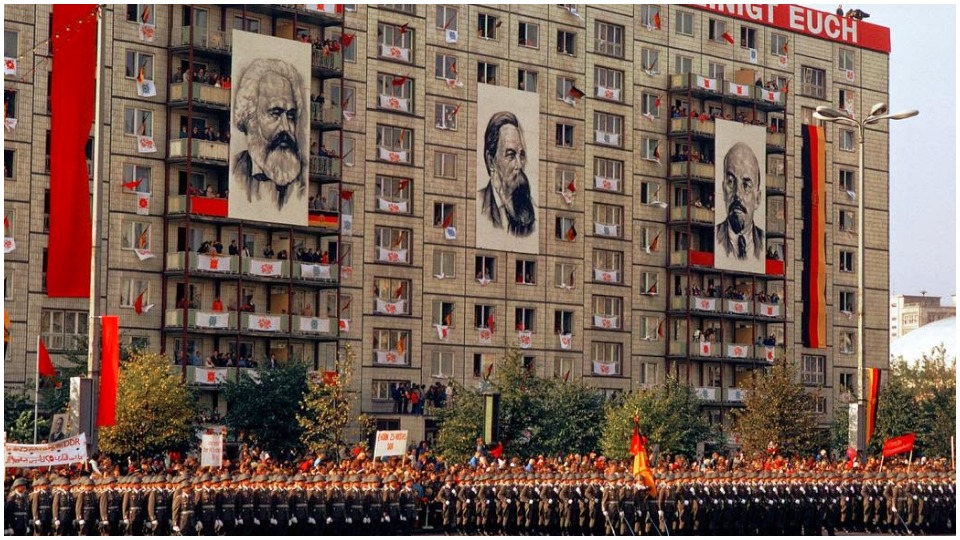
I believe the architects may have actually used this picture as a model for housing development along a light rail line:

The souless-ness of the populace walking along urban corridors with such development models is captured by this classic photo:

It's hard to judge from here who's at fault - has the contractor really f*cked up?
The story in the Post indicates that the City is not declaring a breach, but is terminating the agreement for its convenience. This apparently means that the City will have to make the contractor whole:
The breakup could cost DIA upward of $200 million, including making Great Hall Partners whole for their investment and borrowing. Estimates are still being put together, DIA finance chief Gisela Shanahan said.
https://www.denverpost.com/2019/08/13/denver-airport-dia-construction-contract/
If the Great Hall really didn't perform its agreement, the City could have attempted to declare a breach, and then could have litigated whether they have to make Great Hall Partners whole. The fact that they chose the path they did makes me think one or more of the following to be true:
1. Although Great Hall may have been in breach, the City didn't have the balls to to go to court against Great Hall and wanted an easy (albeit expensive) out.
2. Great Hall isn't in breach, and most if not all the fault here lies with the city.
3. Great Hall may be in breach, and/or may have done a crap job of managing these issues but the city negotiated a total crap contract that didn't' really protect the city from these outcomes.
If this were a private business dealing with Great Hall, any party with a credible claim of breach likely would have declared a breach to attempt to avoid the termination fee and/or to use the breach claim to negotiate down the the amount of the break up fee. From experience, government tends to avoid such hard ball tactics.
Whatever the truth, bad news for the airport and I got to think the cost overruns and financial problems will likely mount.

It's hard to judge from here who's at fault - has the contractor really f*cked up?
The story in the Post indicates that the City is not declaring a breach, but is terminating the agreement for its convenience. This apparently means that the City will have to make the contractor whole:
The breakup could cost DIA upward of $200 million, including making Great Hall Partners whole for their investment and borrowing. Estimates are still being put together, DIA finance chief Gisela Shanahan said.
https://www.denverpost.com/2019/08/13/denver-airport-dia-construction-contract/
Denver clearly believes GHP is trying to fleece Denver, that they're not negotiating in good faith. Apparently litigating through the Dispute Resolution Process would be time consuming, very expensive and disruptive to getting the project done.She said GHP is open to negotiating a "mutually acceptable resolution" to avoid triggering the Dispute Resolution Process in the agreement.
I suspect DIA's preoccupation with the timetable probably would have made any threats of litigation less credible. Now they are going to directly oversee operations and design. They are just going to contract out the actual construction. Apparently, the concrete is safe enough for construction equipment according the February report.
Between this, FasTracks, the C470 project, and the convention center, we are starting to look super inept at procuring contractors and completing critical civic/infrastructure projects. By the way, CDOT might terminate their contractor for the C470 project. That project was supposed to be done August 1.
What was the 3rd project? The one on Speer?They've done this twice before (coming in and buying a permitted project) and just go ahead with the approved design since that was probably included in the sales price. No reason to think that the 3rd time will be any different.
Great post.I think you all are a bit dramatic about it lol. Radiant looks fine and does Alexan 20th Street Station. Alexan Arapahoe Square is a little rough but that was supposed to be the “cheaper” building between the two Alexan’s so they didn’t invest as much into materials or finishes. I think it’s because they are built in a sea of parking lots so unless it was an architectural wonder, you guys wouldn’t like it... because it sticks out. Once the rest is built out, it will blend into the urban fabric. And yes the new Greystar one will help. Also those barges are putting a 1000 residences into a lame part of downtown. All city’s have uninspiring buildings... even block long ones.


Agreed. Clearly inspired by East Berlin, circa 1980, but with less inviting retail.
I believe the architects may have actually used this picture as a model for housing development along a light rail line:
The souless-ness of the populace walking along urban corridors with such development models is captured by this classic photo:
I think you all are a bit dramatic about it lol. Radiant looks fine and does Alexan 20th Street Station. Alexan Arapahoe Square is a little rough but that was supposed to be the “cheaper” building between the two Alexan’s so they didn’t invest as much into materials or finishes. I think it’s because they are built in a sea of parking lots so unless it was an architectural wonder, you guys wouldn’t like it... because it sticks out. Once the rest is built out, it will blend into the urban fabric. And yes the new Greystar one will help. Also those barges are putting a 1000 residences into a lame part of downtown. All city’s have uninspiring buildings... even block long ones.
TCR projects tend to the pedestrian and if that's the worst then that's not too shabby. TCR, could jazz up their cookie cutter a bit when desired. For example, in Cherry Creek they utilize recessed balconies which gives the building a more sophisticated look on the outside as well as feel to the tenants.Like I said, it provides density and nothing else. In my mind, 18th & Market, also a land barge, is done right...
I think you all are a bit dramatic about it lol. Radiant looks fine and does Alexan 20th Street Station. Alexan Arapahoe Square is a little rough but that was supposed to be the “cheaper” building between the two Alexan’s so they didn’t invest as much into materials or finishes. I think it’s because they are built in a sea of parking lots so unless it was an architectural wonder, you guys wouldn’t like it... because it sticks out. Once the rest is built out, it will blend into the urban fabric. And yes the new Greystar one will help. Also those barges are putting a 1000 residences into a lame part of downtown. All city’s have uninspiring buildings... even block long ones.
I am having some fun at the expense of the Welton Street corridor and the Denver land barge/Soviet housing style. Radiant does indeed have some positive qualities, including some solid material choice (brick and glass) and some very cool interiors.
Having said that, the disappointment to me is not that Denver has some uninspiring buildings that came out this cycle - all cities do, as you note. It's that so very little high quality, inspiring residential large building construction came out of one Denver's greatest economic cycles in its history. Compare that to Austin and Seattle and other cities, Denver got a lot boxes and barges, and, IMHO, no truly exceptional towers. Even the most notable tower, the Confluence, in my view, while having many positives, did not live up to its potential for such a prominent site. (Country Club towers also has a lot to like, but is away from the urban core).
Uninspiring occurs everywhere, even in Austin, Seattle and, I'm sure, even in Vancouver. But at least those cities have plenty of examples of outstanding and inspiring large residential structures that have been added this cycle.

I can’t speak to Austin but for Seattle, they have DRB in place and also are able to achieve higher rents supporting higher quality materials and design. For instance I opened a high rise in the Denny Triangle area, similar to the Confluence (less metal and more glass) but my two bedrooms started at $3890. If you look at buildings pushing those rents, most would agree they like the design. Most people on here aren’t in favor of DRB or any other restriction placed on design elements in favor of cheaper rents. For instance we could say half block sites must be built as twin towers past a certain level (as what Seattle did) but then you increase the cost of construction pushing rents higher or developers will stay under that height lessening the density and available supply. Not saying its perfect but just saying it’s not that big of a deal. They are the first buildings in a transitioning zone. Once the new Greystar, Kenect, various Condo proposals and those adult dorms go up, those awful soul sucking ships won’t have the same impact on the skyline. I used to hate the Manhattan but now it just blends into Union Station and Riverfront.
I think it caught a bid and reversed course slightly but on a day when stocks are down it's always nice to see my Denver's own Newmont Mining shares catch a bounce as Gold is now the highest in 6 years.NEW YORK/LONDON (Reuters) - The U.S. Treasury yield curve inverted on Wednesday for the first time since June 2007, in a sign of investor concern that the world’s biggest economy could be heading for recession. The inversion - where shorter-dated borrowing costs are higher than longer ones - saw U.S. 2-year note yields rise above the 10-year yield.
The U.S. curve inverted on Wednesday to as much as minus 2.1 basis points US2US10=TWEB, a metric widely viewed as a classic recession signal. The U.S. curve has inverted before every recession in the past 50 years, offering a false signal just once in that time.
Dupe.

That's the way it is and that's the way it was.Billions of people are moving out of poverty into a lifestyle that developed nations have enjoyed... “What we want is 9 billion people who have a quality of life, while managing CO2. What’s the pathway?” asked Vijay Swarup, vice president of research and development at ExxonMobil Corp.’s research and engineering company.
Finding an answer to a challenge so large requires “a reset” — a complete rethinking of assumptions and ways of doing things, and collaboration across the private and public sector, and across scientific disciplines. “We need every ‘ology’ out there, and then we need engineering,” he said.
ExxonMobil’s agreement with NREL makes the 2,200-employee Golden lab the connection to other Department of Energy research arms too.

