Confederation Line (Stage 1) | In Service 1.0


Status
Not open for further replies.
Stephen Blais on Twitter:
https://twitter.com/StephenBlais/status/1003997776483532800
A lot of ppl ask about winter maintenance on the ⭕️train Confederation Line - Switches are heated and will be regularly cleared using brush sweepers and snow brooms/blowers, we can also operate trains in overnight hours during a storm to keep the track clear for AM service

De7qH85VMAARHSH.jpg
 
Is this an issue in Calgary or Edmonton?

Good Day.

Not nearly to the extent that we are susceptible.....but they are subject to the occasional icing difficulty. They are far more used to large snows.

Eastern Ontario, Western Quebec, and New Brunswick, (along with the northeastern US states) are virtually the world's capital in freezing rain exposure and experience.

The solutions mentioned above - heated switches and brushing, along with the occasional torching crews, are common for switch maintenance, and continuous running, including overnight (cancelling otherwise regular maintenance), are also common solutions for other electrified jurisdictions.

As was mentioned, it is a good thing that they had last winter's experience under their belts - good exposure and foreplanning on what to expect.:tup:

EnJoy!
 

Good Day.

The opening and closing photo of two LRVs on track east of Hurdman.....
the curve at the top of the photo, at the blue-roofed building - has the space for, but no track in, the area on the curve that was to have had a siding or pocket track !!!

This speaks to the concensus to my previous question about space at the south side of the trench east of Tunney's station - reserve space for a deadend siding.

This also re-inforces my previous post concerning Geo-Ottawa - it still shows the double-ended siding on that curve, east of Hurdman, west of Tremblay, there (which was also in contradiction of the early plans showing a pocket track siding between the eastbound and westbound tracks thereabouts (no surprise that got changed, way expensive on an excessive number of switchpoints - so, NO short turns at Hurdman)).

So...... actual final evidence of what we are getting remains to be the actual hard evidence of actual final construction of what we are really getting - all in utter secrecy, of course !!

:sly:

One thing I noticed is that on GeoOttawa, that pocket track that wasn't built is displayed as a solid line rather than a line with dashes (as a train track normally would be).

But generally, the data on geoOttawa doesn't tend to be updated with new information a whole lot. For example, the Stage 2 plan for the Trillium Line still includes a dead end stub of track behind the LCBO despite the fact that it was removed last spring.
 
True, but unless they run trains all night ling (as 1overcosc said), the overnight period is where they could have risk of ice buildup.

Yes, and I would imagine that if there is a risk of an overnight icing event, they would do just that. The TTC calls them "storm cars".
 
One thing I noticed is that on GeoOttawa, that pocket track that wasn't built is displayed as a solid line rather than a line with dashes (as a train track normally would be).

........

Good Day.

yeah... on that subject, I will not get into debate - there are just too many variants and variations by multiple map maintenance and updaters in various maps and protocols to really establish or depend on any kind of standard.
Unless it is so noted on a legend incorporated into the map concerned, and adhered to, then there is no use debating the subject.

IMHO.:rolleyes:
EnJoy!
 
Yes, and I would imagine that if there is a risk of an overnight icing event, they would do just that. The TTC calls them "storm cars".

Good Day.

In the FEDCO update June 5 just posted, page 33, they have explicitly stated for seasonal operations, quote :

Forecast-based mitigation, such as operating trains in overnight hours during a storm to keep the track clear for AM service

UnQuote.

For what it is worth, and as per previous discussion.

EnJoy!
 
Yes, and I would imagine that if there is a risk of an overnight icing event, they would do just that. The TTC calls them "storm cars".

I wonder if they'd be automated since our trains are supposedly capable of running without a driver. It would seem like a waste to have drivers on those trains all night just to keep the rails from icing.
 
Could just be me, but why does this grate look bigger than the ones I used to see in Toronto? I don't remember them taking up so much space on the sidewalk.

fSyXfeJ.jpg
 
I swung by the simulator as well, and someone told me the front wheels (on each end) will be able to spray sand onto the rails which has been working to provide traction. But they did say the sheer weight of the trains has been enough to get through the ice and snow they've built up.

The existing Trillium Line trains have sanders, as do most locomotives. You can usually see the pile of sand on each side of the rails where the sanders come to a stop at station platforms.
 
Could just be me, but why does this grate look bigger than the ones I used to see in Toronto? I don't remember them taking up so much space on the sidewalk.

fSyXfeJ.jpg

It does seem larger, but I wonder if it's because we use a single tunnel instead of twin tunnels, plus probably changes in building standards over the past 50 years.

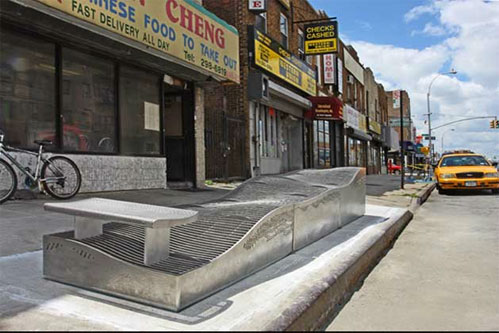
Since we have such large grates, they should have done something like this:

floodbench.jpg

https://www.planetizen.com/node/52065?amp
 
As was mentioned, it is a good thing that they had last winter's experience under their belts - good exposure and foreplanning on what to expect.:tup:

Yup. As mentioned earlier, apparently they ran into troubles with the ice storm we had this past winter, so learned something from it.
 
It makes sense that they would have had problems this winter, since they had segments of catenary up in places where they didn't yet have trains running (like on the west side) that could knock off the ice build-up.
 
I just meant that the pantograph on the Citadis is installed by people who's jobs it is to do that. Putting a fake on on the diesel plow would be an in-house job, they might not want to take the risk.

I wasn't suggesting that they jury rig something with duct tape. It would need to be designed by an engineer, optimally by the manufacturer of the plow. It might be more expensive up front, but not having to run trains all night, especially if drivers are required, would have it save money in the long run, though I guess it depends how many times they will need to run all-night trains per year.
 
Status
Not open for further replies.


Back
Top