Confederation Line (Stage 1) | In Service 1.0


Status
Not open for further replies.
Interesting. I wonder how they drain the water.

I can't find a photo, but I've seen the leaky stations for the tunnelbana. They've got decorative 'trees' that grow from the station platform. The trunks are drain pipes, looping around to the ceiling, holding a 12" diameter pan to catch the drips. Some of the trees are gigantic. Really an awesome solution.
 
I can't find a photo, but I've seen the leaky stations for the tunnelbana. They've got decorative 'trees' that grow from the station platform. The trunks are drain pipes, looping around to the ceiling, holding a 12" diameter pan to catch the drips. Some of the trees are gigantic. Really an awesome solution.

Sounds cool. Although I could see that if Ottawa were trying to minimize costs they would just slap on concrete.
 
Sounds cool. Although I could see that if Ottawa were trying to minimize costs they would just slap on concrete.

I'm not sure "just slapping on concrete" describes the engineering treatment that was required for Ottawa's downtown transit tunnel through rather porous and fractured shales and mudstones.
 
We could have had a waterfall just west of Rideau Station. It could have been a natural train wash, except one day the missing van might have come through.
 
I'm not sure "just slapping on concrete" describes the engineering treatment that was required for Ottawa's downtown transit tunnel through rather porous and fractured shales and mudstones.

Agreed. They are making a reinforced concrete tube.

Also, just to be clear, even though, as you said, Stockholm's geology is essentially Canadian Shield, Ottawa's tunnel isn't going through the Canadian Shield.
 
Agreed. They are making a reinforced concrete tube.

Also, just to be clear, even though, as you said, Stockholm's geology is essentially Canadian Shield, Ottawa's tunnel isn't going through the Canadian Shield.

In Ottawa they're using a new blind-side style of waterproofing membrane, which is a big thick sheet of rubber, with a few encapsulated layers (the yellow in the photos). This is placed first before concrete is cast, hence why it's called 'blindside' waterproofing. There is a grid of valves cast into the concrete tunnel wall which are monolithic with the rubber membrane. If water leaks through defects in the membrane(s) and through the concrete (which shouldn't be too cracked as it is an arch in compression), the valve port can be opened and pressure-grouted with a crystalline cementitious mix to fill voids and cracks behind the membrane layer, thus trying to plug the leak from the backside. It's a complicated system and I've never seen it work, but it sounds like it makes sense.
 
In Ottawa they're using a new blind-side style of waterproofing membrane, which is a big thick sheet of rubber, with a few encapsulated layers (the yellow in the photos). This is placed first before concrete is cast, hence why it's called 'blindside' waterproofing. There is a grid of valves cast into the concrete tunnel wall which are monolithic with the rubber membrane. If water leaks through defects in the membrane(s) and through the concrete (which shouldn't be too cracked as it is an arch in compression), the valve port can be opened and pressure-grouted with a crystalline cementitious mix to fill voids and cracks behind the membrane layer, thus trying to plug the leak from the backside. It's a complicated system and I've never seen it work, but it sounds like it makes sense.

That is interesting. Thanks for sharing. It is still reinforced concrete though, right?
 
That is interesting. Thanks for sharing. It is still reinforced concrete though, right?

Good Day....

yup.... full meshed rebar and pressure-fed concrete into the moving tunnel forms. The rebar mesh is what peeled back and trapped the three workers in their cherry-picker as they were wiring it up into place in the tunnel ceiling just in from the east portal a bit ago, attaching it to tie-backs planted through the membrane into the shotcrete initial tunnel lining and the rock in behind.
 
Lot of movement at Lyon Stations' Podium Building entrance. They've removed the plywood from the opening and are now installing what I assume are the window frames.
 
Agreed. They are making a reinforced concrete tube.

Also, just to be clear, even though, as you said, Stockholm's geology is essentially Canadian Shield, Ottawa's tunnel isn't going through the Canadian Shield.

Intimately aware of that, as I have a nice little collection going of fossils from those same strata that the tunnel was mined out of. :)
 
Intimately aware of that, as I have a nice little collection going of fossils from those same strata that the tunnel was mined out of. :)

Ordovician trilobites (pseudogygites latimarginatus) from the shale deposit of the Billings Formation? I've collected a few of those over the years.
 
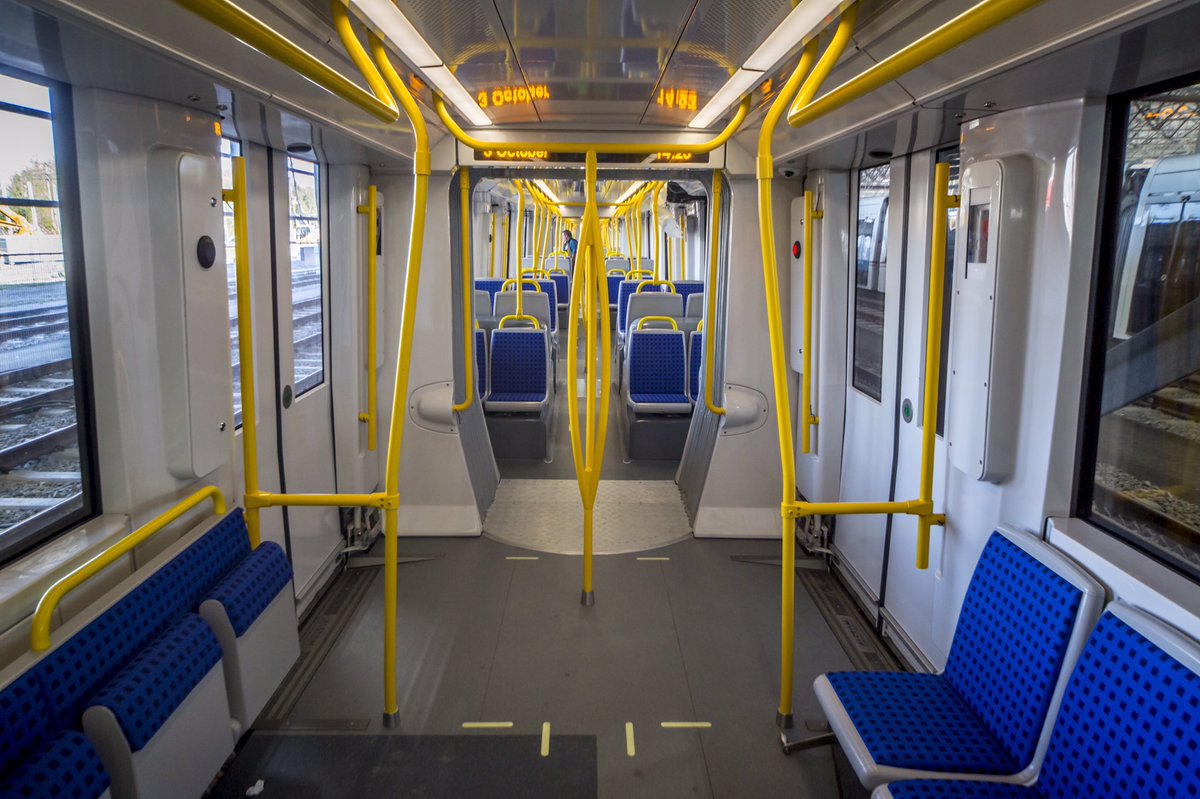
Another look at at the LRV interior

DONuIInW0AAlJFM.jpg

https://twitter.com/JimWatsonOttawa/status/928707061713584128

Pimisi

DOduozDXkAAlUec.jpg


Cyrville

DOdupIBWAAEyT_L.jpg


DOdupkQWkAEkio2.jpg


DOdvJ5PW4AAOh20.jpg

https://twitter.com/Canardiain/status/929833567907143681
 
Will bicycles be allowed on board? If so, I assume only in a designated area? I really liked what I saw in the Portland Light Rail system, the trains had designated bike areas where it was mandatory to essentially hang your bike from a special hook - even on a crowded train, my bike was not in the way and it was super easy to unhook and unload since this bike area was right by a set of doors.
 
Will bicycles be allowed on board? If so, I assume only in a designated area? I really liked what I saw in the Portland Light Rail system, the trains had designated bike areas where it was mandatory to essentially hang your bike from a special hook - even on a crowded train, my bike was not in the way and it was super easy to unhook and unload since this bike area was right by a set of doors.

I think it's been said that bikes will be allowed in designated areas, but it wasn't clear if this would be the case during peak periods.
 
I still cant get over the number of seats that they maintained in the train sets. Very much a commuter train more so than a metroesque train. I understand there are some spots with elevated floor planes due to clearance for suspension and wheels, but the remainder of the seating is what makes the buses so difficult to navigate during rush hour in the first place.
 
I still cant get over the number of seats that they maintained in the train sets. Very much a commuter train more so than a metroesque train. I understand there are some spots with elevated floor planes due to clearance for suspension and wheels, but the remainder of the seating is what makes the buses so difficult to navigate during rush hour in the first place.

Many of the seats go over the bogies and wheel wells so they are not optional, even if you removed them there would be mounds. In fact most of the flat areas are dedicated to open space with foldable seats. That's the main disadvantage of low-floor vehicles.
 
I still cant get over the number of seats that they maintained in the train sets. Very much a commuter train more so than a metroesque train. I understand there are some spots with elevated floor planes due to clearance for suspension and wheels, but the remainder of the seating is what makes the buses so difficult to navigate during rush hour in the first place.

That's precisely what it is though; commuter rail built to metro standards, like BART in San Francisco (but with light rail instead of heavy rail). The primary use of this train is to get suburbanites downtown. The urban subway aspect is just a happy coincidence.

In other news, Queen Street west bound now has a turning lane to Lyon north bound, i.e. Lyon is now a two-way street for two blocks instead of just one. This was probably done to accommodate the post-rail STO routes.
 
Ordovician trilobites (pseudogygites latimarginatus) from the shale deposit of the Billings Formation? I've collected a few of those over the years.

I think I have at least three or four different species; what's under New Edinburgh? Is that Billings as well?
 
Status
Not open for further replies.


Back
Top