• City-versus-city activity is flat-out banned from being posted here in all its forms.

    City vs city trolling sets up a rather nasty and personal fight between forumers from one place and forumers from another place, potentially affecting hundreds of members any time it breaks out. Nothing good comes of versus-trolling, but long after the insults and mockery have been removed, bad feelings between individuals and between groups tend to linger, oftentimes popping up in unrelated threads for months afterwards.

    Thus, when it comes to 'versus' trolling, a line must be drawn--sharply. Anyone who crosses that line shall be disciplined, up to and including suspension and even summary banishment without warning. Forum moderation and administration shall be the arbiter of what constitutes versus-trolling, so if you think your post might be perceived as an unfair attack on an entire city that will upset residents there, tread lightly or reconsider how you intend to express your opinion. No forumer shall successfully claim ignorance of our policy against versus trolling, and no forumer should believe he can get away with it.

    The ban on versus activity applies to all posts and all threads, even ones that are not initially set up as city-versus-city.

    If you see any troublesome posts please report them using the "report a post" icon -
    report.gif
    in the upper right corner of every post on the forum.

Your city's Chinatown


I will start with Toronto. It covers 4 census tracts (tracts 36, 37, 38 and 39) and about 1.5 sq km/0.6 square miles.

110689_1.jpg


One important thing to note about Toronto's Chinatown is that it overlaps with Kensington Market. The Alexandra Park housing project is also in one of the census tracts.

Toronto's Chinatown used to be right behind where City Hall is today. The old Chinatown was demolished to make room for City Hall in the 1960s. Chinatown moved west to Spadina Avenue after they were displaced. Spadina Avenue until the 1950s was the heart of Jewish Toronto.

The Chinese population grew through the 1970s and even more in the 1980s. Since the 1990s the Chinese population has probably been pretty stable - many have moved onto other city areas or the suburbs, but their numbers are replenished by new immigrants.

That's only one of them too.

I know you said Urban Chinatowns so I won't talk about Markham, but Chinatown East is urban enough over at Gerrard and Broadview.
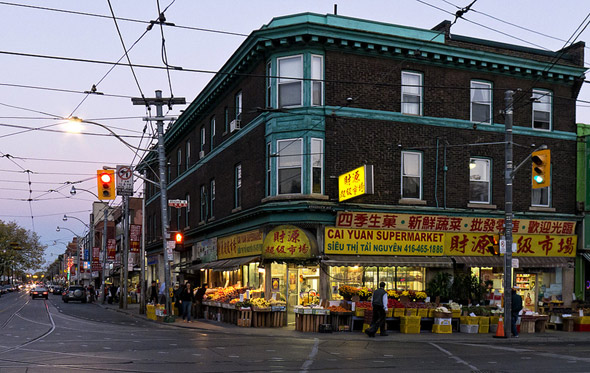
20101009-potd.jpg

.

east_china_town.png

.

16Sep09_ChineseArchway.jpg

.
 
I think she lives in the green one.

2v2b08z.jpg

Snerk. Love it.

Here, we have a subdivision where the percentage of Asian residents is a whopping three percent! Considering that the city's Asian population is around one percent, and considering that subdivision is in the middle of an area where there about forty Asian-owned businesses and churches, I guess that's our defacto "Chinatown."
 
Pittsburgh doesnt have a Chinatown anymore, most of it got flattened in the mid 1900s for highways and on ramps. Theres like 3 buildings left from the old Chinatown. Plus Pittsburgh is like one of the least diverse major cities in the nation.
 
Despite 16% of the Population identified as "Asian", San Diego doesn't have a Chinatown. Only 3% of the Asian pop is Chinese I believe.

The closest thing we have is Kearney Mesa, which is home to Vietnamese, Chinese, Korean restaurants. City Heights is a high density residential district with many Vietnamese restaurants popping up.

Right. City Heights has Little Saigon
 
Chicago's Chinese population is ~40-45,000 people. And Chinatown is 2 miles south of The Loop, or "downtown" if you will.

By comparison, NYC's Chinatown is about a mile north of Wall Street or about 3 miles south of Midtown, whichever "downtown" you prefer.

I guess it's because the city is so North Side-centric 2 miles south of the Loop feels more removed?

It seems that Armour Square (population 13,000, 1 square mile, 72% Asian) is more or less synonymous with "Chinatown" but adjacent Bridgeport also has a large Chinese population.

https://en.wikipedia.org/wiki/Armour_Square,_Chicago
 
I guess it's because the city is so North Side-centric 2 miles south of the Loop feels more removed?
it doesn't feel removed because the city is northside-centric, it feels removed because the area is kind of isolated by expressways, the river, massive railroad viaducts, former/current housing projects, and abandoned railroad land. it's nothing at all like the chinatowns in other cities like san francisco or toronto where you can just sort stumble into chinatown. in chicago, to go to chinatown, you have to be making a point to go to chinatown. so, while it's not all that far from downtown as the crow flies, it kind of feels like a little isolated chinese world unto itself. i think that aspect makes it feel much further from downtown than it actually is.
 
I guess it's because the city is so North Side-centric 2 miles south of the Loop feels more removed?

It seems that Armour Square (population 13,000, 1 square mile, 72% Asian) is more or less synonymous with "Chinatown" but adjacent Bridgeport also has a large Chinese population.

https://en.wikipedia.org/wiki/Armour_Square,_Chicago

Armour Square is the Community Area within which "Chinatown" is located. It's the same relationship between "Andersonville", our Swedish enclave, and Edgewater, the official community area. Throughout the city you'll find many small, unofficial neighborhood designations located within our 77 official community areas.

Also, Chicago's Chinatown has always been separated from the Loop by a very large piece of railroad land, .5 miles wide and over a mile long. But it's only 'disconnected' if you're looking at its relationship to the Loop. It's connected just fine to the rest of the South Side: Bridgeport, Douglas, and the Near South Side neighborhoods. I grew up near Chinatown; I used to ride my bike over there all the time; there's nothing "removed" about it.

And while Chicago's Chinese population is concentrated in Chinatown and Armour Square, it also spreads west across the South Side into Bridgeport and even McKinley Park. Kelly High School, which is about 4 miles west of Chinatown, has a pretty large Chinese student population.

And since when is Chicago "North Side-centric"? :sly: According to whom?
 
Last edited:
in chicago, to go to chinatown, you have to be making a point to go to chinatown. so, while it's not all that far from downtown as the crow flies, it kind of feels like a little isolated chinese world unto itself. i think that aspect makes it feel much further from downtown than it actually is.

...I mean, I guess.

With the Sear's Tower front and center, I don't really get that, but okay...
 
^ if you visit chinatown in san francisco or new york or toronto or london, they are fully integrated into the urban fabric of their cities. you can just be stumbling about toronto and accidentally come across their chinatown. it's just woven seamlessly into the urban core of the city. ditto for any of those other cities.

in chicago's case, no tourist in the entire history of tourists has ever just stumbled upon chicago's chinatown. you have to want to go to chinatown (and know how to get there) to ever end up there. with the abandoned railroad land to the north, the river and industrial no man's land to the west, the stevenson/dan ryan expressways to the south, and old project land and railroad ROWs on the east, chicago's chinatown absolutely feels cut-off and isolated into its own little world in a way that i've never experienced with any other city's chinatown.

yes, from some vistas wthin chinatown you can see the sears tower rising above in the distance to remind you that you're still in chicago, but if you ever tried to walk from chinatown back to the sears tower, it'd be a long, lonely, boring walk through a lot of no man's land. that's the disconnect i'm talking about.
 
Last edited:
Agree with Steely. And it's kind of unfortunate. Then again Chicago doesn't get much Chinese immigration anyway.
 
welp cleveland's historic chinatown is an interesting case as it was on and just off rockwell thru the 1980s, but then it moved over to st.clair/superior and got renamed asiatown. this area is just east and abuting the downtown core near csu. probably has like 10k people and its doing pretty well. it could use a big shot of local publicity though because a lot of people in the metro dont know or dont know much about it, but the city is working on that. i think originally the chinese folks in old chinatown were from the guangdong area. rather unsung and one of my favorite areas back home in le cleve.
 
And it's kind of unfortunate.

the isolation cuts both ways. it makes it harder for tourists to get to and explore, but it also helps keep the neighborhood pretty damn chinese. when i visited london's chinatown for example, it reminded me of chicago's greektown in that there are a lot of ethnic restaurants and other visual ques to the ethnicity in question, but the area doesn't seem to be overly popualted with people from the ethnicity in question. kind of like a "ethnicity-town" in name only sorta place.

in chicago's case, chinatown is still overwhelmingly populated by chinese americans, and i am of the belief that its relative isolation has helped keep gentrification at bay to a certain degree.
 
^ If anything, Chicago's Chinatown is actually becoming more Chinese, with Chinese influx spilling into nearby hoods like Bridgeport.

The Wells-Wentworth connector and more development along Cermak east of the expressway will eventually weave Chinatown further into the city, but at least for now Steely is 100% correct, Chinatown really feels like a world unto its own.
 
^ if you visit chinatown in san francisco or new york or toronto or london, they are fully integrated into the urban fabric of their cities. you can just be stumbling about toronto and accidentally come across their chinatown. it's just woven seamlessly into the urban core of the city. ditto for any of those other cities.

in chicago's case, no tourist in the entire history of tourists has ever just stumbled upon chicago's chinatown. you have to want to go to chinatown (and know how to get there) to ever end up there. with the abandoned railroad land to the north, the river and industrial no man's land to the west, the stevenson/dan ryan expressways to the south, and old project land and railroad ROWs on the east, chicago's chinatown absolutely feels cut-off and isolated into its own little world in a way that i've never experienced with any other city's chinatown.

yes, from some vistas wthin chinatown you can see the sears tower rising above in the distance to remind you that you're still in chicago, but if you ever tried to walk from chinatown back to the sears tower, it'd be a long, lonely, boring walk through a lot of no man's land. that's the disconnect i'm talking about.

Yes. Chicago lacks the smooth transition from downtown to residential neighborhoods that you get in Manhattan, San Francisco, Boston, Philadelphia and Toronto. By "North Side-centric" I mean that the transition from downtown to the North Side is smoother than it is going to the West and South sides.

In terms of its location, it's more like Toronto's Gerard St. Chinatown.

Though it's true that its location keeps it more homogeneously Chinese and less threatened by gentrification, while in Manhattan, San Francisco and Toronto it flows more into other neighborhoods.

The Armour Square community area is 72% Asian, the vast majority Chinese, so that's probably a Chinese population of around 8,000 or so. Or a "greater Chinatown" of around 20,000 if Bridgeport is included.
 
Steely is 100% correct, Chinatown really feels like a world unto its own.
i will amend my earlier statement with the acknowledgement that at least chinatown is very easy and convenient to get to by el. just take the red line south to the "chinatown" stop and you're right there. it's isolation is really just a lack of good pedestrian/urban fabric connection.

this threads reminds me, i need to get my ass down to chinatown sometime soon, it's been way too long.....
 
^ if you visit chinatown in san francisco or new york or toronto or london, they are fully integrated into the urban fabric of their cities. you can just be stumbling about toronto and accidentally come across their chinatown. it's just woven seamlessly into the urban core of the city. ditto for any of those other cities.

in chicago's case, no tourist in the entire history of tourists has ever just stumbled upon chicago's chinatown. you have to want to go to chinatown (and know how to get there) to ever end up there. with the abandoned railroad land to the north, the river and industrial no man's land to the west, the stevenson/dan ryan expressways to the south, and old project land and railroad ROWs on the east, chicago's chinatown absolutely feels cut-off and isolated into its own little world in a way that i've never experienced with any other city's chinatown.

yes, from some vistas wthin chinatown you can see the sears tower rising above in the distance to remind you that you're still in chicago, but if you ever tried to walk from chinatown back to the sears tower, it'd be a long, lonely, boring walk through a lot of no man's land. that's the disconnect i'm talking about.

Of course. I forgot to look at it through the lens of a tourist or someone from the suburbs. Like I said, I grew up less than a mile away, so the idea that Chinatown is located in some kind of 'no man's land' is just silly.

More to the point, who gives a shit if idiot tourist can't stumble into Chinatown? Good. I'm glad they stay generally confined to their 4 square mile downtown area. And the comparison with Toronto, SF, or NYC is just silly. Chicago's Chinatown is a true ethnic enclave, home to nearly half the city's entire Chinese population. Who cares if it isn't exactly a tourist commodity that one can easily stumble upon?
 
i will amend my earlier statement with the acknowledgement that at least chinatown is very easy and convenient to get to by el. just take the red line south to the "chinatown" stop and you're right there. it's isolation is really just a lack of good pedestrian/urban fabric connection.

Because it's not easily or conveniently accessibly by car, bike, or on foot??? You act like Chinatown is separated from the rest of the city on all sides by desert. :koko:
 
The Armour Square community area is 72% Asian, the vast majority Chinese, so that's probably a Chinese population of around 8,000 or so. Or a "greater Chinatown" of around 20,000 if Bridgeport is included.

The Chinese population that is spread throughout Bridgeport and McKinley Park and concentrated in Armour Square is somewhere between 20-25,000.
https://data.cityofchicago.org/Facilities-Geographic-Boundaries/Boundaries-Census-Tracts-2010/5jrd-6zik


Back
Top