Hi Folks,
My wife and I have been out of town helping our daughter with her new baby so I am a little bit late in commenting on the two photos shown here.
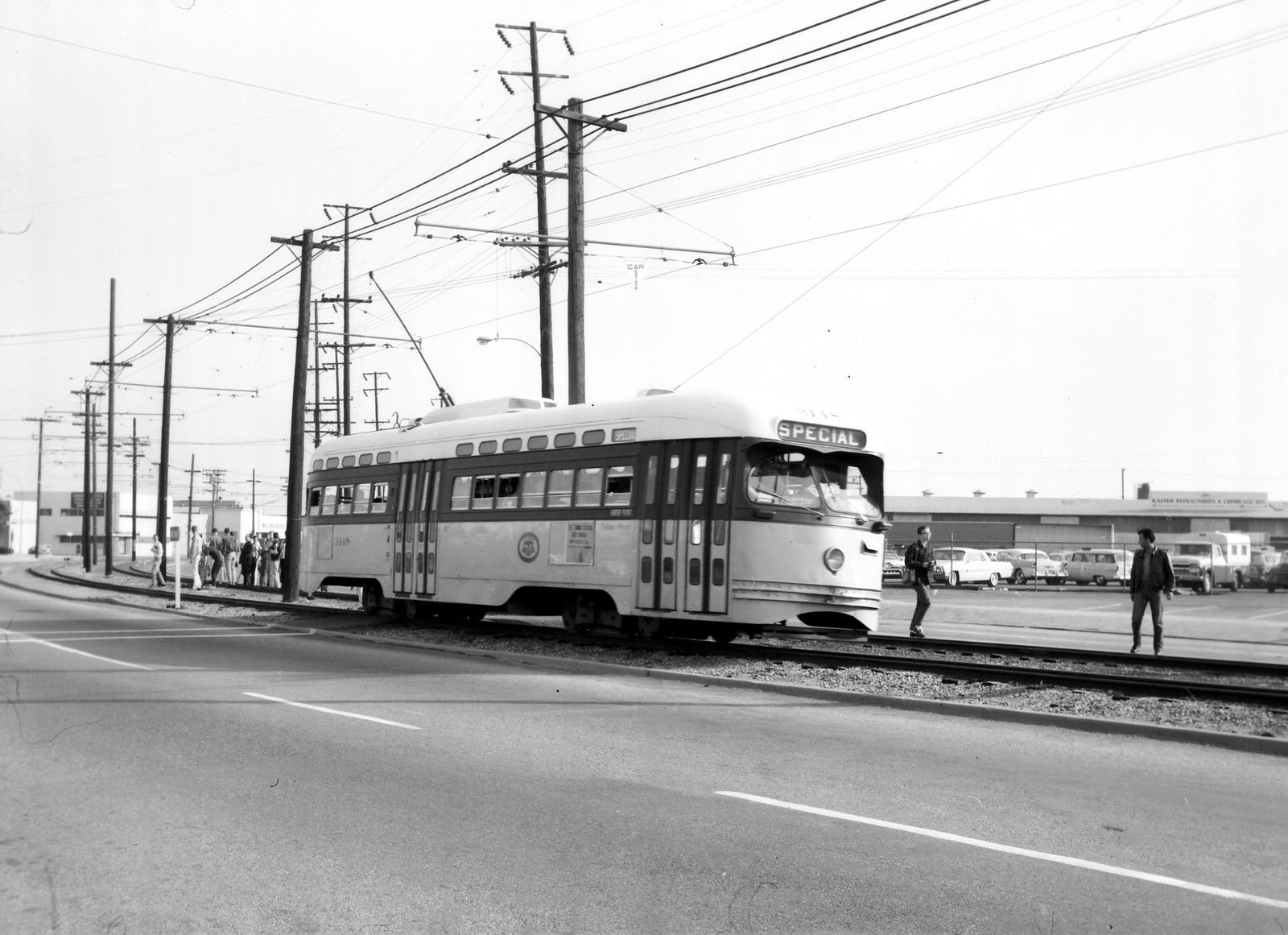
Ed Workman correctly identified the location in Post25587, but was off a bit on the date, an easy thing to do given the automobiles in the second photo. While this was a railfan excursion, it was not the Railroad Boosters trip of 1938, but rather the Southern California Electric Railway Association trip of June 16th, 1950. Note the light colored 1950 Pontiac convertible parked at the curb opposite the 950. Also, a color photo of Car 950 on that same trip can be seen here under the title 950 on Eagle Rock Boulevard:
http://www.pacificelectric.org/category/los-angeles-railway/5-line/
As Ed noted, the trackage on Lamar Street terminated near SP’s Lamar Street Roundhouse and Los Angeles General Shops. This trackage was operated as a shuttle service for SP employees and the dash sign did not carry a number or letter route designation, merely S.P. Shops, as seen on this sign in my collection. Also, not that there is no route designation in the square box on the roof, as this car was not in regular service on this day.The V-Line sign was added by one of the fans. In answer to
Lorendoc's questions, 1., these were two sided signs. The reverse usually designated a "turnback" car that would terminate it's run short of the end of the line. The signs would be swapped by the operator at each end of the line when the car reversed its direction, although it was not uncommon for a sign to be carried at each end eliminating the need to swap ends. 2., The photo of 950 on the single track is taken near the end of the Larmar Street trackage. SP Workers would disembark here and walk to the roundhouse and shops.

Perhaps the most unique and noirish thing about the two photos is the 950 herself. She is a one-off car classified as Type E, and was originally one of two LARY funeral cars, Descanso (Peace) and Paraiso (Paradise). These two cars swapped names over time and this is explained on the Orange Empire Railway website.
Prior to wide spread use of the automobile, many street railways offered Funeral Car services to cemeteries along their routes. The Descanso was built by LARY in August 1911 with two compartments, one running crosswise behind a separate motorman's compartment at the front of the car for the deceased's casket and immediately behind a second for the mourners. Luxuriously appointed in a chapel atmosphere with plush seats and stained glass windows, Descanso and Paraiso would often make as many as seven trips a day to the cemeteries along the system. However, This service was terminated in 1921 as automotive hearses came into vogue. In January 1922 LARY converted the Descanso into a PAYE (Pay As You Enter) “passenger” car by replacing the plush seats with wooden ones, removing the casket section and elegant stained glass and repainting the car from it’s original light gray into standard LARY Yellow. However, passengers were quick to recognize it as the old Descanso and refused to ride it!
In June of 1924 it was shopped a second time and given the appearance seen in these two pictures. At that time she was given the number 950 and designation Type E. She thereafter served mostly on the 5-Line until being sold for scrap on April 2, 1951, and taken to Terminal Island in July of that year to “give up the ghost”.
On July 3, 1940 the Paraiso was donated to the Railroad Boosters as Descanso and moved to Summit, California and placed beside the Santa Fe mainline for use as a clubhouse. She remained at Summit until 1967 when she was taken to the Orange Empire Railway museum and restored to her original appearance. See:
http://www.oerm.org/collection/yellow-cars-la-railway/lary-descanso
Cheers,
Jack


 revious: AlvaroLegido, I don't think there was a loop at the end of Lamar.




 )