ethereal_reality
Active member
oops. sorry
Last edited:

 revious: Thank you for the information Stage Squint.
-another man and his newspaper, this time in Westlake Park, circa 1905

ebay
I can't figure out where in Westlake Park this was taken.
Is it just me, or does the statue to the left of reading man resemble a golem with outstretched arms?
_


McPherson arrived in Los Angeles in 1918 with her children and her mother, who helped run the temple for many years. (They eventually parted ways when, in an argument about church business, Aimee punched Minnie and broke her nose.) The preacher's healthy ego (at age 20, she wrote a 686-page autobiography) grew with her fame. Predictably, so did her loneliness. Her own church doctrine, the Foursquare Gospel, prohibited remarriage during the lifetime of a former spouse; but McPherson, a voluptuous woman (who, as Sutton describes, put some carnality into the biblical metaphor of the Church as the Bride of Christ) had a number of dalliances before her eventual, and failed, third marriage. http://articles.latimes.com/2007/may/06/books/bk-gross6
In 1926, when she disappeared for more than a month, the New York Times published almost 100 stories about the saga -- about the same number devoted the previous year to the Scopes trial. Her career probably could not have happened anywhere but in Los Angeles: Johnny Mercer's lyrics for "Hooray for Hollywood" boasted that "anyone at all from Shirley Temple / to Aimee Semple is equally understood." Yet she had powerful critics: Sinclair Lewis, Upton Sinclair and Frank Capra made scathing fictional treatments of McPherson. http://articles.latimes.com/2007/may/06/books/bk-gross6


1914 ?? (Still relying on Equine Power!) Station No. 14 3401 S. Central Avenue (Is it really '14? DWP suggests structure was used from 1900-02 as Chemical Engine Co. No. 2, and then from '02 to '19 as Company No. 14.
http://catalog.library.ca.gov/exlibris/aleph/a19_1/apache_media/4R3UXS472BICNMELMBA1GJK4M5SV5I.jpg
A meeting of the American Association for the Advancement of Science at the California Institute of Technology in the 1920s or 1930s. View 1: group photo shows Albert Einstein standing in the middle, wearing a dark suit. View 2: group photo shows Albert Einstein (left), shaking hands.
 revious:

After discovering this thread, one thing that kept bringing me back (and motivated me to contribute) was the polite, almost genteel feel of Noirish Los Angeles.
Following up on my recent Santa Fe Avenue post, here are a few more shots from that weekend. Presented in monochrome, to capture the Noir mood.
Acme Wiping Materials Co. Filtering waste and sterilized wiping -- why settle for less? 1327 Palmetto Street.


Is this picture supposed to show the raising of the first marker? If it's near the Plaza Church I'd expect to be able to recognize some of the buildings in the background, but I can't. Unless it's in the back of the church which might explain it. That whole block, pretty much, is a parking lot now.

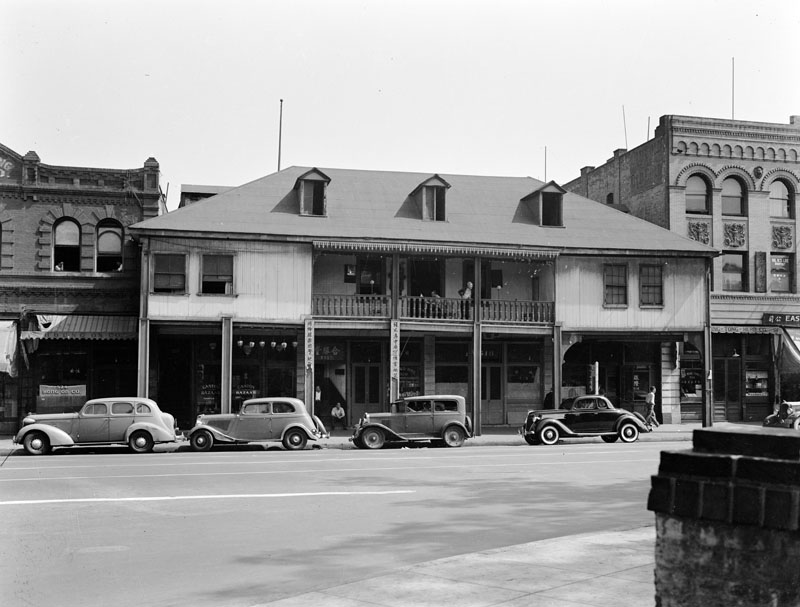


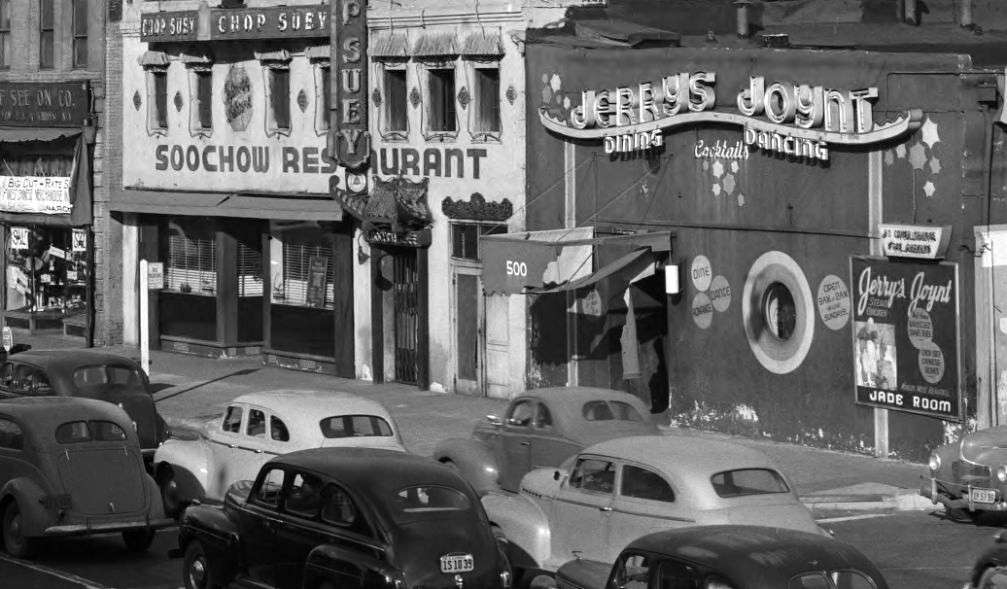


 revious: That list should be very helpful MR. It's fascinating to read as well.


Something a little off base, for you or anyone else familiar with the various "passes" between LA proper and the Valley. Aside from Cahuenga Pass, did any of the other passes have street cars - on tracks? (Not referring to America's first Trackless Trolley.) The question is prompted by an "Elder's" recollection of street car traffic either on Benedict, Coldwater, or Franklin Canyon. I have consulted the usual maps, but do not see any of the passes (except for Cahuenga) marked. That doesn't mean the trolley traffic wasn't tried, even experimentally, but I don't recall seeing anything about this.
There might be a slight "sliver" of truth to this thought because there are references to a Coldwater Canyon Line and evidence of what looks like a spur line to the mouth of Coldwater, but not clear there were tracks that led "up and over".
I'm almost certain there was never any kind of public transit through the canyon. I see what looks like a spur on a 1912 PE system map, but from remembering that the main line of tracks through the area ran along Santa Monica Boulevard, this spur must have run up only to about where Sunset and Beverly Drive meet today. There wouldn't have been enough people living in Coldwater or the Valley to justify a rail line when PE was still building them.


A happy luncheon honoring Albert E. (Could the same touchup artist who worked on Aimee's Manhattan Pl home have applied the same talent to some of these luncheneers?)
http://jpg1.lapl.org/pics40/00039972.jpg
 revious:

http://www.thaddeuslowe.name/MLEchohouse.htm
My parents used to take us up there when we were little, it was a pretty long hike, but not too difficult. Seems the hotel was owned by the owner of the railway, Professor Thaddeus Lowe.