What cities are Midwest


I think it's very clear
eek.gif
 
I live in Oklahoma City, and we all consider ourselves midwest. I rarely meet someone who thinks we're southern.
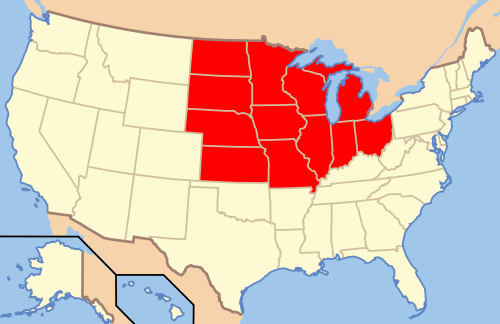
Most midwesterners consider the midwest to end along the Ozarks in Missouri, which isn't too far south and southwest of St. Louis, and somewhere not to far south of KC. I'd have to agree with them, as I start seeing cowboy hats, etc, and the climate starts noticeably shifting in Missouri - deeply hot summers and somewhat frequent mildish winter days here and there. Most people around here and east/north would lump Oklahoma in with Texas as being south-central or southern plains.

500px-Map_of_USA_Midwest.svg.png


I'd agree with that map with the caveat that far SE Missouri is Dixie. The Ozarks are more like Appalachia.

This map is basically correct. I have lived in Michigan my entire life and traveled extensively. Michigan is in the midwest and Detroit is a Midwestern city. You can basically say any state with a college in Big 10 country is the Midwest. lol. So Michigan, Ohio, Indiana, Illinois, Iowa, Wisconsin, Nebraska, Minnesota Missouri and maybe the Dakotas. The only one that I would not include is Pennsylvania. Anything west of that is the West. Anything south is the South. lol. Oh, and Kansas.
 
Last edited:
I appreciate the map. Being a westerner, I knew roughly where the midwest was, but not exactly. Nice to finally get a little better understanding.
 
I have driven through all of those states and there is a distinct difference between the east Midwest and the west Midwest (separated by the Mississippi. The eastern states, Michigan, Ohio, Indiana, Illinois, Wisconsin and Minnesota are all still heavily forested with lots of large cities. West of the Mississippi always seems more open with an even greater agricultural and less industrial identity. Michigan is very distinct because so much of its identity comes from the great lakes. I think part of the reason it is hard to identify Midwestern states because they very so much more varied than people who live outside the region understand.
 
Last edited:
sort of. most of illinois and indiana north of Indy seem very wide open. missouri has lots of woodlots, and of course huge national forests south of I-44/sw of st. louis which has a completely different character than most of the midwest. minnesota is like missouri in a way with a mix of thick forests and farmland. iowa is pretty agricultural obviously. rural illinois north of I-70 and east of the illinois river (or away from the mississippi valley) often feels like a giant industrial scale agricultural machine.
 
The most out of place city I hear called midwestern is Pittsburgh. It isn't an "east coast" city per se, but it certainly isn't midwest. Its kind of its own place, the only major city in the middle of Northern Appalachia.
 
A forest cover map, for reference, so no one has to guess:

map1_forweb.gif

Globalforestwatch.com

Illinois is, indeed, mostly cleared, as is much of western Ohio. It's also pretty clear that Michigan, Wisconsin and Minnesota have northern lands that remain pretty heavily forested. I know in Michigan, at least, it'ss because much of the state consists of soils and climate that don't lend themselves to intensive agricultural usage relative to the areas south and west. We've got a very heavily agricultural area based off Saginaw Bay that travels southwest to around metropolitan Lansing, and a very narrow (but long) fruit belt along the coast of Lake Michigan. But much of the rest of the land used for agriculture is more scattered.
 
From a Canadian perspective, Manitoba is the only "Midwestern" type of province in Canada. It's a very different feel in Manitoba (feels like Minnesota, Illinois, Iowa, etc.)than the other two Prairie, or "Plains" Provinces, which feel more like eastern Montana and Wyoming, western North and South Dakota, etc.
 
I would say windsor, ontario has a somewhat Midwestern feel to it, given its location and proximity to Detroit, Michigan, Ohio and Indiana. We are still very Canadian though!
 
Pittsburgh is not midwest nor is Salt Lake City. Classic midwest cities are Tulsa, Oklahoma City, Chicago, St. Louis, Kansas City, Dayton, Cincinnati, maybe Dallas, Lexington, and Louisville.
 
Illinois is, indeed, mostly cleared, as is much of western Ohio. It's also pretty clear that Michigan, Wisconsin and Minnesota have northern lands that remain pretty heavily forested.

A little quibble:

Illinois, Indiana, extreme western Ohio and the southwest half of Minnesota have not been "cleared" or deforested. Their native, pre-settlement state is tallgrass prairie, more or less identical to eastern Kansas, Nebraska and Northern Missouri. In fact those lands have more trees than they have in human history. The primary change is that the prairies have been converted into cropland.

map.gif
 
I was born and raise in MI and we are definitely considered the midwest. I would also say that Minneapolis, Chicago, Detroit, Columbus, and Pittsburg are midwest. I always thought of the midwest as being the region that supported the industrial centers of Chicago and Detroit. The agricultural areas west of the midwest are the great plains.
 
A little quibble:

Illinois, Indiana, extreme western Ohio and the southwest half of Minnesota have not been "cleared" or deforested. Their native, pre-settlement state is tallgrass prairie, more or less identical to eastern Kansas, Nebraska and Northern Missouri. In fact those lands have more trees than they have in human history. The primary change is that the prairies have been converted into cropland.

map.gif

Late back to the party, but thanks for that correction. I was not aware of how wide-spread the tallgrss prairies were. I was under the incorrect assumption that Illinois had been far more forested.
 
Pittsburgh is not midwest nor is Salt Lake City. Classic midwest cities are Tulsa, Oklahoma City, Chicago, St. Louis, Kansas City, Dayton, Cincinnati, maybe Dallas, Lexington, and Louisville.

Wha? I've never, ever heard of Dallas being Midwestern. Tulsa, OKC, and Lexington definitely aren't Midwestern, either. Louisville? I know there's an argument for it, but, IMO, it's not a convincing one.

The real, indisputable, classic Midwestern cities are Detroit, Cleveland, Chicago, Milwaukee, Minneapolis–St. Paul, and St. Louis.
 
plains cities have unique characteristics for sure, kind of like hybrid southern-midwestern cities in a way. kansas city is a midwestern city with plains characteristics (so is indianapolis), tulsa is a plains-ish city with midwestern characteristics. plains cities dont have that deep, smoky urban history.
 
kansas city is a midwestern city with plains characteristics (so is indianapolis)

So is Minneapolis.

In a lot of ways, Denver is a Great Plains city overlaid with a strong, if recent, western culture.

It also bears mentioning a lot of the smaller Great Lakes and Western NY cities share a similar built environment to the rust belt/plains transition cities like KC, Omaha, Des Moines and Minneapolis. I'm thinking of Buffalo, Rochester, Toledo, Syracuse (and to some degree Detroit and even Cleveland).

I think what you are talking about its largely a function age and the relative importance of a given city's industrial history.

As I've mentioned earlier and elsewhere, though:

"Rust Belt" and "Midwest" are not synonyms, any more than "farmland" and "Midwest" are.
 
The Midwest to me has always been the Dakotas, Kansas, Nebraska, Missouri, Iowa, Minnesota, Wisconsin, Illinois, Indiana, Ohio and Michigan


Back
Top