
You are using an out of date browser. It may not display this or other websites correctly.
You should upgrade or use an alternative browser.
You should upgrade or use an alternative browser.
noirish Los Angeles
- Thread starter ethereal_reality
- Start date
- Status
- Not open for further replies.


Chuckaluck
New member
A&P Market, Circa 1930. Location? Citizen's Savings Bank sign suggests Hollywood. Source suggests the location may be in Vernon. Were there multiple Citizen's Savings Bank signs or am I confusing them with similar Hollywood/B of A/Security Pacific signs?

 CalStLib
 http://scripophily.net/cinatrsabalo.html
 http://currency.ha.com/c/item.zx?saleNo=141211&lotIdNo=11087
Citizens National Bank: From 5th and Spring to Script.
 http://scripophily.net/cefiprbucolo.html
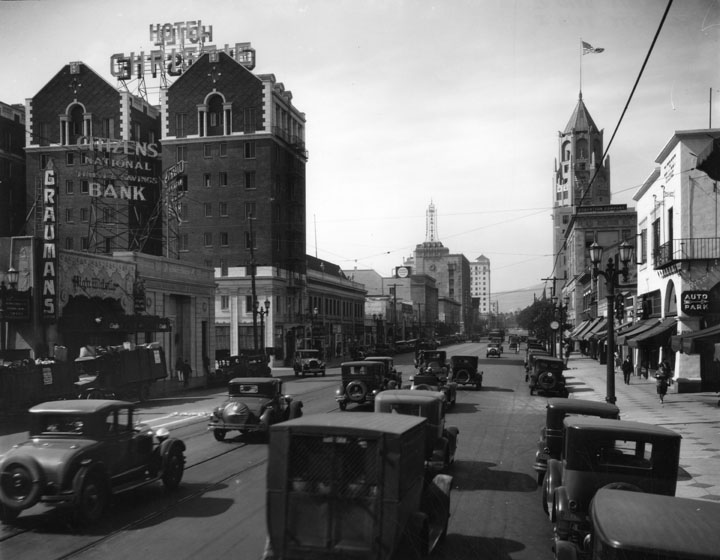 water and Power.org
Citizens National Bank: From 5th and Spring to Script.
Gerry Building (1947) Maurice H. Fleishman

I found very little:
Gerry Building (1947)
Maurice H. Fleishman, architect
Fleishman (9 Aug 1909-12 Sept 2009) both lived (1011 Lexington Road) and worked (333 S Beverly Drive) in Beverly Hills. He practiced for 48 years.
His rendering for the Joelli Building (1955), NE corner, S Beverly Dr & Gregory Way (since remodeled):

usc digital library
Looking (in vain) for more info on the Gerry Building....
I found very little:
Gerry Building (1947)
Maurice H. Fleishman, architect
Fleishman (9 Aug 1909-12 Sept 2009) both lived (1011 Lexington Road) and worked (333 S Beverly Drive) in Beverly Hills. He practiced for 48 years.
His rendering for the Joelli Building (1955), NE corner, S Beverly Dr & Gregory Way (since remodeled):
usc digital library
A&P Market, Circa 1930. Location? Citizen's Savings Bank sign suggests Hollywood. Source suggests the location may be in Vernon. Were there multiple Citizen's Savings Bank signs or am I confusing them with similar Hollywood/B of A/Security Pacific signs?
CalStLib
http://scripophily.net/cinatrsabalo.htmlhttp://currency.ha.com/c/item.zx?saleNo=141211&lotIdNo=11087
Citizens National Bank: From 5th and Spring to Script.
http://scripophily.net/cefiprbucolo.html
water and Power.org
One of Citizens Bank's founders (1890) was none other than Thaddeus SC Lowe, of Mt. Lowe fame. http://blog.wellsfargo.com/guidedbyhistory/2012/01/citizenship.html

http://forum.skyscraperpage.com/showpost.php?p=4650048&postcount=754
http://forum.skyscraperpage.com/showpost.php?p=4647420&postcount=745
Hollywood Ranch Market
Nice color noirish pic of the Hollywood Ranch Market, 1954, Vine Street between Fountain and La Mirada (Broadway Hollywood sign, center left margin):

dear old hollywood
And another showing the tell-tale roof of the former Mandarin Market:

findadeath
The Mandarin Market (M.L. Gogerty, 1928) went in a year after Mann's Chinese went up. It had a full-service market, bakery, restaurant and a Texaco kiosk:
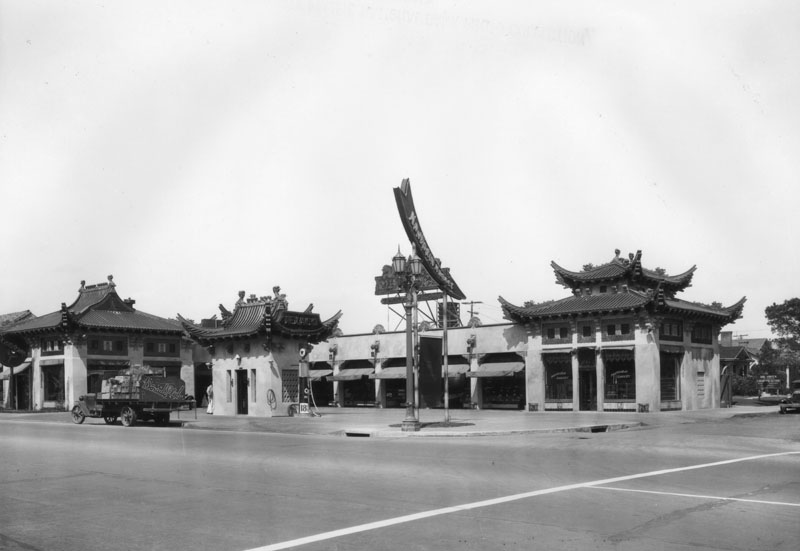
waterandpower.org
The Hollywood Ranch Market never closed; it had turnstiles instead of doors. It also had an automated doughnut machine one could watch through the front window. Almost twenty feet of machinery and conveyor belts that did everything from mixing the dough through delivering the finished product.
On his last morning, James Dean had coffee and doughnuts here while his Spyder was serviced at Competition Motors across the street at 1219.
The Hollywood Ranch Market was my local grocery when I lived in Hollywood not long before it closed forever.
ethereal_reality posted some great black & whites earlier:
http://forum.skyscraperpage.com/showpost.php?p=5338294&postcount=4160
Nice color noirish pic of the Hollywood Ranch Market, 1954, Vine Street between Fountain and La Mirada (Broadway Hollywood sign, center left margin):
dear old hollywood
And another showing the tell-tale roof of the former Mandarin Market:
findadeath
The Mandarin Market (M.L. Gogerty, 1928) went in a year after Mann's Chinese went up. It had a full-service market, bakery, restaurant and a Texaco kiosk:
waterandpower.org
The Hollywood Ranch Market never closed; it had turnstiles instead of doors. It also had an automated doughnut machine one could watch through the front window. Almost twenty feet of machinery and conveyor belts that did everything from mixing the dough through delivering the finished product.
On his last morning, James Dean had coffee and doughnuts here while his Spyder was serviced at Competition Motors across the street at 1219.
The Hollywood Ranch Market was my local grocery when I lived in Hollywood not long before it closed forever.
ethereal_reality posted some great black & whites earlier:
http://forum.skyscraperpage.com/showpost.php?p=5338294&postcount=4160
Love the pix of the "Safety Zones"------
Somehow I doubt if they would pass muster these days.....LOL
Somehow I doubt if they would pass muster these days.....LOL
Zenda Ballroom:

usc
DTLA streetlamps
When did we lose the great DTLA five-globe streetlamps?
When did we lose the great DTLA five-globe streetlamps?
BifRayRock
New member
A&P Market, Circa 1930. Location? Citizen's Savings Bank sign suggests Hollywood. Source suggests the location may be in Vernon. Were there multiple Citizen's Savings Bank signs or am I confusing them with similar Hollywood/B of A/Security Pacific signs?
water and Power.org
As bank signs go, B of A's Miracle Mile effort is "up there." (Jekyll's 5471 Wilshire Blvd. (Cloverdale) is listed in the '42 directory. What kind of business was it?)
1947
Same area looking west.
"Sitkin Furs - For the woman by a woman."
Who knew there were hills west of Ralphs?
BifRayRock
New member
Santa Monica's Miramar
http://www.miramar-redevelopment.com/#!__history-of-the-miramar
A postcard dream or two . . .
 cdlib.org

December 14, 1937
 Lapl
May 15, 1952 Miramar Dog Show featuring a boxer (J. Dempsey) and some boxers
 Lapl

 cdlib.org
1974
 lapl
 cdlib.org
A Dreamy Moreton Bay Fig Tree
 http://rentalo.com/64648/thefairmontmiramar.html
http://www.miramar-redevelopment.com/#!__history-of-the-miramar
A postcard dream or two . . .
December 14, 1937
May 15, 1952 Miramar Dog Show featuring a boxer (J. Dempsey) and some boxers
1974
A Dreamy Moreton Bay Fig Tree
Last edited:
BifRayRock
New member
BifRayRock
New member
May 21, 1945 - Frank's Nurseries in Santa Monica. Does Building still exist? (

Robert Goka's show-place flower and plant nursery, known as Frank's, fronts an entire block on fashionable Wilshire Blvd., near Santa Monica. The display shop features tropical plants. Goka says not a single pane of glass has ever been broken, although it is easy for the public to see through the large shop windows that the nursery is Japanese-operated. We have all the business we can handle, he adds. Goka was well-known at Manzanar, http://content.cdlib.org/ark:/13030/ft1r29n7bv/?query=santa%20monica&brand=calisphere


FredH
New member
When did we lose the great DTLA five-globe streetlamps?
ca. 1931) - Early 5-globe street light at Second and Hill Streets

water and power.org
tovangar2: If you are interested in the history of street lights in Los Angeles, this is a very good website:
http://waterandpower.org/museum/Early_Bureau_of_Power_and_Light_Streetlights.html

Flyingwedge
Active member
Wings of a Goose
On June 11-12, 1946, the two wings of the Spruce Goose were towed 28 miles at 2 mph from the Hughes Airport in Culver City to Long Beach, where the plane was assembled. Along the way, 2,100 power and telephone lines were moved.
Here in this LA Times photo are the two wings on June 11, just after they've been towed from the west end of the airstrip, across a dirt ramp, and onto southbound Lincoln Blvd:
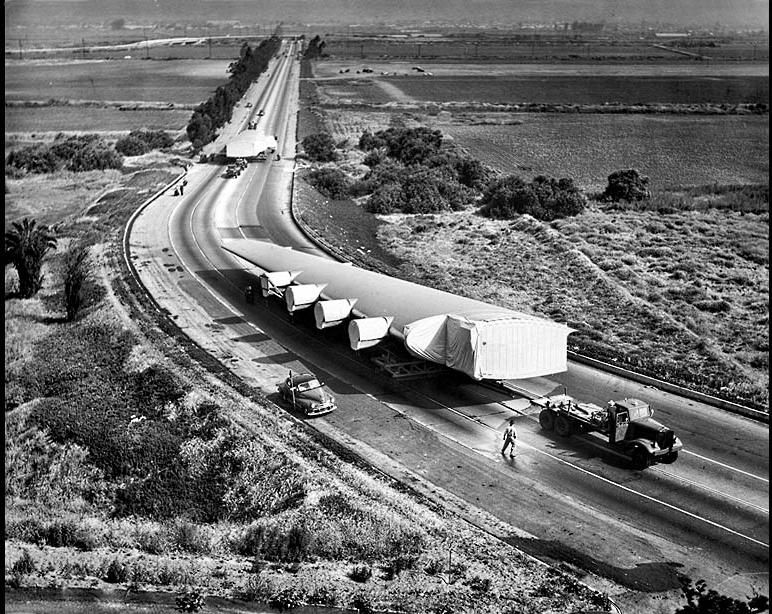
In the distance you can just barely see the Culver Blvd bridges over Lincoln Blvd and, to the left, over Ballona Creek. A little closer in is Jefferson Blvd, marked by the line of power poles. Left to right across the picture just north of the trailing wing appears to be a creek, or at least a ditch of some sort. (I remember seeing a culvert under Lincoln in about that spot with 1930 stamped in the concrete.) I'm guessing that's a remnant of Centinela Creek, which historically flowed along the base of the Westchester bluffs and was eventually put in a concrete channel and diverted into Ballona Creek further upstream.
Let's use ER's 1947 map to show where this happened. In the b/w photo the wings are about where the red circle is:
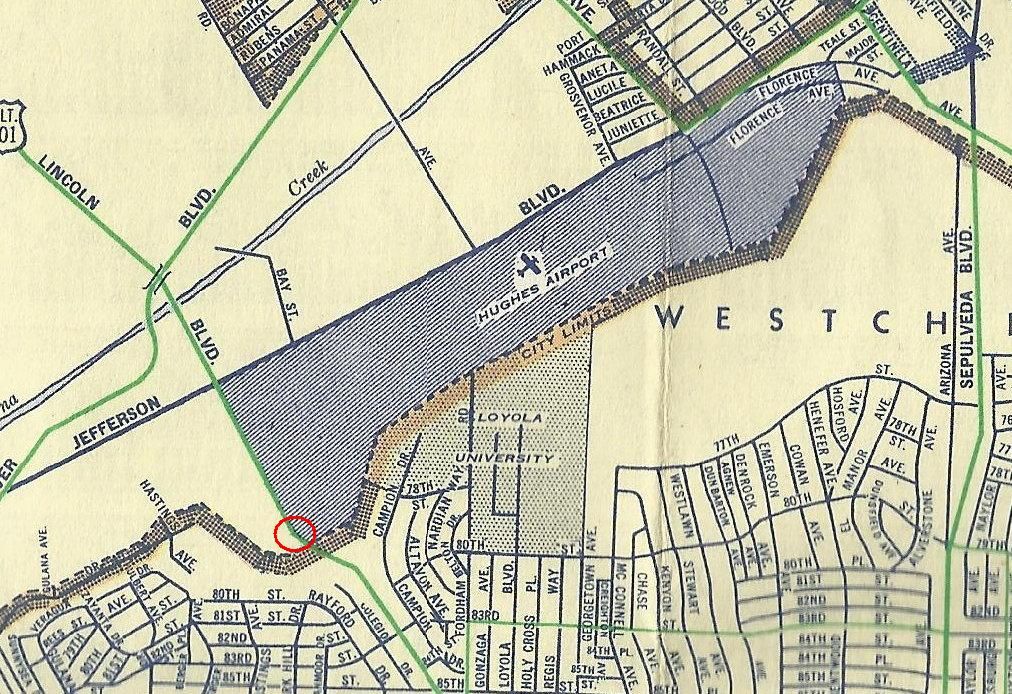
And the same view today:
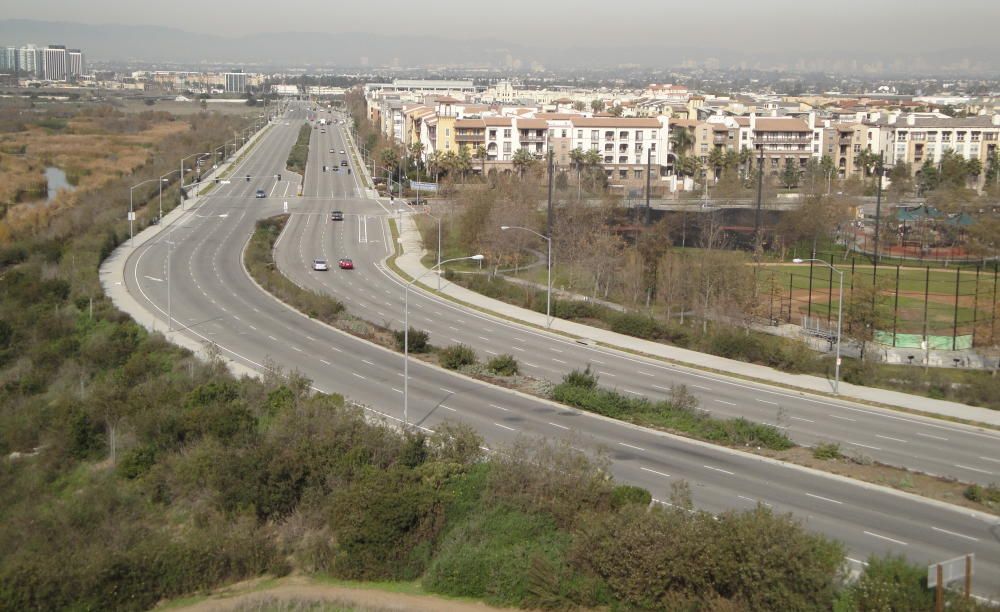
The highrises at upper left are Marina del Rey; the ballfield and sea of condos at right are part of Playa Vista, the development at the old Hughes Airport site. The water west of Lincoln (opposite the T intersection) is part of a manmade freshwater marsh:
http://www.ballonafriends.org/restoration_freshwater_marsh.html
More info and old pics at: http://framework.latimes.com/2012/10/09/1946-move-of-the-spruce-goose/#/5
Color photo by me
On June 11-12, 1946, the two wings of the Spruce Goose were towed 28 miles at 2 mph from the Hughes Airport in Culver City to Long Beach, where the plane was assembled. Along the way, 2,100 power and telephone lines were moved.
Here in this LA Times photo are the two wings on June 11, just after they've been towed from the west end of the airstrip, across a dirt ramp, and onto southbound Lincoln Blvd:
In the distance you can just barely see the Culver Blvd bridges over Lincoln Blvd and, to the left, over Ballona Creek. A little closer in is Jefferson Blvd, marked by the line of power poles. Left to right across the picture just north of the trailing wing appears to be a creek, or at least a ditch of some sort. (I remember seeing a culvert under Lincoln in about that spot with 1930 stamped in the concrete.) I'm guessing that's a remnant of Centinela Creek, which historically flowed along the base of the Westchester bluffs and was eventually put in a concrete channel and diverted into Ballona Creek further upstream.
Let's use ER's 1947 map to show where this happened. In the b/w photo the wings are about where the red circle is:
And the same view today:
The highrises at upper left are Marina del Rey; the ballfield and sea of condos at right are part of Playa Vista, the development at the old Hughes Airport site. The water west of Lincoln (opposite the T intersection) is part of a manmade freshwater marsh:
http://www.ballonafriends.org/restoration_freshwater_marsh.html
More info and old pics at: http://framework.latimes.com/2012/10/09/1946-move-of-the-spruce-goose/#/5
Color photo by me

Lwize
Member
A couple of interesting news bits from the LA Times this morning:
http://www.latimes.com/business/realestate/la-fi-property-report-20130114,0,293355.story
We've had pictures of the Palms Depot in here, right?
Any before/after pictures of the Commercial Exchange Building?
Work has begun on a $30-million apartment and retail complex in Palms near a planned station for the Expo Line that will connect downtown Los Angeles with Santa Monica...
Palms is near Culver City — where Expo Line service from downtown currently ends — and is one of the oldest neighborhoods in Los Angeles. The first Palms train station opened in 1875 and closed in 1953. The old depot was moved to Heritage Square Museum in Montecito Heights, where it is preserved.
Vacant downtown L.A. building for sale
A long-vacant 1920s office building in a recovering neighborhood of downtown Los Angeles has hit the market for almost $14 million as the city's historic core attracts new residents and investors.
The 13-story Commercial Exchange Building — which was once cut in half vertically and shrunk in size — has been mostly empty for at least two decades, real estate broker Phillip Sample of CBRE Group Inc. said. In recent weeks, however, more than 100 potential buyers have toured the property at 416 W. 8th St.
"We've got a lot of boutique hotels looking at this," Sample said.
Other possible buyers are considering turning it into apartments, creative offices or student housing.
The blocks east of Staples Center and the Los Angeles Convention Center have seen a flurry of real estate activity recently. More than 1,000 new apartment units are set for construction there over the next 30 months, and one of the largest planned retail and housing projects is across the street from the Commercial Exchange Building.
The building was completed in 1924 after that southern section of downtown Los Angeles was rezoned from an upscale residential neighborhood to commercial use, local historian Greg Fischer said.
"After World War I, the city fathers decided we needed a larger downtown," he said.
City officials decided to widen Olive Street in the mid-1930s, and the owners of the Commercial Exchange Building at 8th and Olive were obligated to remove a nearly 10-foot slice from the middle of the building. Engineers reunited the two pieces by sliding the western portion east, thereby opening up more space on Olive Street. The process cost $60,000, The Times reported in 1935.
Owl Drug Co. was once headquartered in the building, Sample said. Another occupant was "Tarzan" author Edgar Rice Burroughs, who operated his own publishing company.
That area of downtown fell out of favor in the decades after World War II as department stores followed their customers to the suburbs and white-collar businesses moved to newer offices closer to the 110 Freeway.
Selling the Commercial Exchange Building is a partnership called Spring Seventh Loft, Sample said. The sellers expect to arrange a deal by next month.
http://www.latimes.com/business/realestate/la-fi-property-report-20130114,0,293355.story
We've had pictures of the Palms Depot in here, right?
Any before/after pictures of the Commercial Exchange Building?
Lwize
Member


images - heritagesquare.org
Palms Depot
Overland travel by wagon, stagecoach or horse to the West, and Southern California in particular, was expensive and slow and trails were poorly maintained and badly mapped. With the arrival of the Southern Pacific in 1876, Southern California was transformed virtually overnight. The train offered a more efficient solution for hauling mail, freight and passengers. Farmers from the east and mid west were the first group courted by the railroad to settle the region. The railroad profited by transporting agricultural commodities across the country. Furthermore, Los Angeles was a paradise compared to cities in the east that seemed to be choking on factories and overcrowding. The railroad companies, the largest landowners in California and eager to sell more of it, was responsible in many ways for manufacturing an idealized version of the area’s assets and potential, what today we call the “California Dream”.
The cluster of low hills that laid about midway between Los Angeles and Santa Monica at first prevented the construction of a railroad line between the two cities. However by 1887, a new train depot stood overlooking a newly laid out grid of streets from the new subdivision called the Palms. This town was the only sign of urbanization between Los Angeles and the sea. A few years later the Palms Depot became part of the Southern Pacific rail system, and then in 1908 became electrified. The Palms Depot provided passenger and freight service until 1933 when the agency was transferred to Culver Junction, a mile to the east. "The Big Red (trolley) Cars" continued to stop at Palms until the line was discontinued in 1953. The station also served as a backdrop for many films, including shorts by Laurel and Hardy and The Little Rascals, and served for a time as a Boy Scout clubhouse. The Palms Depot was declared a historical monument in 1963; nevertheless, it fell into disrepair and was finally condemned. In 1975, S.O.S. (Save Our Station), a grass roots organization, succeeded in moving the depot to the museum, thus saving it from demolition.
The exterior and interior have been restored to their original Eastlake style. Today the depot serves as the Museum's Visitor Center and Store. Tours begin on the station platform.
http://heritagesquare.org/about/tour

GaylordWilshire
New member
Any before/after pictures of the Commercial Exchange Building?
"Before" pictures are harder to find than I would have thought. Here's an article on the opening of the building
in 1924; the second picture, also from that time, shows, if not too clearly, that there were 11 double windows
the length of the 8th Street facade..


The current picture below reveals the slice taken out of the fourth set of
windows (from Olive St)

Here's one from "in between"...

Last edited:
Water & Power Museum
Thx FredH, I know the W&P site. They show the lamps into the late 30's and then mention that a few were still around in the 50s. I was hoping to find out when the bulk of them went missing. Probably a post-war "progress" effort.
BTW everyone, I was chatting by email with Jack Feldman, the webmaster over at the Water and Power Museum, and he mentioned that that they rely on visitors to help them correct any mistakes on the site, as they have a very small staff. So, if one see's any inaccuracies in the 3,000 photo descriptions, please let him know. They really appreciate it:
[email protected]
ca. 1931) -
tovangar2: If you are interested in the history of street lights in Los Angeles, this is a very good website:
http://waterandpower.org/museum/Early_Bureau_of_Power_and_Light_Streetlights.html
Thx FredH, I know the W&P site. They show the lamps into the late 30's and then mention that a few were still around in the 50s. I was hoping to find out when the bulk of them went missing. Probably a post-war "progress" effort.
BTW everyone, I was chatting by email with Jack Feldman, the webmaster over at the Water and Power Museum, and he mentioned that that they rely on visitors to help them correct any mistakes on the site, as they have a very small staff. So, if one see's any inaccuracies in the 3,000 photo descriptions, please let him know. They really appreciate it:
[email protected]
- Status
- Not open for further replies.