
You are using an out of date browser. It may not display this or other websites correctly.
You should upgrade or use an alternative browser.
You should upgrade or use an alternative browser.
The Great Canadian Skyline thread for CMAs 1 million and under
- Thread starter sparky212
- Start date


Long live McKenzie seeds!
C
Cambridgite
Guest
Well Yellowknife does have a population under 20 000, and Kitchener is nearly double Peterborough. For a 500 000 CMA is is pretty lame. They must have one of the, if not the lowest tower per capita ratio of any greater area over 100 000 in Canada.
Keep in mind that, within the urbanized core, there are 5 downtown cores. I showed the 3 largest (the two others are in Cambridge). Rather than one core expanding out and consuming all the others, they more or less grew together. And even besides that, the tri-city area is very decentralized and expansive. Even if you forget about the downtown cores, there are numerous nodes of activity from regional shopping centres, power centres, intense retail strips, office parks, university districts, major apartment clusters. It's a pretty large place that the downtown photos alone don't do any justice to. Ironically, it feels like a much larger metropolitan area when you're driving around in the suburbs and could easily pass for the hustle and bustle of any suburban area around a large city like Toronto. I would say pretty much the only small town features about the area are the lack of an old, developed, solid downtown core.
Other non-downtown skylines.
Fairview Park Mall area off in the distance, looking from the eastside of downtown.

King/University - King/Columbia skyline. A cluster of apartment buildings to the north of uptown Waterloo and Wilfred Laurier University.

Victoria Hills skyline (the hood) in West Kitchener.


And don't take this as a negative spin on the whole area, just in the aspect of urban density.
Don't worry, I'm not one of the other Waterloo Region forumers who will remain nameless. :haha:

touraccuracy
Registered Loser
Edit: didn't see the other thread for suburbs http://forum.skyscraperpage.com/showthread.php?t=163085
Last edited:


Spocket
Back from the dead
Ultimately I wonder if Kitchener/Waterloo/Cambridge/Guelph isn't actually a better model even if by accident. With everything being more evenly distributed throughout the region , the classic North American urban planning problems are probably considerably less pronounced.
Cambridgite (and anybody else in that region) is this the case ?
Cambridgite (and anybody else in that region) is this the case ?

Distill3d
Glorfied Overrated Guest
But North Vancouver is Vancouver, it just has a separate government. Same thing for Burlington. It's part of the same urban area as Hamilton. It's basically a part of Hamilton that is separate from it by an imaginary line.
Burlington is part of both the GTA and Hamilton isn't it?

flar
..........
Burlington is part of both the GTA and Hamilton isn't it?
Yes it is. The GTA is made up of Toronto plus the regions of York, Halton, Peel and Durham. Burlington is in Halton Region so it is included in the GTA. Burlington is also included in Hamilton's CMA and Hamilton's UA (urban area) by Statistics Canada. Burlington is generally considered part of Greater Hamilton.

Aylmer
Still optimistic
Sarnia, Ontario

I'm really sorry, but that is the saddest skyline I have ever seen.

C
Cambridgite
Guest
Ultimately I wonder if Kitchener/Waterloo/Cambridge/Guelph isn't actually a better model even if by accident. With everything being more evenly distributed throughout the region , the classic North American urban planning problems are probably considerably less pronounced.
Cambridgite (and anybody else in that region) is this the case ?
Depends what you mean be "the classic North American urban planning problems" (maybe you could specify). We certainly have the problems of urban sprawl, traffic congestion, and car dependance no less than most Canadian cities. I think it actually makes it even harder to pull off a functional transit system when you don't have one downtown core with a very large number of people working there. The largest is downtown Kitchener with only 12,000 workers (though will probably be around 16,000 when the Lang Tannery is renovated and moved into). However, one kind of accidental stroke of luck we have is that we have many major destinations forming a line. This is the impetus behind the current iXpress bus service and future LRT line. So while downtown Kitchener may not warrant an LRT line in itself, it lines up with 2 or 3 other downtowns (depending on the route chosen), 2 or 3 major indoor malls (depending on the route chosen), 2 universities, another major activity area, and 1 or 2 hospitals (depending on the route chosen). Collectively, this builds a spine that has a lot of potential to be built onto further. Think of the Yonge Street corridor in Toronto or Peachtree Street in Atlanta, but less significant.
Another consequence of this urban form is that you have a region with a less cohesive identity. On one hand, this adds more interest to the Region than a single downtown, inner city, with suburbs around it. On the other hand, people in the different cities don't see themselves as relating to their neighbour cities as much (whereas Burnaby is an obvious suburb of Vancouver). If you take Cambridge for example, most people in Cambridge do their shopping and other regular errands in Cambridge and don't venture further than the very southern parts of Kitchener very often unless they happen to work there or have some other extenuating circumstance (maybe if there's a concert or they're visiting friends, etc). In my case, I wouldn't know a great deal about the other neighbour cities if I wasn't doing my schooling in Waterloo. Even with Guelph, I barely ever go there, but I do know people who commute to school there, go to Guelph bars and clubs, and work in Guelph. However, they are in a separate regional municipality, so our transit systems are not co-ordinated. The hope is that GO transit can take on that role as they move west from the GTA.

sparky212
Member
I'm really sorry, but that is the saddest skyline I have ever seen.
It looks better if you go to the boat launch. But it's still sad for a city that size.:haha:


Distill3d
Glorfied Overrated Guest
I'm really sorry, but that is the saddest skyline I have ever seen.
then you've never seen Grande Prairie...

photo source: google earth.
Last edited:
flar
..........
At least Sarnia has a decent highrise, Kenwick Place.
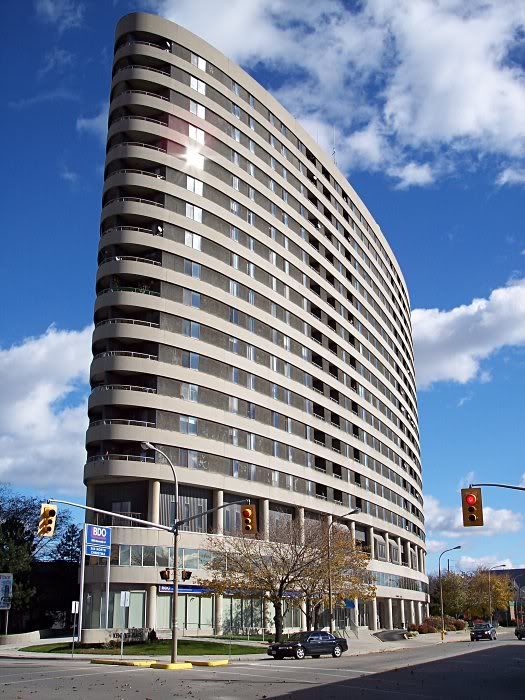
There are really no tall buildings southwest of London (other than Windsor of course). There are a few "high rise" apartments in Chatham and Wallaceburg but I don't think any of them are more than 12 storeys. So Sarnia has a kick ass skyline for that part of the country.
There are really no tall buildings southwest of London (other than Windsor of course). There are a few "high rise" apartments in Chatham and Wallaceburg but I don't think any of them are more than 12 storeys. So Sarnia has a kick ass skyline for that part of the country.

Elmira Guy
New member
Brockville, Ontario, Pop. 21,000. I think it has a pretty decent "mini-skyline" for such a small city. It is a really nice place too.


Nice pics!
I did my teaching placement in Brockville. I thought it was a nice little city too!