Winnipeg | Downtown Developments & Discussions


Maybe MMF can pry one of the lots along Main St away from their current owners. Maybe the land next at 416 Main or near the former Earls.
 
Maybe MMF can pry one of the lots along Main St away from their current owners. Maybe the land next at 416 Main or near the former Earls.

My personal first choice is that lot on main street. Right next to P & M, adjacent to the east Exchange, walking distance to Blue Cross Park (and a slightly longer walk to The Forks). I would think it's a natural, but then again I don't have a few $million lying around to invest in it.
 
Hopefully near the Sutton so they can show them what a real hotel is supposed to look like. Maybe the lot across from the RBC Convention Centre

I hate that parking lot. Unfortunately the brass and union for Workers Comp will never give up access to their precious, heavily subsidized surface parking.
 
There's 2 ways that workers comp lots gets developed.

1. They move.
2. The property is developed with a parkade for comp people, at no cost to comp.
 
Winnipeg, police and downtown crime
By: Editorial
Wednesday, Sep. 16, 2026

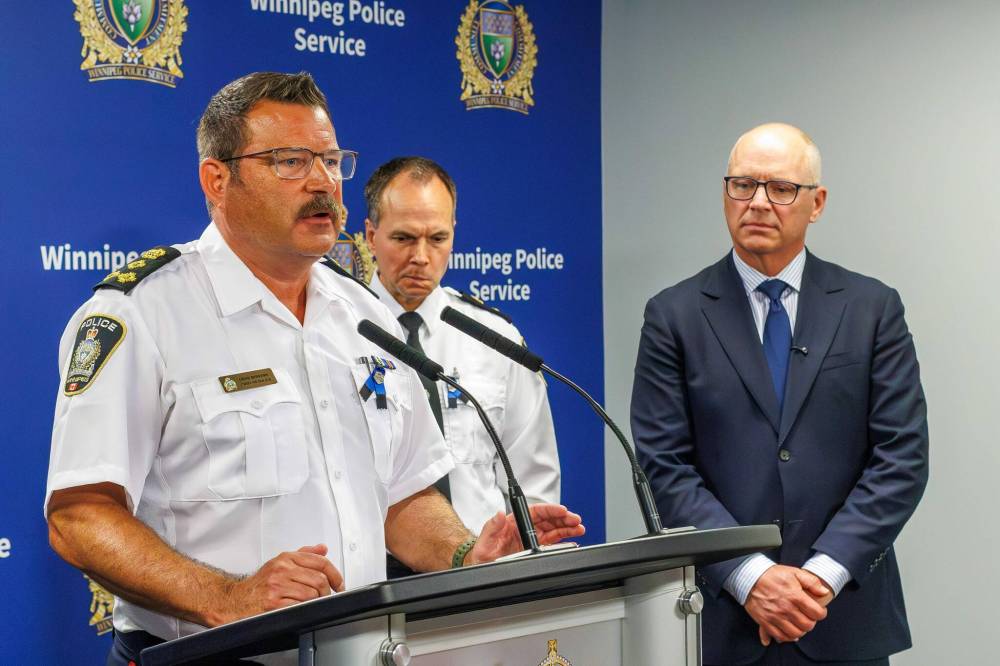
4556767_web1_260626-Police-0034.jpg

MIKE DEAL / FREE PRESs fileS

Winnipeg Police Chief Gene Bowers


A safer downtown is not much use if people are still afraid to walk there.

That is the uncomfortable message from Winnipeg’s latest police citizen survey, and one city council should take seriously.

Downtown crime has fallen this year, according to the most recent police statistics. Violent crime is down even more. But for most Winnipeggers, the downtown still feels like a place to avoid, particularly after dark.

Only 44 per cent of survey respondents said they feel very or reasonably safe walking alone downtown during the day. At night, that number plunges to just eight per cent. Among women, it is an appalling three per cent, compared with 14 per cent of men.

Police Chief Gene Bowers says overall downtown crime has decreased 10 per cent year-to-date and violent crime has fallen 19 per cent.

Those are real improvements. But they are improvements from a troubling baseline, not evidence that Winnipeg has solved its downtown safety problem.

The city’s violent crime severity index was 170.06 in 2025, according to Statistics Canada. It was lower than in 2024 and 2023, but still far above the 125.98 recorded a decade earlier.

Crime can be falling and still be far too high.

Meanwhile, the survey also showed most people — 57 per cent — said Winnipeg has too few police officers. Just four per cent said there are too many.

The police service’s own staffing numbers bear out that concern.

Winnipeg had 166.8 police officers per 100,000 residents in 2025. That was slightly higher than the 164.8 recorded in 2024, but was the second-lowest ratio in the past 20 years. The peak was 210.4 officers per 100,000 in 2013.

Bowers has asked the city for more officers, including 36 additional members to staff two more cruiser cars. But so far, council has not approved that new funding (pay attention, mayoral and council candidates!).

Public safety is one of the most basic responsibilities of municipal government. That does not mean more police will solve every problem downtown. Police cannot arrest their way out of homelessness, addiction, mental illness or poverty.

The province must do more on health care, housing and social services, and Winnipeg needs to continue supporting non-police responses to people in crisis.

But those realities are not an excuse for understaffing the police service.

In fact, the survey provides another reason to strengthen it. Ninety-three per cent of respondents said a quick response to calls for service is very or extremely important. Yet only 44 per cent rated WPS excellent or good on its response time.

When officers are stretched thin, they spend more time answering calls and less time doing proactive policing.

Response queues grow, foot patrols become harder to maintain and investigations compete with emergency calls. The public sees fewer officers and wonders where they are.

City hall continues to talk about revitalizing downtown. But there is little point in approving plans to attract more people to the core if those people don’t feel safe being there.

The Downtown Community Safety Partnership and Downtown Winnipeg BIZ are doing important work. The increase in police foot patrols are crucial.

But none of it changes the central message from the survey: Winnipeggers remain deeply uneasy about downtown safety.

The objective should not be merely to produce better crime statistics. It should be to create a downtown where people actually feel safe enough to live, work, shop, visit and walk around after dark.

A safer downtown cannot remain a promise, a strategy or a statistic.

It has to be something Winnipeggers can actually feel.
Winnipeg Free Press
 
The editorial reprinted here is, of course, one person's opinion. Aside from the usual "more must be done" vagary one often reads in editorials, plus the misleading suggestion that the police are somehow saying that Winnipeg has "solved" it's downtown crime problem, I think there's something here that deserves a closer look.

The writer claims to speak for Winnipeggers "feelings" towards downtown, and in a broad sense they probably do. What I would like to see is a "dissection", if you will, of those feelings.

What has caused those feelings of a lack of safety? Are they based on personal experience, the experiences of friends or associates, or on general perceptions?

If based upon experiences, what were they? Did just the the sight of a dishevelled person cause the anxiety, or was there some personal interaction? Did the person ask for money? Were they aggressive or passive? Was your personal safety directly threatened?

I'm sure a broad survey of people would show some "yes" answers to all these questions, but the actual proportions would be interesting to see.

My point is that many people seem to trust their "feelings", despite the fact that our feelings are often incorrect. I'm sure we can all look back on circumstances where our feelings told us someone "loved" or "hated" us, and they turned out to be completely off-base.

We can't dismiss our feelings; they tend to guide our actions, for good or ill, throughout our lives. What we can do, however, is take a moment to see if our feelings jibe with the reality around us. As it applies to the downtown, are the "feelings" the editorialist cites based on reality or perception, and what has formed those perceptions? It would be an interesting study.
 
The reimagined Air Canada “Window” Park integrates green infrastructure as a fundamental part of the park's environmental performance, social function, and long-term resilience.

These elements support the project's broader vision of creating an inclusive urban gathering space while responding to climate, stormwater, and ecological challenges in our urban condition.

5wSVWcd.jpeg


uLW7yIL.jpeg
scatliffmillermurray
 
At first I was disappointed with the MMF walking away, because they done a great job with so many downtown buildings. But the silver lining for me in the article is that the Fort Garry hotel still has value. So many historic buildings are not worth anything and in horrible shape. Owners struggle to sell them, give them away (like the Bay), or repurpose them. Goods news is that the Fort Garry hotel continues to be desirable both locally and internationally.

I’m very happy they were outbid. Fort Garry needs a hotel specialist with deep pockets and an international flag. MMF building a new hotel would be great. I wish they would buy the Marlborough and make it a hotel again. They often used the beautiful banquet rooms for their meetings before it closed.
 
Bloomberg Featured Project

PWzUMUJ.jpeg


Winnipeg, Manitoba
Reclaiming a downtown corridor for walking, gathering, and play


fGuQwBY.jpeg


Neighborhood: Downtown

Number of Interventions: 4 blocks

Installation Dates: June 30 – July 14, 2025

City-Designated Partners:
Cool Streets
Downtown Winnipeg Business Improvement Zone
CentreVenture Development Corporation
City of Winnipeg
City-Designated Artists

Artistic Director: Stéphane Dorge

Lead Artist: Takashi Iwasaki

Mural Artists: Architects at Play (Joseph Orobia, Karen Umandal), Marc Kuegle, Alex Plante, Kal Barteski, Kale Sheppard, Laura Lee Harasym, Mike Zastre, James Culleton

Square Footage of Artwork: 24,000

Cost
Design: $12,250

Labor: $77,750

Materials: $25,000

The Project
Re-imagining Graham Avenue involved a fast-paced street mural project that transformed a bus corridor into a pedestrian area, with park-like features and festival space. Eight murals, tied together by the work of a lead artist. The street murals were installed on four city blocks over a two-week period in July 2025. Colourful murals (with a palette reflecting many different partner organizations and businesses) brought to life approximately 24,000 square feet of road space, and helped temporarily transform the road into animated pedestrian space where people can walk, bike, eat and play on Graham.

Best Practice Highlight: Partnering for Success
The Re-imagining Graham project was led with partnerships in mind. It brought key stakeholders and their connections to the table to find creative ways to animate the street. This included lighting, seating, placemaking competition, street furniture, games and of course, street paint. For the street paint portion of this project, the artists worked collaboratively with a project manager, Stéphane Dorge, to guide the process, as well as and a lead artist, Takashi Iwasaki,. For such a large site, collaboration, teamwork and partnerships were crucial to doing the best with what we had.

Before:
wKp6MzA.jpeg

After:
wDjaksh.jpeg


"It’s great to see a Graham Avenue that is more colourful, more dynamic, more pedestrian-friendly. This funding helped us make some quick changes and take the first steps toward a long-term vision of making Graham one of downtown’s signature streets."
Mayor Scott Gillingham

"I hope that people see this project and say, ‘Yes, this makes sense, this street should be a place for people, both now and in the future.’ Downtown is worth the investment, and this project is helping people see that."
Karin Kliewer, Senior Planner, City of Winnipeg

EM5FhEB.jpeg


wIK9gOK.jpeg


6lNWOmt.jpeg


Ldyu4OL.jpeg


hiDE955.jpeg


X6I7XTv.jpeg


ccL1ZjU.jpeg


miKFP6j.jpeg


1bnMCtj.jpeg


hJnJDOv.jpeg

Bloomberg


Back
Top