
Carboy15
CanAutoroute1
https://www.brandonsun.com/local/20...ill-include-brandon-on-winnipeg-regina-routes
Disgression Alert: Canada Transit Renaissance???
Disgression Alert: Canada Transit Renaissance???

https://www.brandonsun.com/local/20...ill-include-brandon-on-winnipeg-regina-routes
Disgression Alert: Canada Transit Renaissance???

Free PressProvince must resume role in transit funding
By: Editorial
Tuesday, May. 12, 2026
Opinion

MIKAELA MACKENZIE / FREE PRESS FILES
Public transit is an essential service for many people.
For a province that claims to be serious about fighting climate change, reducing traffic congestion and building more livable communities, Manitoba’s approach to public transit makes very little sense.
The provincial government has found room in its budgets for broad-based tax cuts on gasoline and groceries — measures that disproportionately benefit higher-income households — yet it continues to leave Winnipeg Transit largely on its own financially.
That needs to change.
The Kinew government should restore the 50/50 transit funding agreement with the City of Winnipeg, a long-standing arrangement scrapped by the former Progressive Conservative government in 2016.
Under that model, transit operating costs were shared equally between the province and the city.
Its cancellation was penny-wise and pound-foolish. A decade later, the consequences are showing up every day at bus stops across Winnipeg.
Transit service has deteriorated. Riders routinely deal with buses that don’t show up, overcrowded buses that pass them by and unreliable schedules that make getting to work, school or appointments unnecessarily stressful.
Even the city’s much-publicized new transit network, implemented last year, failed to solve the core problem because it reshuffled routes and eliminated hundreds of bus stops without adding the resources needed to improve service.
You can redesign routes all you want, but if there aren’t enough buses, drivers and operating dollars behind the system, riders will still be stranded.
That frustration was on full display Saturday at the Manitoba legislature, where more than 100 demonstrators gathered to call for better transit funding.
Organized by Climate Action Team Manitoba and the Amalgamated Transit Union, the rally featured a simple but powerful message: more buses, more routes and more reliable service.
Public transit is not a luxury service, it is essential infrastructure. For many Winnipeggers — particularly students, seniors, low-income residents and people with disabilities — public transit is their primary connection to jobs, education, health care and daily life. When buses are unreliable, those residents pay the highest price.
The province often talks about reducing greenhouse gas emissions. Transportation is one of the largest contributors to emissions in Manitoba. If government genuinely wants fewer cars on the road, it must provide people with a realistic alternative.
Reliable public transit reduces congestion, lowers emissions and cuts wear and tear on roads and infrastructure.
But the City of Winnipeg cannot shoulder the burden alone.
Winnipeg will spend roughly $128.6 million on transit operations in 2026, increasing to $133.8 million in 2027, excluding fare revenue. Provincial operating support, meanwhile, has remained flat at about $42 million since 2017. Adjusted for inflation, that’s a funding cut.
The province deserves some credit for dedicating about $10 million in its 2026 budget to provide free transit for kindergarten to Grade 12 students in several Manitoba communities, including Winnipeg. That policy may help families with costs and encourage younger people to use transit.
But free fares are of limited value if buses are late, overcrowded or absent altogether.
Governments reveal their priorities through spending decisions, and right now Manitoba is prioritizing politically popular tax cuts over long-term investments in public infrastructure.
Broad-based tax reductions on gasoline and groceries may generate headlines, but they are poorly targeted tools for affordability. Higher-income households benefit the most because they spend more on fuel and consumer goods. Meanwhile, those tax cuts drain public revenues that could be used for more pressing needs.
Restoring 50/50 transit funding would not solve every challenge facing Winnipeg Transit overnight, but it would represent a serious commitment to building a transportation system that is reliable, accessible and capable of meeting the needs of a growing city.
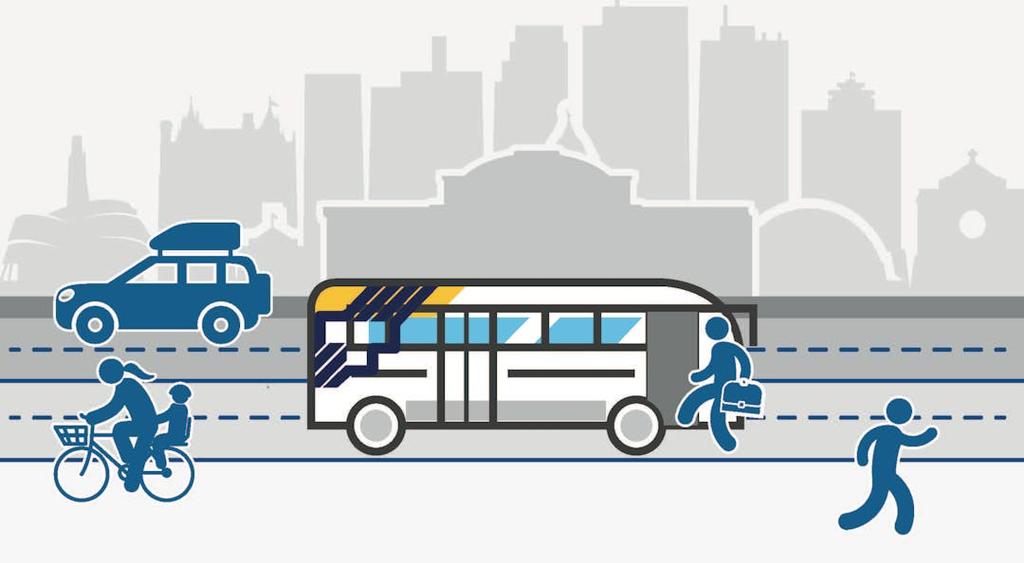


The only way rapid transit can work down St. Mary's without causing traffic Armageddon or bulldozing half the Norwood/Old St. Vital neighbourhood would be to tunnel under or build an elevated transit way.
St. Mary’s Road / Downtown Corridor Study
Transportation2050 identified that some transportation corridors will need to change to take on new roles and new demands within the network, whereas other corridors will require some level of infrastructure upgrades to accommodate increased traffic, even with the impending shift to greater use of sustainable modes such as transit and active transportation. Consequently, several new, distinct corridor programs have been identified. These programs are:
• Rapid Transit Corridors Program
• Strategic Road Network (SRN) Program
• Multi-modal Corridors Program
The St. Mary’s corridor (Downtown to the Perimeter) is identified as a Rapid Transit dependent corridor (Transportation2050 Map 4). This corridor will eventually have a study led by Winnipeg Transit to determine corridor changes to allow for upgraded (rapid and/or high volume) transit service to be incorporated into the right-of-way, while continuing to permit vehicular travel. However, Winnipeg Transit is currently focusing on the Downtown Corridors (Portage Avenue and Main Street) and the Northern Corridor (Main Street from Sutherland Avenue to Inkster Boulevard).
Transportation2050 identifies this segment of St. Mary’s Road as a short-term road improvement need (2024-2033) with the footnote “St. Mary’s Road was advanced to the short term to undertake a corridor analysis study” (Transportation2050 Map 9). Subsequently, funding was identified in the Supplement to the 2025 Adopted Budget for the St. Mary’s Road (St. Anne’s Rd to Tache Ave) – Study of Potential Traffic Flow Improvements.
The purpose of the St. Mary’s Road (St. Anne’s Rd to Tache Ave) – Study of Potential Traffic Flow Improvements is to identify potential traffic flow and road safety improvements that can be implemented in the short to medium term at lower cost and without substantial changes to the St. Mary’s Road right-of-way. Significant changes to the roadway cross-section and right-of-way are not the goal of the study. More significant scale corridor changes may be considered as part of the future Rapid Transit corridor study.
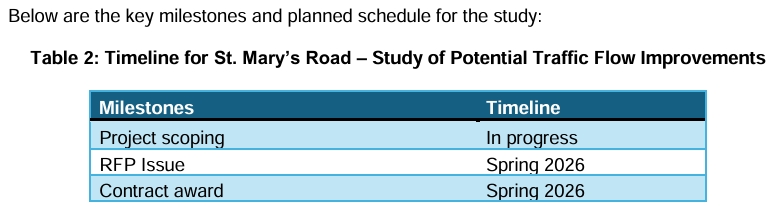

"The purpose of the St. Mary’s Road (St. Anne’s Rd to Tache Ave) – Study of Potential Traffic Flow Improvements is to identify potential traffic flow and road safety improvements that can be implemented in the short to medium term at lower cost and without substantial changes to the St. Mary’s Road right-of-way. Significant changes to the roadway cross-section and right-of-way are not the goal of the study. More significant scale corridor changes may be considered as part of the future Rapid Transit corridor study."
This really limits what solutions can be identified...other than maybe parking limitations and prohibiting left turns at a bunch of minor intersections. Left turners really slow the flow in the undivided stretch.
Public works mentioned they will be exploring reversible lanes, lanes that switch direction to handle rush hours, they specifically mentioned Calgary's use of them.

Public works mentioned they will be exploring reversible lanes, lanes that switch direction to handle rush hours, they specifically mentioned Calgary's use of them.