Metro Vancouver Transit Discussion II


God help us...:rolleyes:

What the Hello Kitty: Kawaii Compass Cards being resold for wild amounts
Amir Ali
Apr 7 2026, 3:45 pm

It may not come as a surprise, based on previous limited edition Compass collections, but the latest TransLink Hello Kitty collectible has folks in a tizzy.

Daily Hive Urbanized recently reported the wild lengths folks went through to gain access to the cards in the first place.

Now, early adopters are reselling the kitty collectibles for hundreds of dollars...


https://dailyhive.com/vancouver/hello-kitty-compass-cards-resale
 
Another news say people were lining up by 4am when the sale began at 11am. That's a wait of 7 hours. So a profit of $80 means they earn less than $11.50 per hour, not including the time and cost of getting there, posting and selling the thing.
 
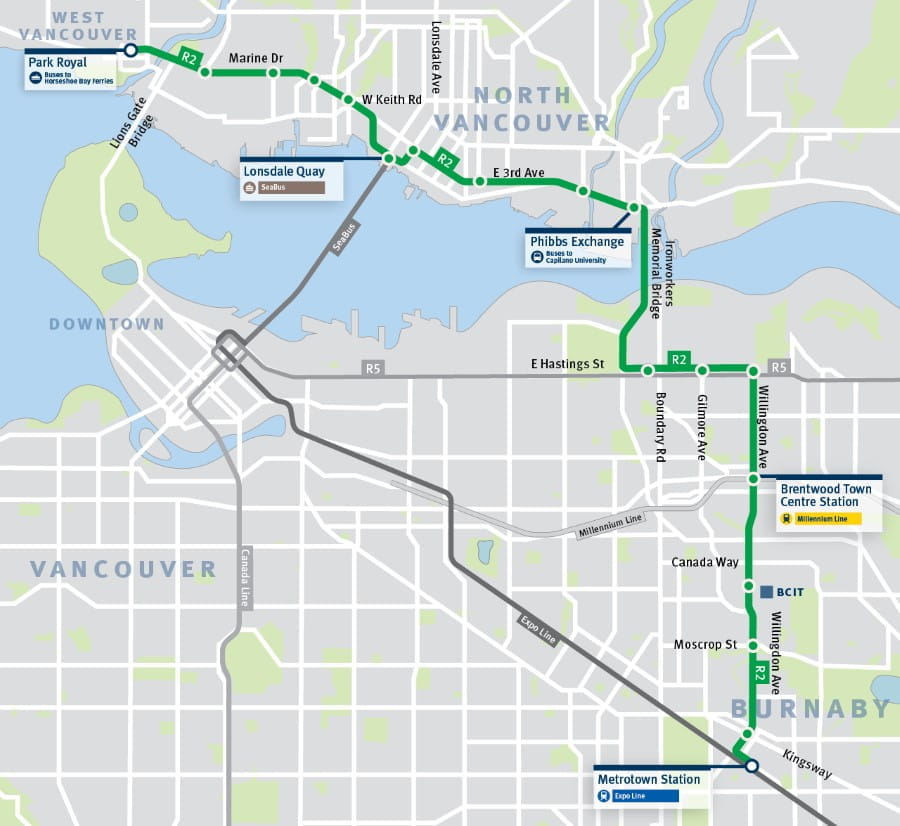
TransLink fast-tracks major RapidBus expansion from North Shore to Metrotown

The new R2 Marine–Willingdon RapidBus is expected to begin service in September — more than three months ahead of schedule.

Construction will begin at the end of April 2026 and continue throughout the summer. A total of 14 existing bus stops will be modified, with two additional bus shelters being built; three new bus stops will be added in Burnaby to improve accessibility.

With this new route, the #222 Willingdon Express between Phibbs Exchange and Metrotown, which currently operates during weekday peak hours only, will be discontinued in September. The R2 extension will replace the #222, with all-day service seven days a week and more capacity to relieve overcrowding. Route 130 will continue providing local service, with most trips terminating at Kootenay Loop. The R2 extension will not include changes to bus priority or HOV lanes in Burnaby.

mct_image_r2_extension_map.jpg


Image from the link above.
 
I am very pleased about the R2's peak hour wait time being improved from 10 minutes to 6-7 minutes. Here's hoping they can sustain that.
 
Another news say people were lining up by 4am when the sale began at 11am. That's a wait of 7 hours. So a profit of $80 means they earn less than $11.50 per hour, not including the time and cost of getting there, posting and selling the thing.

They might worth 1000's of dollars in the future. There's a video on youtube of grown ass men fighting over Pokemon cards, so these collectables are in high demand.
 
Three new stops being added are as follows:

Willingdon at Kingsway
Willingdon at Moscrop
Hastings at Gilmore

In the meantime, it looks like the 130 will maintain 2 trips/hour late, 4 trips/hour during the day with alternating 2tph phibbs/kootenay each during rush.

I work at Goldeneyes games, I should give R5-130 a try just for a simulation. I've had enough of the 16 after games where 2 of 3 trips/hour after 21:30 are jam packed.
 
I can't believe we're still entertaining "North Shore-Metrotown BRT". It's not exactly a secret that there will never be any bus priority across the Second Narrows and most of the streets the R2 goes down simply don't have the bandwidth for BRT infrastructure. I get the feeling they're kicking the can down the road until eventually funding for the SkyTrain gets proposed by a politician.
 
I can't believe we're still entertaining "North Shore-Metrotown BRT". It's not exactly a secret that there will never be any bus priority across the Second Narrows and most of the streets the R2 goes down simply don't have the bandwidth for BRT infrastructure. I get the feeling they're kicking the can down the road until eventually funding for the SkyTrain gets proposed by a politician.

If anything they are just in the design phase. 100% they'll get a BRT line as an interim "solution" by 2030-31 There's no way Skytrain is being built by 2040.
 
Last edited:
I mean do you realistically see a Skytrain line and new bridge being built for say 2040? 2050? 2060?

It's a stretch to say they are entertaining the idea. If anything they are just in the design phase. 100% they'll get a BRT line as an interim "solution" by 2030-31

In terms of design and construct, 2040 is absolutely still possible. That's 14 years away, we just had the Canada Line open 17 years ago and the evergreen extension was still in preliminary construction 14 years ago (the Broadway Subway, Pattullo Bridge replacement and GMT replacement were in their infancy of discussions, with the Surrey Langley Skytrain just a proposed future LRT line).

Expanding the Second Narrows is the next obvious large bridge/tunnel project we have after the GMT replacement. Even if there's a change of government, it's still a project that a right wing government would pursue, and in that case it's really a question of whether Skytrain or BRT is built into that replacement bridge.

Yeah design/construct is straight forward so it's the funding that will be their problem.

It'll easily be a 5-6 billion dollar project factoring in the bridge costs. Park Royal-Metrotown is a 21km line while Surrey-Langley is all elevated down the middle of a suburban highway. And factor in five additional stations and who knows how many of those will be underground or above ground.
 
Didn't the Canada Line get built ahead of schedule? And it only cost $2 billion. They built that whole thing faster and cheaper than it's costing for the Broadway extension. Why is everything now too expensive and time consuming?
 
Didn't the Canada Line get built ahead of schedule? And it only cost $2 billion. They built that whole thing faster and cheaper than it's costing for the Broadway extension. Why is everything now too expensive and time consuming?

Canada Line was underbuilt with 40 metre platforms and single track sections at the Richmond and YVR ends… not ideal
 
Didn't the Canada Line get built ahead of schedule? And it only cost $2 billion. They built that whole thing faster and cheaper than it's costing for the Broadway extension. Why is everything now too expensive and time consuming?


The Canada Line had a cheaper upfront cost partially because it’s a a P3 project, the builder/operator then gets to pocket 35 years of profit for operating the line. In the two decades since it was built construction costs have skyrocketed, most notably during Covid.
Also, that 2 Billion is 3 Billion in 2026 dollars.
 
It's been discussed a lot over the years, but the key to the Canada Line's comparatively low cost and fast construction was short platform lengths. The successful bidder aggressively prioritized short platform length and specification of train type, internal configuration, and operational service level program that would fulfil the requirements of the RFP to the letter and nothing more.

With sloping topography along the Vancouver alignment, shorter station platforms let the station boxes and tunnels be built closer to the surface. Shorter platform length permits a station box depth that is just sufficient to let the connecting tunnels maintain a limited grade and smoothly transition from the level station area to a sloping tunnel. A longer platform would require the approaching tunnels to level out earlier. To maintain the gradual transition from level platform area to sloping tunnel to match topography, the station and tunnel would need to be built deeper. Deeper stations means longer construction and more complex engineering. Deeper tunnels necessitate boring, versus the potential for cut-and-cover construction for tunnels closer to the surface. Shallower stations also let people reach platform level or exit the station faster, reducing the total number of people in the station, and, thus, its design capacity and code obligations (e.g. fewer exit stairs, fewer barrier-free shelter-in-place zones, less emergency ventilation, etc.). It is all a virtuous cycle to have small stations close to the surface.

The downside, as we famously know, is that after the RFP contract period expires, which drove all of the fundamental design decisions, one is left with a system for which incremental capacity improvements become more challenging over time. You run trains more frequently, you buy more trains, you modify the interior layout to increase capacity, minimum separation distances may be marginally reduced, you increase train length to the platform maximum, etc. But eventually you are just maxed out with no remaining options.

It's important to keep perspective and recall that all designs have an ultimate system capacity limitation, but they are admittedly more readily apparent when one starts with the foundational constraint of short platforms.

And yet they keep pushing TOD along its route when they know it cannot easily be expanded. I was thinking of how cheap-ass it seems now when I rode to Yaletown recently (1st time in years) and you can see how crowded it was and how they cheaped out on escalators (at every station).
 
That should have been done when it was built… wonder what the cost would be now?

Another thing that's been discussed a lot over the years. They were dug out to 50m - some of them were only finished to 40m and basically have a false wall blocking off the unfinished area.
 
And yet they keep pushing TOD along its route when they know it cannot easily be expanded. I was thinking of how cheap-ass it seems now when I rode to Yaletown recently (1st time in years) and you can see how crowded it was and how they cheaped out on escalators (at every station).


I'm amazed at how full trains get even on evenings and weekends… wonder how long it will be until they order more?


The lack of stations at 16th, 33rd, and 57th is unfortunate too (especially with Heather Lands and Langara Gardens/Pearson redevlopments)


Another thing that's been discussed a lot over the years. They were dug out to 50m - some of them were only finished to 40m and basically have a false wall blocking off the unfinished area.


I know, you can see it in some of the stations… given that those interior finishes were probably small in comparison with the excavation and concrete, it's bizarre that they wouldn't have done it all together. Silly P3's…


Back
Top