I know shockingly little about the bridge plans, but retrofits can be absurdly expensive too. You could pay billions, with years of disruption, and still get a bridge that's way below code (no breakdown lanes for example), is STILL vulnerable, and will only last another decade at best.

You are using an out of date browser. It may not display this or other websites correctly.
You should upgrade or use an alternative browser.
You should upgrade or use an alternative browser.
I-5 Bridge Replacement - Formerly Columbia River Crossing | Proposed
- Thread starter MarkDaMan
- Start date
From the IBR website. No discussion on technical merits of retrofit. From the below it sounds like a “color of money” thing. Well, this is just great. We have $4.1b earmarked, of the $14b needed. I’m very curious to see what happens next. $14b seems like an impossibility in current funding environment…so now what?
Q: Why can’t you retrofit or replace other regional bridges using the money from the IBR Program? Wouldn’t that be a more prudent use of taxpayer dollars?
A.
The IBR Program has secured $2.1 billion of federal funding through the U.S. Department of Transportation Mega grant Program and Federal Highway Administration Bridge Investment Program (BIP). These are highly competitive funds that were awarded specifically for bridge replacement efforts, so they cannot be shifted to other regional priorities. Both states have also committed $1 billion to help meet the needs of travelers in Oregon and Washington. Replacing the 108-year-old Interstate Bridge with a modern, seismically resilient, multimodal corridor is a priority for the region and the nation, as demonstrated by these investments.
From the IBR website. No discussion on technical merits of retrofit. From the below it sounds like a “color of money” thing. Well, this is just great. We have $4.1b earmarked, of the $14b needed. I’m very curious to see what happens next. $14b seems like an impossibility in current funding environment…so now what?
Q: Why can’t you retrofit or replace other regional bridges using the money from the IBR Program? Wouldn’t that be a more prudent use of taxpayer dollars?
A.
The IBR Program has secured $2.1 billion of federal funding through the U.S. Department of Transportation Mega grant Program and Federal Highway Administration Bridge Investment Program (BIP). These are highly competitive funds that were awarded specifically for bridge replacement efforts, so they cannot be shifted to other regional priorities. Both states have also committed $1 billion to help meet the needs of travelers in Oregon and Washington. Replacing the 108-year-old Interstate Bridge with a modern, seismically resilient, multimodal corridor is a priority for the region and the nation, as demonstrated by these investments.
It is worth noting that bridge replacement is 40% of total project cost (from a Joe Cortright interview w/ Jonathan Maus). That means 5.44 of the estimated 13.6 billion would theoretically be sufficient to replace the bridge.
The light rail is another 2 billion on top of that supposedly (According to Clark County Today).
So there is A LOT of cost savings possible if they simply remove the 5 miles of highway widening and interchange redesign, but as far I know they would need a new environmental review process if they wanted to take highway widening out of the project.
Bridge structural engineer here. Seismically retrofitting a bridge of that age and type is not something I'd recommend. Bridges are only expected to last 75-100 years due to environmental deterioration and fatigue, and those bridges are overdue for replacement. They can be frankensteined for a while, but reliability starts to suffer, and the sheer number of parts that have to be strengthened or replaced starts to make it a big headache. I worked on one project on the bridge that involved replacing the bearings at two spans. The old bearings were falling apart due to corrosion and fatigue. Probably cost around $1 million, and we had to close the bridge a few times for jacking and material deliveries. Just to replace eight small pieces (critical pieces, but still...). Then there's the liquefaction side too, which I'm sure would be very complicated. AND the lift span, with the top-heavy counterweights. Would be extremely complicated to retrofit that. Lift spans that old are also a headache to maintain.
I do think it would make a lot of sense to strip the project down to just the bridge, which is about 50% of the cost. Further savings could be found by narrowing it to 8 lanes and simplifying construction by building it upstream (shifting the Pearson runway east a tad, something the airport's master plan calls for doing anyway and which was never studied in either the CRC or IBR...)
I do think it would make a lot of sense to strip the project down to just the bridge, which is about 50% of the cost. Further savings could be found by narrowing it to 8 lanes and simplifying construction by building it upstream (shifting the Pearson runway east a tad, something the airport's master plan calls for doing anyway and which was never studied in either the CRC or IBR...)
I swear to god this thing is a zombie - apparently the coast guard OK'ed the shorter clearance, fixed-span bridge:
https://www.opb.org/article/2026/01/16/i-5-interstate-bridge-washington-oregon/
Reporting seems somewhat tone-deaf, with subtitle saying that work could "start this year". The notion that the most recent cost estimates are over $13 billion are buried at the bottom of the article with a single sentence. Also implies that Joe Cortright invented the number, when in fact he got it from the IBR committee through a public records request.

2oh1
9-7-2oh1-!
Wow. 13 billion. Up from 6 billion. Up from a billion for the previous attempt at this bridge. And still, even as the price balloons into the stratosphere, nobody stops to consider cheaper alternatives.
I know, I know. Nobody wants to hear any of this.
Nobody can convince me this is the best way to spend 13 billion dollars, which we all know will balloon up to 15... or 20? This is crazy.
Does the bridge still not include MAX?
Too many people aren't thinking through the implications that come from turning this project into one big singular thing. I'm truly shocked by how short sighted so many people are.
By pumping more vehicles through this one bridge, they'll be pumping more traffic straight into downtown Vancouver, as if that makes any sense at all.
By pumping more vehicles through this one bridge, they'll be pumping more traffic straight through north Portland and into the Rose Quarter, as if either area is prepared to handle it. And before some knucklehead says "Well, we'll widen roads there too." At what cost? At what benefit? At what amount of further damage to those neighborhoods?
Interstate 5 never should have been routed straight into cities, but the planners didn't think that through. It should have been routed around the city, so that only the traffic that needs to come in and out of the city is routed into and out of the friggin' city.
It is what it is and we are stuck with it. Routing even more cars through it will take a bad situation and make it worse. I will always advocate for The Common Sense Alternative, because this latest incarnation of the CRC is stoooooooooopid. It is so foolish that I'm honestly embarrassed for those who push for it to be built.
I know, I know. Nobody wants to hear any of this.
Nobody can convince me this is the best way to spend 13 billion dollars, which we all know will balloon up to 15... or 20? This is crazy.
Does the bridge still not include MAX?
Wow. 13 billion. Up from 6 billion. Up from a billion for the previous attempt at this bridge. And still, even as the price balloons into the stratosphere, nobody stops to consider cheaper alternatives.
I know, I know. Nobody wants to hear any of this.
Nobody can convince me this is the best way to spend 13 billion dollars, which we all know will balloon up to 15... or 20? This is crazy.
Does the bridge still not include MAX?
13 billion includes 2 highway-adjacent MAX stations in Vancouver and one on Hayden Island.
2oh1
9-7-2oh1-!
13 billion includes 2 highway-adjacent MAX stations in Vancouver and one on Hayden Island.
Well that's at least something. Still... that price is insane and it's just going to grow.
Feds codify $100 million for IBR light rail in recently-passed spending bill:
https://www.opb.org/article/2026/02...lacement-federal-spending-package-light-rail/
It's a pittance, but a maybe a sign that politicians are still committed to the project, ballooning pricetag be damned?
https://www.opb.org/article/2026/02...lacement-federal-spending-package-light-rail/
It's a pittance, but a maybe a sign that politicians are still committed to the project, ballooning pricetag be damned?
I think the $100 million toward light rail is a symbolic gesture that says the bridge will get replaced and light rail will be on it. Given that the full project price tag exceeds available funds, I would guess the project will be delivered in phases (some being funded and others not at this time). The $6+ billion they have should be enough money to complete the bridge I suspect.
I think the $100 million toward light rail is a symbolic gesture that says the bridge will get replaced and light rail will be on it. Given that the full project price tag exceeds available funds, I would guess the project will be delivered in phases (some being funded and others not at this time). The $6+ billion they have should be enough money to complete the bridge I suspect.
I haven’t looked close enough at proposed phasing, but as if often the case with these mega projects is they need the need the widened road to accommodate lane shifts during bridge construction, especially one being built off alignment. Keep 3 lanes open always, each direction, and you need to connect old freeway to new (a tight s-curve to bring vehicles onto the new bridge is not tenable long term, so can’t be done temporarily merely hoping the remainder of funding comes). Very quickly the mere replacement of the bridge eats up miles of freeway to make it work.
I am curious to see what incremental usable phases can be built (i.e. phases that achieve a beneficial use even if the remainder never gets funded).

Price tag to replace Interstate 5 Bridge could cost billions more than expected

Washington and Oregon officials now say it could cost more than $15 billion to replace the Interstate 5 Bridge between Portland and Vancouver and upgrade a five-mile segment of the freeway, a huge increase from the most recent estimate released in 2022.
The bridge replacement will likely cost between $13.5 billion and $15.2 billion, project officials say, with a likely cost of $14.4 billion. Four years ago, officials said the most likely cost was $6 billion.
Yet leaders have only secured $5.5 billion for the bridge replacement, leaving lawmakers from both Oregon and Washington wondering where they will find the money to complete the project, which is now not expected to be finished for two decades.
Oregon Gov. Tina Kotek and Washington Gov. Bob Ferguson, both Democrats, doubled down on their commitment to completing the project Tuesday. In a joint press release, both governors said replacing the bridge is essential because it faces “significant risk of collapse in the event of an earthquake.”
...continues at the Oregonian.
And a slightly different angle:
...continues at BikePortland.
Freeway expansions value-engineered out of Interstate Bridge Replacement project, for now
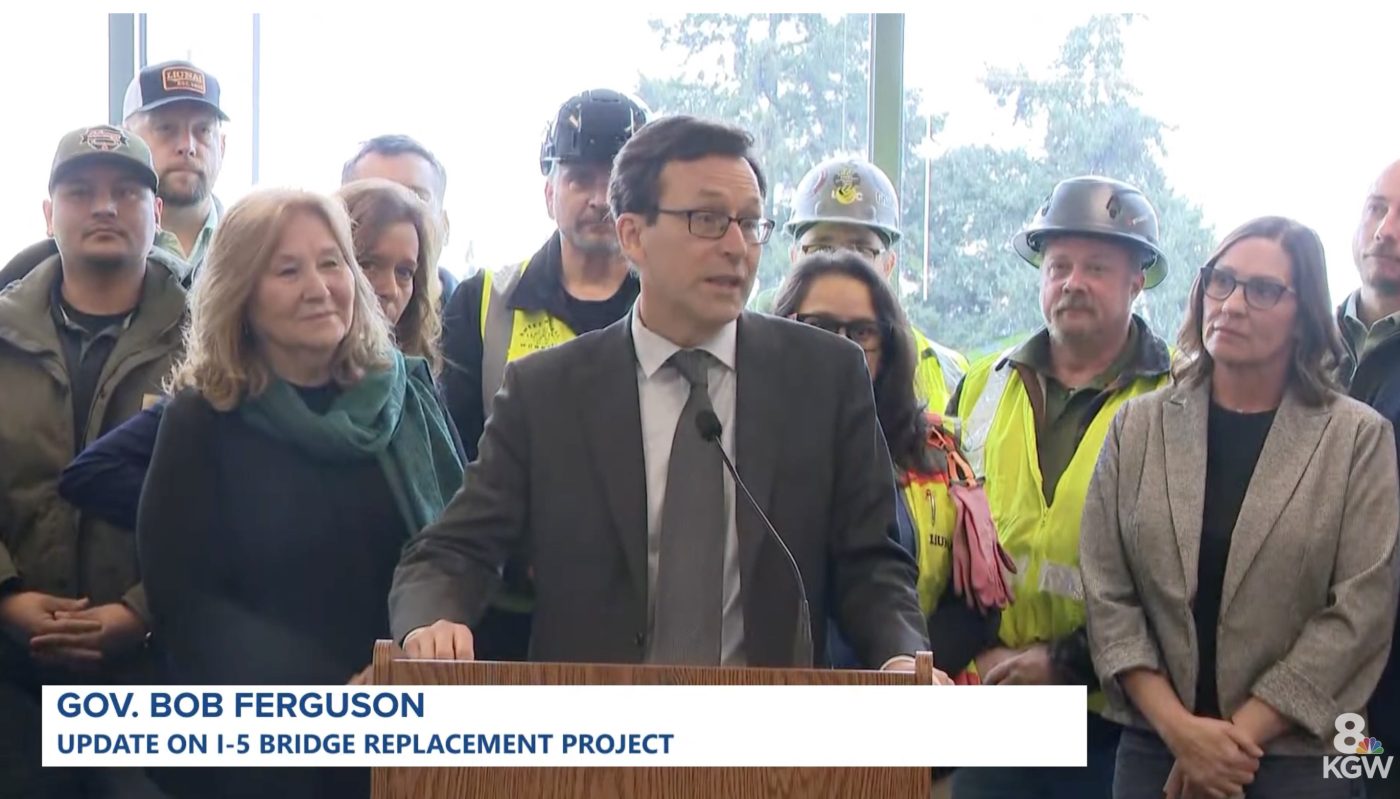
At a press conference in Vancouver today, Washington Governor Bob Ferguson announced that the Interstate Bridge Replacement Program will finally live up to its name.
Instead of five miles of freeway expansions and seven new interchanges, the project will be phased to include just the bridge replacements and an extension of MAX light rail across the Columbia River. Also making the cut in this “core set of projects” is the shared-use paths that will give bicycle riders and walkers new connections across the river.
Yes, project officials have finally relented and have decided to right-size the project in the way dozens of environmental and social justice organizations in the Just Crossing Alliance have been encouraging them to do for years now.
...continues at BikePortland.
That's great news. It's clearly important to get a replacement going due to the failure risk, and it looks unlikely that they'd get a ton more money. So build it. And definitely do the rail. Clark County will love that when it happens. I'm not worried about more lanes. The governors are acting like adults.
I’m still super interested to see how this look in reality. Given you need the lanes shift and temp roads (permanent vs temp lanes is not a huge cost delta). I’d love to see these plans.
And of course, they shook sofa cushions to find $5.5b between both states, fed, tolling. Where is the extra 40% gap coming from?
I imagine they'll build a single bridge with 2+2 lanes + rail + bikes alongside of the existing alignment. Then a potential future phase would be a second four-lane bridge (or three may be ok) in the current alignment.
That could result in some limited "temporary" construction on one side (a set of ramps), but avoid that issue on the other side.
Logistics and disruption will be SOOOO much easier with a narrower project, though it'll still be incredibly complex.
That could result in some limited "temporary" construction on one side (a set of ramps), but avoid that issue on the other side.
Logistics and disruption will be SOOOO much easier with a narrower project, though it'll still be incredibly complex.
Actually I'm confused. Is the idea to build the full bridge width in the initial phase (two bridges apparently), and just not do anything in the rest of the corridor?
Here are the best conceptual plans I can find. Not sure how current these are to the current plan:
https://www.interstatebridge.org/media/downloads/Appendix C - MLPA Roll Plot.pdf
Pages 3 and 5 show the complexity. Pretty much ALL of these sheets will need to be built in their entirety, since the alignment shifts and you still need to connect to all the ramps in both OR/WA, which will now be in a different location relative to the I5 alignment. Widening beyond that is relatively simple since it's just widening on the existing alignment (could be real estate cost that escalate that cost, I don't see pricing data included anywhere - that might be close-hold for now). From my recollection of driving north, the exist ROW is pretty wide and could easily add a lane if needed w/o major real estate actions.
At the north end of the bridge (sheet 4), you can easily see you can't just "end at the end of the bridge" as the new roadway isn't anywhere near ready to be merged with the existing alignment (existing alignment is shown transposed).
I don't know what we can infer from all that, if they haven't specified phased or near-term concepts.
With parallel bridges, there's precedent for doing one bridge at a time due to money or space. It's also common for the first bridge to serve both directions for a while, including temporary ramps on one side. The drawings show plenty of width for one bridge to do this.
No matter what they do, they'll need to go a little beyond the bridge to connect to the existing roadway.
Actually I'm confused. Is the idea to build the full bridge width in the initial phase (two bridges apparently), and just not do anything in the rest of the corridor?
Yes, the plan is to in the near-term build the two bridges over the Columbia River, link them up at either end, build light rail to Vancouver Waterfront, and remove the existing bridges. The rest of the 5 mile corridor is to be phased in afterward. They have also planned for a possible "Step 1" approach should they be unable to close a 2.2 B funding gap, where the bridges are constructed with room for light rail but the tracks and stations are left yet to be built.


Link to full presentation: https://www.interstatebridge.org/media/vtfdtrwx/20260317_esg_meeting_presentation_remediated.pdf
Last edited: