Quebec, the French Language, and Quebecois Identity


Status
Not open for further replies.
Why would it be jarring? Being a sovereignist does not necessarily imprison one in Quebec.
Symbols matter. If you're the leader of the Algerian Liberation Army fighting against colonial power France and you send your children to the Sorbonne in Paris, it's certainly jarring. Above all, I think it's the message that it sends that is bad optic: basically, good higher education can only be had in Anglophone universities, that's what it's saying. You would expect a PLQ leader to do that, but not a PQ leader.
 
Why Oxford? (overhyped and over-expensive) Why not some top-notch school in France. Isn't he a Francophone? What's the message there? Good higher education can only be in English??

:rolleyes:

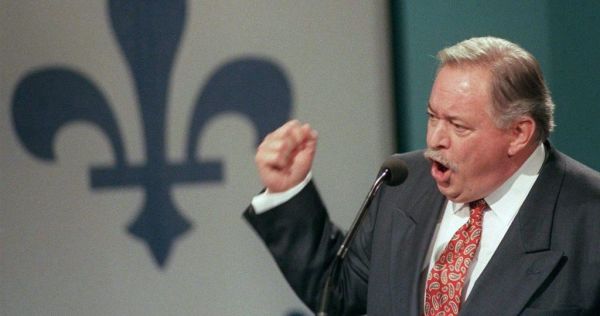
Ask Jacques Parizeau, who graduated with a PhD from the London School of Economics.

jacques-parizeau-1024x576.jpeg
 
:rolleyes:

Ask Jacques Parizeau, who graduated with a PhD from the London School of Economics.

jacques-parizeau-1024x576.jpeg
You really have an obsession with Jacques Parizeau, don't you. Question of generation I suppose.

You should read his biography on Wikipedia. Enlightening.
Dans les années 1950, le Québec connaît une croissance économique sans précédent. Malgré la prospérité matérielle, les Québécois francophones demeurent largement en situation d'infériorité économique par rapport à leurs compatriotes anglophones. Les entreprises les plus importantes du Québec étant alors contrôlées par des intérêts britanniques ou américains, les entreprises dirigées francophones se voient marginalisées au sein de leur propre société. La faible valeur accordée au savoir-faire canadien-français se reflétait également dans le manque de choix dans les emplois disponibles, même pour les diplômés universitaires, et dans le peu de spécialistes en économie au Québec.

Préoccupé par cette situation, le professeur François-Albert Angers cherche alors à former un contingent de jeunes économistes canadiens-français pouvant éclairer la société. Plus particulièrement, il tient à envoyer ses meilleurs étudiants se perfectionner en Europe afin qu'ils puissent faire profiter les futures générations de leurs connaissances, pour ainsi créer une véritable classe d'entrepreneurs de langue française au Québec. C'est dans cet esprit nationaliste qu'Angers propose à Jacques Parizeau de poursuivre ses études en France pour obtenir un doctorat. Misant sur son protégé, il propose de lui verser un salaire de professeur (payé par les HEC) pour toute la durée de ses études, à condition qu'à l'obtention de son diplôme, celui-ci revienne enseigner aux HEC. Ce marché conclu, à l'été 1950, Parizeau quitte donc le Québec et s'installe à Paris. Il y fait la connaissance de plusieurs économistes français réputés, tel que François Perroux, dont le credo interventionniste aura une influence durable sur sa pensée. Ces études lui permettent ainsi d'obtenir deux diplômes de cycle supérieur; l'un de l'Institut d'études politiques de Paris, l'autre de la Faculté de droit de Paris, en juin 1953.

Suivant la tradition des HEC, Angers avait insisté pour que Parizeau poursuive son éducation dans une institution française. Toutefois, au fil de ses études, Jacques Parizeau avait constaté le peu de valeur accordé aux diplômes français en économie, y compris en Angleterre et aux États-Unis. Ce constat s'ajoutant au mépris envers les francophones du Québec amène Jacques Parizeau à revoir sa stratégie. Afin d'obtenir toute la légitimité possible, surtout aux yeux des patrons anglophones, Jacques Parizeau décide plutôt de poursuivre ses études dans une institution de langue anglaise. En février 1953, il décide de quitter Paris pour Londres et de s'inscrire à la London School of Economics (LSE)22. Intéressé par de nouvelles approches en économie, choisissant de se « spécialiser en économétrie et en théorie mathématique », il soutient une thèse de doctorat dirigée par l'économiste James Edward Meade (disciple de John Maynard Keynes et lauréat du Prix Nobel d'économie en 1977) sur les échanges commerciaux du Canada de 1869 à 1952.
PSPP, who went to school long after the end of the Anglo domination of Québec, doesn't have such excuses. Besides, he did not even study in France, unlike Parizeau. He seems typical of those 'rootless elites' judging from his bio, which is quite funny for the leader of a sovereignist movement.

Journalists should challenge him on this point during interviews. I'm sure he would reply defensively and aggressively.
 
I've met Jacques Parizeau. He was a part time prof at one of the schools that I taught in, many years ago.

I actually admire him very much, without necessarily agreeing with him on numerous issues. He was a force to be reckoned with...and he did not suffer fools gladly. I have heard stories about him being on the examination board of PhD candidates, and giving them a hard time during the thesis examination, if he felt that they didn't know their stuff.
 
I think you're talking as a fluent English-speaker who follows the news in Anglo-Canada closely, which is not exactly the case of the majority of the Québécois.

I don't think one has to be as astute as me in order to see it. French was a bit of a joke in the Liberal leadership race, all the way to the announcement event on Sunday when the results were only announced in English from what I heard in the media. As I said, the Liberals have moved to a very superficial commitment to the bilingual duality with a Governor General who speaks no French and a provincial Lieutenant Governor in New Brunswick (the only officially bilingual province) who was a unilingual anglophone and named by Justin Trudeau. Not to mention their centralizing ways and almost systematic refusal of any request from Quebec to do its own thing. And of course the court challenges to Quebec Bills 21 and 96 that they are supporting in various ways.

My guess is that these are stormy seas and that at the moment some Quebec electors prefer the devil they know (the Liberals) to the devil they don't know as well (the Conservatives) to get through it.
 
^^Most voters do not pay attention to what's going on, whatever the country. Do people in Québec really pay attention to these things that happen outside of Québec? :shrug:
 
^^Most voters do not pay attention to what's going on, whatever the country. Do people in Québec really pay attention to these things that happen outside of Québec? :shrug:

They pay attention enough and there is enough discussion around the watercooler or coffee for perceptions to form.

Here is Canada's Foreign Affairs Minister Mélanie Joly telling a francophone reporter yesterday that she'll answer questions in English first. Not sure why she did that - there is no official government or Liberal party policy on that to my knowledge.

https://x.com/1837patriotes/status/1899159334728208599
 
Observations from Québécois media and social media on Mark Carney's installation as Canadian Prime Minister:

- Quebec ministerial representation in Cabinet went from 33% to 20%.

- The position of federal Minister responsible for official languages has been eliminated.

- Mark Carney, who took the oath in both languages (as Canadian PMs typically do), did so extremely laboriously in French even though he was reading a text.

- Very little French was heard at the ceremony, aside from the handful of francophone Ministers themselves.

We're annoying, aren't we? :D

It might be annoying but it's important in Quebec. Champagne seems to be a key minister surely he could have warned him how Quebec media would cover this? (I guess he's mostly lived outside of Quebec)

He seems to not understand how urgent the impression of his French is. Stop spending hours a day planning strategy and start studying French. Talk to advisors most of whom are bilingual in French. You can improve a lot even in two weeks. I have seen many poor bureaucrats cram for two weeks and get back to a C level if the base is there. Yes including pretty old ones.

Quebec can give him this election if the polls showing a strong lead among Francophones are correct and hold up 60 seats in Quebec are possible in which case they could get back to the point where the Liberals win the election by the time they get to Kingston and Toronto gives them a majority.
 
Observations from Québécois media and social media on Mark Carney's installation as Canadian Prime Minister:

- Quebec ministerial representation in Cabinet went from 33% to 20%.

- The position of federal Minister responsible for official languages has been eliminated.

- Mark Carney, who took the oath in both languages (as Canadian PMs typically do), did so extremely laboriously in French even though he was reading a text.

- Very little French was heard at the ceremony, aside from the handful of francophone Ministers themselves.

We're annoying, aren't we? :D

So from over-represented to more or less what it should be.
 
It might be annoying but it's important in Quebec. Champagne seems to be a key minister surely he could have warned him how Quebec media would cover this? (I guess he's mostly lived outside of Quebec)

He seems to not understand how urgent the impression of his French is. Stop spending hours a day planning strategy and start studying French. Talk to advisors most of whom are bilingual in French. You can improve a lot even in two weeks. I have seen many poor bureaucrats cram for two weeks and get back to a C level if the base is there. Yes including pretty old ones.

Quebec can give him this election if the polls showing a strong lead among Francophones are correct and hold up 60 seats in Quebec are possible in which case they could get back to the point where the Liberals win the election by the time they get to Kingston and Toronto gives them a majority.

Indeed, that should be the PM's highest priority in the current circumstances.
 
Observations from Québécois media and social media on Mark Carney's installation as Canadian Prime Minister:

- Quebec ministerial representation in Cabinet went from 33% to 20%.

- The position of federal Minister responsible for official languages has been eliminated.

- Mark Carney, who took the oath in both languages (as Canadian PMs typically do), did so extremely laboriously in French even though he was reading a text.

- Very little French was heard at the ceremony, aside from the handful of francophone Ministers themselves.
It's the new normal, just as America getting detached from Europe and refocused on Asia. Better be used to it.
 
We'll see whether he'll make his speech in French in Paris. I'm not holding my breath....

And knowing Macron as we unfortunately know him here, I bet he'll speak to your PM in (badly pronounced) English too.

bwP6crG.png
 
I'm quite moderate compared to many on this forum regarding our current situation with the US. But even I decided going to the US during the next 4 years is probably not a great idea.
 
Status
Not open for further replies.


Back
Top