VIA Rail


If they're going to operate consists with single locomotives with no workable contingency plan if it breaks down, perhaps the consists should actually be mixed instead. Have one of the cars be a DMU that's capable of pulling the consist at diminished speed in case of emergency so the train can limp to the nearest place where people can be retrieved. I did worry about having the new trains having a single loco if they're going to operate on the future northern mainline (Havelock sub) which is much more remote than the current route. But it seems like they're leaning toward electrification which makes it likely a new rolling stock model will be used.

I heard it's technically possible to convert the Siemens models to use overhead wires but there will likely be enough uses for them elsewhere for that not to be necessary. Hopefully any HFR/HSR route will use EMUs with a backup generator or significant battery reserve in case of power failure. Something like that will probably be needed anyway since the last I heard the electrification is only expected to cover about 90% of the route so the trains would need a way to bridge any gaps. The unelectrified sections would probably be entering or leaving metro areas where they'll share track with freight providers who don't want any overhead wires. Locomotives are great for intercity in many parts of the world, but single loco consists on a route that contains remote or otherwise difficult to access sections seems like an exception.
 
^ That's a good point. If they're insisting on a greenfield route between Peterborough and Ottawa through the Shield (which it seems the bidders are), then the probability of there being long segments of track that are far away from the nearest road are quite high.

There's several high voltage power lines in Ontario that follow a similar route between Peterborough and Ottawa to cut down on transmission losses and serve the hydroelectric dams on the Madawaska River. Some sections of these lines pass over pretty remote forest country. HydroOne actually maintains access "roads" along these lines but they're often only accessible by jeep, and are also made available to ATV users and hikers in a lot of cases. A plan to build a new route through the Shield is realistically going to require access roads as well.
 
Sure, but how to convince the bean counters at the federal government?

To evacuate a single train, you’d need 3-5 buses. To cover the entire corridor within a 2-hours drive, you need to contract bus companies in the Victoriaville, Brockville/Cornwall, Belleville/Cobourg and London area. As a rough estimate, a single bus driver costs a bus company some $100k per year and the ownership and maintenance of a single bus $200k.

That said, such emergency bus service would have been useless during the December 2022 winter meltdown (as most roads were closed) or the October 2023 incident where a Siemens train was stuck for very similar reasons as last weekend at an inaccessible location just outside Gare Centrale.

Maintaining significant resources for more-or-less annual events will always be difficult to justify for a company which deploys less than 30 Corridor trains at any given time, which is why I argue that evacuating trains at not easily accesible areas should be a government responsibility…

You know as well as I do that contingency fees don't require paying 100% of the annual cost just to maintain reserve. There will be a cost and it should be passed to customers.

If VIA isn't even allowed to set contingency by Transport Canada, this is indeed a problem with micromanagement that needs to be corrected.
 
^ That's a good point. If they're insisting on a greenfield route between Peterborough and Ottawa through the Shield (which it seems the bidders are), then the probability of there being long segments of track that are far away from the nearest road are quite high.

There's several high voltage power lines in Ontario that follow a similar route between Peterborough and Ottawa to cut down on transmission losses and serve the hydroelectric dams on the Madawaska River. Some sections of these lines pass over pretty remote forest country. HydroOne actually maintains access "roads" along these lines but they're often only accessible by jeep, and are also made available to ATV users and hikers in a lot of cases. A plan to build a new route through the Shield is realistically going to require access roads as well.

Highly unlikely that a private consortium building HFR would self-limit this much in IRROPS design. They'll pay contingency to ensure a minimum emergency response. Private businesses tend to actually care about how their brand is perceived. VIA doesn't seem to have this luxury, as per Urban Sky.
 
Highly unlikely that a private consortium building HFR would self-limit this much in IRROPS design. They'll pay contingency to ensure a minimum emergency response. Private businesses tend to actually care about how their brand is perceived. VIA doesn't seem to have this luxury, as per Urban Sky.

I wonder if this is why Brightline uses two locomotives.
 
I always wondered why Brightline uses two locos for such short trains. Usually if the extra power isn't needed then it would be for traction when accelerating such as if there may be leaves on the track causing wheel spin. GO sometimes does that when it usually uses a single loco. But wouldn't it make more sense to use a DMU? Yes the ones with underfloor power are too noisy and harsh for a luxury product but they could use something like the "power modules" in the Stadler DMUs where each engine is in a sort of small intermediate car isolated from the passenger compartments. Or maybe there's nothing with that design that's FRA compliant. Although they were supposed to be relaxing those rules the last I heard.
 
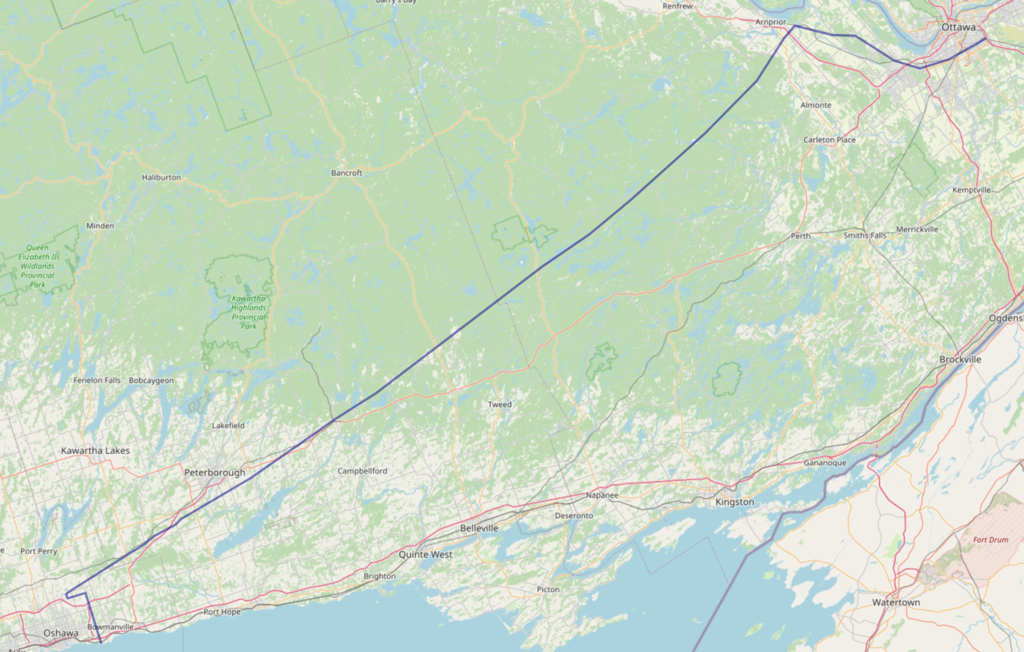
This is the hydro line I'm thinking of: (courtesy of OSM)

hydro.png


It runs from the Darlington nuclear plant to the Ottawa transformer stations. One of Ontario's main high voltage lines. It's route between Peterborough & Ottawa happens to be vaguely similar to what we could expect an HFR proponent to propose. If you zoom in one of some of the more remote sections you can see service tracks that run under or near it. Like here or here.

I'm still very curious what route will be proposed in the end. There's very little NIMBY population to care about but the terrain is challenging. And one thing is for sure - it will be a beautiful ride.
 
^ It would need to follow the existing alignment to some degree though wouldn't it? If it does turn out to be some type of HSR it would need to leave the alignment at times to straighten the curves, but if it didn't follow the alignment to some degree that would nullify most of the advantage of using the Havelock sub to begin with. The main reason the original HFR proposal was based on that route was the lower cost of re-using an existing alignment.
 
^ It would need to follow the existing alignment to some degree though wouldn't it? If it does turn out to be some type of HSR it would need to leave the alignment at times to straighten the curves, but if it didn't follow the alignment to some degree that would nullify most of the advantage of using the Havelock sub to begin with. The main reason the original HFR proposal was based on that route was the lower cost of re-using an existing alignment.

The Havelock sub doesn't actually exist anymore east of Havelock. The Havelock corridor would mean reviving a long-abandoned track between Havelock & Perth (which was VIA's original back-of-the-napkin plan) and then using an existing CPKC line from Perth to Smiths Falls, and from there VIA already owns the tracks from Smiths Falls to Ottawa.

This old route is extremely unsuitable, though. This is a Victoria-era rail line that follows the grade of the terrain to cut down costs at the expense of being insanely curvy. Anything faster than 100km/h and you're not just straightening it.. you're basically building a brand new line near it. Not to mention the line itself has been built over in the towns it used to cross through. This is why the original circa 2017 era VIA plan had stations in Tweed & Sharbot Lake - reviving the Havelock sub through those communities would involve significant expropriation and demolition, so VIA appeased the inhabitants with the promise of stations. And Sharbot Lake is basically unbypassable - the town is hemmed in a peninsula between two bays of a giant lake, and going around the lake means a greenfield bypass of at least 15km because of how big the lake is.

The material people have shared on here from the bidders suggests that the Havelock sub is basically being abandoned in favour of a new greenfield route for this reason. And you might as well put it further north, a bit north of Hwy 7, to shorten the trip and bypass local population. (Eastern Ontario north of Highway 7 and west of Perth is basically uninhabited).
 
Now I know it's a big ask but this is my obligatory beg to the internet gods to get a crumb of service improvement outside the Windsor-Montreal corridor. I dont want HSR or even frequency, but can we at least get a train a day in the West? Maybe a spot of infrastructure between Edmonton and Calgary? I'm not even in Alberta and that seems like a no brainer.
 
Now I know it's a big ask but this is my obligatory beg to the internet gods to get a crumb of service improvement outside the Windsor-Montreal corridor. I dont want HSR or even frequency, but can we at least get a train a day in the West? Maybe a spot of infrastructure between Edmonton and Calgary? I'm not even in Alberta and that seems like a no brainer.

Let's see if VIA survives the next election, given they the leading contender is hell bent on privatizing a lot of things.
 
Let's see if VIA survives the next election, given they the leading contender is hell bent on privatizing a lot of things.
Unaware of any negative remarks of PP against HFR and given that PP rails against public corporations directly competing with private competitors while running for a party which nominally supports HSR and private investments, I would assume that he might descope HFR if it is overreliant on public subsidies, but otherwise let HFR (which absorbs those VIA routes which currently compete directly and credibly against private alternatives) and (non-Corridor) VIA continue on their current paths…
 
I always wondered why Brightline uses two locos for such short trains. Usually if the extra power isn't needed then it would be for traction when accelerating such as if there may be leaves on the track causing wheel spin. GO sometimes does that when it usually uses a single loco. But wouldn't it make more sense to use a DMU? Yes the ones with underfloor power are too noisy and harsh for a luxury product but they could use something like the "power modules" in the Stadler DMUs where each engine is in a sort of small intermediate car isolated from the passenger compartments. Or maybe there's nothing with that design that's FRA compliant. Although they were supposed to be relaxing those rules the last I heard.

I suspect they use one on each end of the train because there isnt a convenient location to turn or wye the train so that the engine is facing the correct way for the return trip. VIA runs with push/pull sets in the corridor a lot as well on some consists that reverse direction right at Union station.
 
I suspect they use one on each end of the train because there isnt a convenient location to turn or wye the train so that the engine is facing the correct way for the return trip. VIA runs with push/pull sets in the corridor a lot as well on some consists that reverse direction right at Union station.

Yeah if that was the only purpose it would make sense for them to have a cab car at one end like the new VIA Siemens trains. Cab cars haven't been a new or novel concept for decades now.
 
I wonder if this is why Brightline uses two locomotives.
From what I recall, two diesel locomotives are required to reach a top speed of 200 km/h, which happens to be the design speed between Cocoa Beach and Orlando Airport. Also, they presumably didn’t want to spend the time and money to wait for Siemens to develop a cab car, as they eventually did for VIA…
 
From what I recall, two diesel locomotives are required to reach a top speed of 200 km/h, which happens to be the design speed between Cocoa Beach and Orlando Airport. Also, they presumably didn’t want to spend the time and money to wait for Siemens to develop a cab car, as they eventually did for VIA…

This makes sense. I wasnt sure of what the speed was on that line.
 
From what I recall, two diesel locomotives are required to reach a top speed of 200 km/h, which happens to be the design speed between Cocoa Beach and Orlando Airport. Also, they presumably didn’t want to spend the time and money to wait for Siemens to develop a cab car, as they eventually did for VIA…

Yeah if that was the only purpose it would make sense for them to have a cab car at one end like the new VIA Siemens trains. Cab cars haven't been a new or novel concept for decades now.

As I understand it, VIA was the first operator to ask Siemens to design and build a cab car. It hasnt been a great experience either.


Back
Top