
You are using an out of date browser. It may not display this or other websites correctly.
You should upgrade or use an alternative browser.
You should upgrade or use an alternative browser.
California High Speed Rail Thread
- Thread starter BTinSF
- Start date

ardecila
TL;DR
I believe speed limit is capped at 110 mph through populated urban corridors. Don't ask me to find the regulation.
There is no such restriction; Amtrak runs at 150mph on parts of the NEC which is very much a "populated urban corridor". The regs don't care about urban vs rural.
However, any rail line with grade crossings is limited to 110mph (FRA Class 6). To go faster than 110, you need to fully grade-separate or remove all crossings.
There is a limited exception in the law where trains can run at 125mph through grade crossings IF the road is equipped with a vehicle arrest system, but it was a technological dead-end. 25 years ago IDOT and a few other states tested a number of arrest systems, but none of them were ever approved by FRA so everyone kinda gave up on 125mph. This is why IDOT had to settle for 110mph top speeds on the Chicago-St Louis line. There's a bit of a double standard here - FHWA approved the arrest system for the Kennedy Expressway reversible lanes, and it has been working successfully for decades at high speeds... but FRA refused to accept it for rail/road grade crossings.

Busy Bee
Closeted Normie
Service up to 110 mph because the blended system has been simulated by Caltrain at speeds of up to 110 mph and shown to be viable.
I guess I'm plucking it from the blended Caltrain/HSR speed limit agreement on the peninsula.

electricron
Active member
Trying to explain better.
125 mph is the max allowed speed by regular passenger trains.
To go faster, your signal system and trains must be certified by the FRA on an individual basis. Meaning bespoked regulations for High Speed Rail.
Legally, regular passenger trains can go faster than 110 mph, up to 125 mph, on as what previously was mentioned, with vehicle restraint systems, none of which has ever been approved by the FRA under its regulations.
So, effectively through regulations, 110 mph is the max speed with grade crossings, to go faster the corridor needs to be fully grade separated.
To go faster than 90 mph, all public crossings must be gated with signals.
For regular passenger trains to go faster than 80 mph, cab signaling is required.
And of course, track quality, curvature, and other conditions affect max track speeds.
And, on corridors where trains are approved to go faster than 80 mph, there may be sections of tracks where the trains must go slower for any variety of reasons.
It looks like HSR will be blended with Metrolink/Amtrak according to this image. And if you look at the presentation, it says this:
Yes that's correct, but I'm wondering specifically if the 2 HSR trains per hour per direction is in addition to whatever frequencies are planned for Metrolink and Amtrak. I ask because 2 tracks seems like it should allow for far more than 2 trains per hour per direction even with some freight interference (especially since only 10 freight trains per day are planned across all 4 tracks). Much of the San Bernardino Metrolink line is single track for example and that is planned to have 2 trains per direction per hour under SCORE.
So my hope is that it's 2 HSR trains plus 4 Metrolink trains (SCORE frequencies) plus some amount of Amtrak per direction per hour.
electricron
Active member
Yes that's correct, but I'm wondering specifically if the 2 HSR trains per hour per direction is in addition to whatever frequencies are planned for Metrolink and Amtrak. I ask because 2 tracks seems like it should allow for far more than 2 trains per hour per direction even with some freight interference (especially since only 10 freight trains per day are planned across all 4 tracks). Much of the San Bernardino Metrolink line is single track for example and that is planned to have 2 trains per direction per hour under SCORE.
So my hope is that it's 2 HSR trains plus 4 Metrolink trains (SCORE frequencies) plus some amount of Amtrak per direction per hour.
Train frequency or headways is determined by the number of tracks, number or size and type of blocks, and train signaling.
A slower max speed train speeds can have more fixed blocks along a certain length of track than higher max train speeds. Then there is the possibility for using moving blocks which requires an even more robust signaling system. There are many variables that can affect train frequency along a section of track.

craigs
Active member
Environmental review of Burbank-Palmdale high-speed rail released
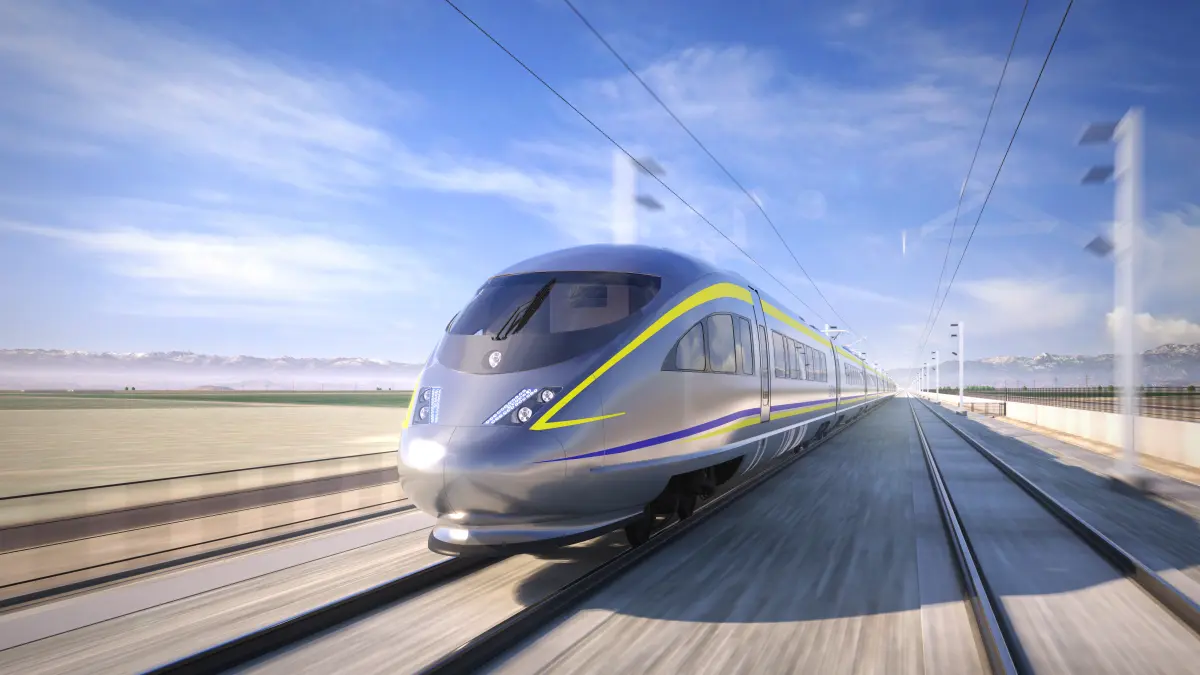
A rendering of the kind of electrified high-speed rail train California plans to run in the San Joaquin Valley. (California High-Speed Rail Authority)
Colleen Shalby
Los Angeles Times
May 24, 2024
Since the earliest plans for the California High-Speed Rail Project, the segment connecting the Central Valley to Los Angeles has been fraught with controversy and technical conundrums. Political pressure and other concerns ultimately pushed the route away from the Grapevine and over the Tehachapis to the Antelope Valley, where it is planned to run along the State Route 14 corridor into the San Fernando Valley.
A final environmental review for a critical 38-mile leg from Palmdale to Burbank was released Friday. If approved by the authority’s board of directors next month, the entire route between Los Angeles and San Francisco would be environmentally cleared for construction. The California High-Speed Rail Authority’s board of directors is expected to make a decision in late June on whether to accept the document, which includes several possible variations of the route with consideration to concerns about cost, aesthetics and environmental impacts raised by community members over the past two years. “This environmental document is the culmination of years of analysis and stakeholder engagement and is a huge milestone in connecting high-speed rail between two of our major metropolitan centers, San Francisco and Los Angeles,” outgoing authority Chief Executive Brian Kelly said in a statement.
. . . .
The preferred route from Palmdale to Burbank is a 38-mile stretch that would connect the Palmdale Transportation Center to the Hollywood Burbank Airport. It would include four tunnels ranging from about 12 to 13 miles in length and would operate underground through the Acton area, the Angeles National Forest and the San Gabriel Mountains National Monument in order to reduce impacts on communities and environmental resources. The trip between the two stations would take about 15 minutes.
. . . .
^ This bit is encouraging:
Sounds like the final piece that still needs environmental review/approval is from Union Station to Anaheim.
“If our board of directors approves this document and the proposed project at their summer board meeting, we will have environmentally cleared 463 of the 494-mile Phase 1 system between the Bay Area and Los Angeles/Anaheim,” Kelly said.
Sounds like the final piece that still needs environmental review/approval is from Union Station to Anaheim.
If the Burbank CAHSR station is underneath the Burbank Airport does that mean that the security to enter the train station will be heightened?
I remember going to the Steven F. Udvar-Hazy Center Smithsonian Museum on the Dulles Airport grounds and because it was inside the airport perimeter the security to enter the museum was a lot higher than it was to go to other Smithsonian museums on the Mall.
Wonder if it will be the same for the Burbank station.
Train frequency or headways is determined by the number of tracks, number or size and type of blocks, and train signaling.
A slower max speed train speeds can have more fixed blocks along a certain length of track than higher max train speeds. Then there is the possibility for using moving blocks which requires an even more robust signaling system. There are many variables that can affect train frequency along a section of track.
All makes sense, but that didn't answer the question of whether it's 2 HSR trains PLUS Metrolink and Amtrak per direction per hour or 2 passenger rail trains TOTAL per direction per hour.
jmecklenborg
Active member
^ This bit is encouraging:
Sounds like the final piece that still needs environmental review/approval is from Union Station to Anaheim.
It only took...16~ years. I still remember where I was the morning after this thing passed and a bunch of strangers were talking enthusiastically about it.
The pressure is building from multiple sides for Metrolink to electrify. From Brightline now having a vested interest and lobbying to electrifying the San Bernardino line to the EIR being complete for SoCal by next year for the Antelope Valley and Santa Ana lines… all clear directives to electrify and stop toying with hydrogen for now. Maybe later for far out lines, but the core system is gonna need catenary stat!! Then we can purchase those FLIRT trains like Caltrain and all this will be capable of 110 mph speeds.

The pressure is building from multiple sides for Metrolink to electrify. From Brightline now having a vested interest and lobbying to electrifying the San Bernardino line to the EIR being complete for SoCal by next year for the Antelope Valley and Santa Ana lines… all clear directives to electrify and stop toying with hydrogen for now. Maybe later for far out lines, but the core system is gonna need catenary stat!! Then we can purchase those FLIRT trains like Caltrain and all this will be capable of 110 mph speeds.
From what I've read online, it seems Metrolink has been dragging its feet on electrification due to having too many miles of track to electrify (although you can argue they only really need to start with the tracks that will be blended with CAHSR) as well as cost, and the complexity of it having to share tracks with Amtrak and freight. I'm not sure how easy or difficult it is to overcome these issues, but it definitely is something they should figure out by the time CAHSR and Brightline roll around. I also agree that toying around with hydrogen is a waste of time and money for the reasons described below.
https://cal.streetsblog.org/2023/07/06/california-needs-leadership-on-electric-railCatenary electric trains can provide substantial service improvements that could make rail competitive with cars, unlike hydrogen trains. Electric motors accelerate faster than combustion engines, including hydrogen. Catenary electric trains also have virtually unlimited range and require no dwell time for refueling, unlike hydrogen, which has a longer refueling time than diesel. Hydrogen has much lower energy density than diesel, so hydrogen-powered trains need to carry more volume or mass for a trip of the same length compared to catenary electric trains, which don't carry fuel.
...
On top of these limitations, hydrogen is substantially less environmentally friendly than electrification due to impacts from its production. Catenary electrification and green hydrogen both use energy from the electrical grid to power trains, eliminating ozone emissions along the tracks. The grid is currently around fifty percent carbon-free, and is mandated to grow to ninety percent by 2035. The problem is that green hydrogen is produced through a multi-step process that involves converting water into hydrogen via electrolysis, using 2.5 times more energy than directly electrifying via overhead wires. It’s also extremely water-intensive. For example, generating enough hydrogen to replace the diesel at one BNSF facility would require 12-20 million gallons of water per day, equivalent to five percent of LA's residential water usage. With climate change creating greater uncertainty over water supplies, electrolysis hydrogen is simply not a realistic replacement for fossil fuels in California’s passenger and freight rail fleets. And as it stands now, electrolysis is largely speculative, accounting for only two percent of the global hydrogen market, while 98 percent of the supply chain is derived from fossil fuels. Regardless of source, we can’t realistically count on having enough hydrogen to power a transportation network.
...
Hydrogen embrittles steel, leaks easily, is highly flammable (think Hindenburg), and requires specialized and land-intensive infrastructure for refueling at multiple points along the train route, in contrast to catenary electrification which requires little infrastructure beyond the overhead wires. Electric trains also require less maintenance compared to diesel: they incur half the maintenance costs over the lifetime of the vehicle.
ardecila
TL;DR
If the Burbank CAHSR station is underneath the Burbank Airport does that mean that the security to enter the train station will be heightened?
I remember going to the Steven F. Udvar-Hazy Center Smithsonian Museum on the Dulles Airport grounds and because it was inside the airport perimeter the security to enter the museum was a lot higher than it was to go to other Smithsonian museums on the Mall.
Wonder if it will be the same for the Burbank station.
I believe all CAHSR stations will have baggage screening similar to Brightline or the AVE system in Spain. Similar to airport security pre-9/11, so not crazy. If you don't have bags you just walk thru, no undressing or shoes BS.
The Burbank HSR station, under the current plan, will be across the street from the NEW Burbank terminal north of the airfield. So you exit the terminal, cross the drop-off road, walk into the HSR station, and descend down to the train platforms. Maybe there will be a skybridge or underground corridor, the plans are not developed yet.
Weirdly Burbank preserved space for the new airport terminal, but allowed a bunch of warehouses to get built where the HSR station will go. So those brand-new warehouses will need to be seized and torn down. I'm sure the warehouse owner will get a big fat payout from CHSRA...
Busy Bee
Closeted Normie
Link Union Station Draft Environmental Impact Report June 2024
https://www.linkunionstation.com/vi..._Supplemental_Environmental_Impact_Report.pdf
https://www.linkunionstation.com/vi..._Supplemental_Environmental_Impact_Report.pdf
Link Union Station Draft Environmental Impact Report June 2024
https://www.linkunionstation.com/vi..._Supplemental_Environmental_Impact_Report.pdf
Whew!!! Looks like even with the phased approach, they will still build the full viaduct across the 101 and for later phases will build out the rest of the tracks.
1626 pages though… that’s way more than the Sepulveda pass transit corridor documents… the bureaucracy of it all.
Last edited:

mattropolis
matt in the city
1626 pages! I only noticed that after I downloaded it. It's too long to go through! hope it's a good plan. Now build the damn thing!