Metro Vancouver Transit Discussion II


Actually, no - the 34 Hastings Express bus was literally an express bus. It made no stops between Kootenay Loop and Main St, precisely because the express wires were too far from the curb. So it wasn't really the equivalent of our modern limited-stop RapidBus routes.

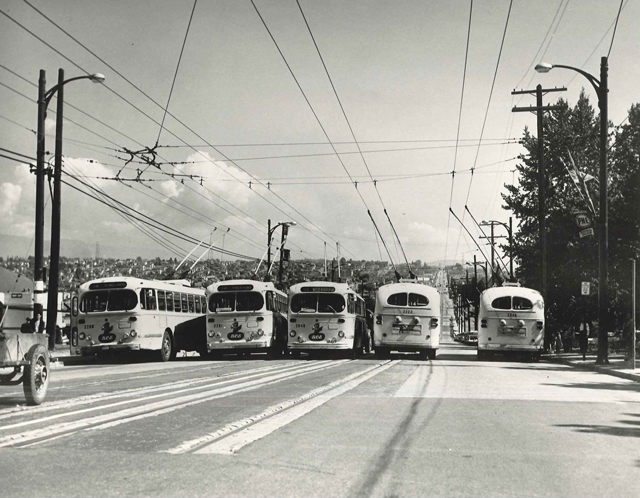
I wonder if it would be possible to rig express wires that ran closer to the curb in order to provide a limited-stop trolley service? There might be issues with uneven wear of the carbon pick-up shoes if the trolley ran for long distances without being directly under the overhead.

why not just put a switch into/out of the local lines, where the express need to stop? more complexity, but i dont see why it couldnt be done.
 
Switches are a big cause of SkyTrain shutdowns, and that's with rails being a lot more durable than trolley wires and caternaries. Unless the feds mandate the retirement of all diesel buses by the end of the decade, I don't see the point.
 
04-14hastings.jpg

(Photo from The Buzzer)

How does an express pass a local bus with that setup?

similar to the above photo, there would be the local & express lines. then at the express stops, a connection between the local/express so the express could pull onto the local for the stop. then as they leave, they switch back onto the express line. the buses would only share the local line at the stops, and only when the express actually needs to stop.

Switches are a big cause of SkyTrain shutdowns, and that's with rails being a lot more durable than trolley wires and caternaries. Unless the feds mandate the retirement of all diesel buses by the end of the decade, I don't see the point.

true, though are there issues with the switches for trolleys? they seem quite reliable, and it would not be near as complex as the switching at 41st/granville. thats a rats nest of connections.

i would rather have trolley vs diesel, and i dont see ICE buses continuing into the future forever. i dont have confidence in the reliability of battery buses in the long term. getting power to the end of trip areas for charging wont be easy as it grows. the chargers are overly complex with moving parts. the range of the buses, not great. overall, trolleys are just better.

Maybe. YMMV, but caternary disconnections happen often enough to be a nuisance even with just one set of wires, and adding switches to the mix will definitely make things more complicated.

In the case of express/local lines, AFAIK either you'd need to have switches at strategic points along the corridor (meaning the express would have to trail behind the local for a while), or one or two every block (increasing the chance of failure). Neither sounds like a good idea to me.
 
I think you are all overthinking this. Just because Translink said it's theoretically possible doesn't mean that they should.

What route needs express trolleys? None.

hastings? R5 exists.
broadway? 99.
41st? R4 says hi.
granville? 10 has been getting its service reduced for the last 2years iirc.
 
I think you are all overthinking this. Just because Translink said it's theoretically possible doesn't mean that they should.

What route needs express trolleys? None.

hastings? R5 exists.
broadway? 99.
41st? R4 says hi.
granville? 10 has been getting its service reduced for the last 2years iirc.

We're debating how TransLink might use the additional trolleys that they have requested bids to supply in an RFP. So they appear to be planning beyond 'theoretically possible'.

Last year they indicated they're thinking of using trolleys on RapidBus or BRT routes where they have dedicated rights of way, because putting in new overhead lines are not as difficult.

And currently R5, 99, and R4 are all diesels or CNG, but they're moving to get rid of those and replace them through electrification in the next 15 years, and ideally sooner, either with trolleys or battery electrics. R5 is planned to switch from RapidBus to BRT in the future too.

The additional buses are only if they exercise both options though, since the initial order is only 106 40' buses. Plus it makes little sense to run 40' on those routes anyways.

Correct me if I'm wrong, but don't they already have a like couple hundred battery buses on order that's meant for the marpole depot? I see the trolley options as a backup plan in case the battery buses don't pan out.

You're correct that the conversation is entirely speculative, as it appears that nobody on here (including me) understands exactly what the 'options' would deliver.

With the 106 confirmed replacement buses plus Option 1 it would suggest a slight expansion of the existing trolley capacity. 106 plus Option 2 would add quite a bit of capacity, which might suggest some expansion of the trolley network, possibly in line with TransLink's comments about examining the option of operating some RapidBuses or BRT as trolleys. And if 106 plus both Options 1 and 2 were acquired, then that would definitely mean that additional trolley capacity is going to be added.

So far, I think only the additional 15 Nova buses for the #100 have been confirmed, added to the two NFI and two Novas bought previously. The new Marpole garage will be able to service and store around 350, and the other TransLink garages are also going to need to be converted to service electric buses too. Altogether TransLink operate around 1,500 diesel, diesel hybrid and CNG buses, and the plan is for all of those to become zero emission vehicles by 2040. Using some more trolleys rather than the existing fleet could contribute to the transition, which is presumably why the RFP has been issued, to see how much that that might cost.
 
We're debating how TransLink might use the additional trolleys that they have requested bids to supply in an RFP. So they appear to be planning beyond 'theoretically possible'.

Given most of the trolley wires are in Vancouver, are they anticipating increased needs around some of the new Skytrain stations? :shrug:
 
Details on the trackwork for the OMC4 tie in, the pocket track switches are being completely rebuilt and swapped to the opposite track from the current configuration.

I am puzzled that with all the effort of rebuilding the track, they're not putting in a full 6-switch multidirectional pocket track here. It just seems short-sighted to me, and the type of thing they'll end up regretting later.
 
I am puzzled that with all the effort of rebuilding the track, they're not putting in a full 6-switch multidirectional pocket track here. It just seems short-sighted to me, and the type of thing they'll end up regretting later.

Perhaps keeping one track in service prohibits that from being built. It would have been great if it was built that way originally, the only reason I can think to not is the abundance of switches at Lougheed.
 
Perhaps keeping one track in service prohibits that from being built. It would have been great if it was built that way originally, the only reason I can think to not is the abundance of switches at Lougheed.
If the diagram is accurate then they're actually removing the two existing switches from the ends of the pocket track and replacing them with switches to the other tracks, respectively. Which seems unnecessary extra work to produce an inferior result.

The other alternative is that the diagram only shows the new switches that will be installed. That would make more sense in my mind and would result in a pocket track that can easily be accessed from both directions, similar to the existing pocket tracks west of Nanaimo and east of Metrotown.
 
Details on the trackwork for the OMC4 tie in, the pocket track switches are being completely rebuilt and swapped to the opposite track from the current configuration.

https://buzzer.translink.ca/2024/05...rain-to-the-new-maintenance-centre-explained/

• Video Link

Thanks!

and here's the OLD configuration.
The new configuration suggests that the start of day train operations from the OMC4 will head to Production Way.
Since it'll be an access track, presumably the pocket track won't be used for train storage since the bigger storage yard is next door,
and all direction access to the pocket track won't be necessary.
But yeah, it is a bit odd that they didn't retain the old switches (unless they were near end of life?)
It could be that the width of the guideway wont have the right angles for an internal 'Y' switch.

• Video Link
 
Last edited:
Yup, they were never going to build a flyover across their tracks. Low frequency use so there is no reason to.


Back
Top