Statistics Canada Reports II


Possiblement mon FrAnKs.

Condos on the plateau in Gatineau are poussing like champignons here mon friend!

J'essaye de dit ça comme un real Gatinois!

I appreciate franglais. It gives me a passing chance at understanding the entire conversation. :)
 
I met and interacted with a group of young Monctonians this week and their franglais was on another level. Their french accent is totally unique as well. It was my first exposure to Franco-NB.
 
Regarding the CMA and CA population estimates to be released at the end of May, they will be almost 11 months out of date, as opposed to the usual 6ish. Will they be helpful at all?

My gut feeling is they won’t be too helpful, with such high growth rates and lots of temporary foreign workers. Once things settle down again we’ll get better ideas of where things are at.
 
That would be my guess as well. The past year or so there’s been a fairly large interprovincial migration from BC and Ontario, to Alberta and the main driver seems to be the cost housing. I suspect a fair number of younger people looking at housing options are part of that.

Age-based population estimates aren't out yet for 2023, but just omitting the pre-pandemic years can clarify post-pandemic trends. Halifax, Calgary, Edmonton, Vancouver all very similar, but Montreal goes negative, and Toronto and Ottawa see a significant drop.

Halifax: 13% increase (106,400 to 120,400)
Montreal: -1% decrease (896,917 to 887,485)
Ottawa-Gatineau: 2.5% increase (315,919 to 323,219
Toronto: 4.6% increase (1,525,651 to 1,589,865
Calgary: 1.2% increase (335,928 to 339,997)
Edmonton: -0.2% decrease (337,990 to 337,289)
Vancouver 4.6% increase (639,274 to 668,998)

If we had the 2023 data my hunch is that we'd see basically the same thing again, except probably Vancouver dropping a little, and Calgary and Edmonton gaining more--due in part directly to interprovincial migration between them all.
 
Have Montreal builders been canceling projects like in Toronto?

The city's 20-20-20 policy on affordable and social housing has slowed new starts. The city has made some changes to it, in order to spur new construction.

I think a big jump in the numbers is in the works a few months from now. Anecdotally, my firm (architect) has seen an influx of new residential projects. Some that were on-hold seeking financing are starting back up.
 
That would be my guess as well. The past year or so there’s been a fairly large interprovincial migration from BC and Ontario, to Alberta and the main driver seems to be the cost housing. I suspect a fair number of younger people looking at housing options are part of that.

Age-based population estimates aren't out yet for 2023, but just omitting the pre-pandemic years can clarify post-pandemic trends. Halifax, Calgary, Edmonton, Vancouver all very similar, but Montreal goes negative, and Toronto and Ottawa see a significant drop.

Halifax: 13% increase (106,400 to 120,400)
Montreal: -1% decrease (896,917 to 887,485)
Ottawa-Gatineau: 2.5% increase (315,919 to 323,219
Toronto: 4.6% increase (1,525,651 to 1,589,865
Calgary: 1.2% increase (335,928 to 339,997)
Edmonton: -0.2% decrease (337,990 to 337,289)
Vancouver 4.6% increase (639,274 to 668,998)

If we had the 2023 data my hunch is that we'd see basically the same thing again, except probably Vancouver dropping a little, and Calgary and Edmonton gaining more--due in part directly to interprovincial migration between them all.
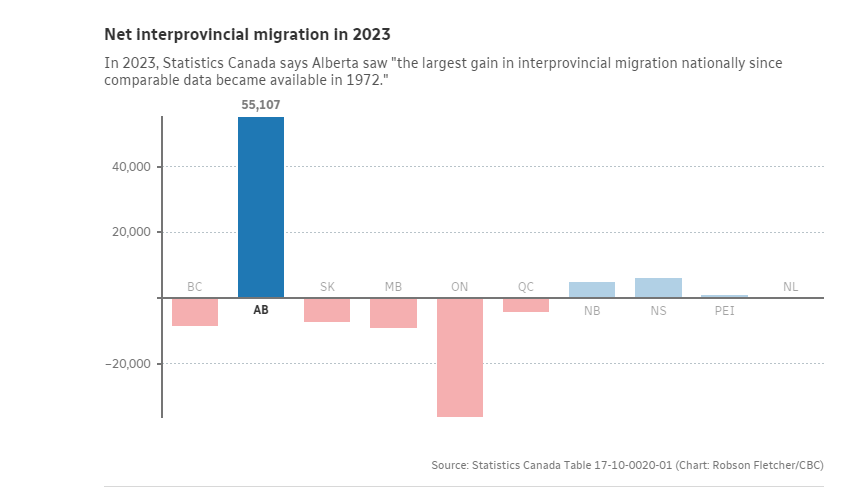
Calgary and Edmonton should see quite a bump in that age range as there was a massive interprovincial net gain last year, and the majority of those people will be in that age group. Halifax should continue along at a good pace with NS having interprovincial net gain.

1711645759502-png.551763
 
Calgary and Edmonton should see quite a bump in that age range as there was a massive interprovincial net gain last year, and the majority of those people will be in that age group. Halifax should continue along at a good pace with NS having interprovincial net gain.

The numbers would be different for sure. Anecdotally, I have some apartments that I rent out, with a couple of units advertising for renters this past year. I had dozens of inquiries and I'd say close to half of the people inquiring were young couples in the 25-40 age range new from Vancouver.
 
StatsCan released GDP numbers for 2023, and the numbers were fairly muted, which was expected given economic softness and the battle between inflation and stimulating growth. Here is an except along with the final figures by province:

Economic growth slows in 2023

In 2023, for the second consecutive year, real gross domestic product (GDP) grew in every province in Canada, except Newfoundland and Labrador, albeit at a slower pace compared with a year earlier for most.

In the territories, production slowed in Yukon and declined in the Northwest Territories, while Nunavut was the sole Canadian jurisdiction where economic growth meaningfully accelerated, with a nation-leading 3.4% increase in 2023.

Although record population growth helped spur economic activity, tight monetary policy, persistent inflation and several climate change-related events constrained output growth across Canada in 2023.

Higher output from services-producing industries in every province and territory bolstered overall economic growth during a challenging year for goods-producing industries in most of Canada in 2023.

Ontario, British Columbia and Alberta were the largest contributors to economic growth in 2023
Ontario (contribution of +0.60 percentage points) was the largest contributor to Canada's economic growth, accounting for almost half of the 1.2% increase in national GDP in 2023.

British Columbia (+0.23 percentage points) was the second-largest contributor to national economic growth, surpassing Alberta (+0.22 percentage points) and well ahead of Saskatchewan (+0.06 percentage points) and Quebec (+0.05 percentage points).

Newfoundland and Labrador (-0.04 percentage points) was the largest drag on national economic output for the third time in six years.


PE +2.21%
BC +1.63%
SK +1.60%
ON +1.58%
AB +1.45%
NB +1.35%
NS +1.34%
MB +1.32%
QC +0.23%
NL -2.49% (only province with negative growth)

NU +3.40
YK +1.60%
NT -0.07% (only territory with negative growth)

From various other sources, there was a difference between what economists had forecasted for 2023, and what actually happened. TD Bank's 2023 predictions below, along with the actual StatCan figure in brackets:

PE +2.3% (+2.21%)
AB +2.2% (+1.45%)
MB +1.6% (+1.32%)
NS +1.4% (+1.34%)
SK +1.2% (+1.60%)
ON +1.1% (+1.58%)
NB +1.1% (+1.35%)
BC +0.9% (+1.63%)
QC +0.3% (+0.23%)
NL -0.4% (-2.49%)

TD's predictions were not totally off, but definitely some notable revisions. They over estimated AB's growth, where apparently construction growth has not materialized a smuch as they thought. They marginally over-estimated growth in MB, NS, PE and QC, while underestimating BC, SK, and ON. BC seems to be the most off, TD had been predicting much more of a slowndown and muted performance relative to other provinces, but that didn't happen in 2023. Predicted to be 2nd lowest, it came out 2nd highest, but in a very very narrow range with the other provinces. 2024 will be interesting, forecasting is fun but always to be taken with a bag of salt, lol

TD report for reference
https://economics.td.com/domains/economics.td.com/documents/reports/pef/ProvincialEconomicForecast_Dec2023.pdf
 
https://www.therecord.com/news/wate...cle_7e8576ac-ec19-5d7b-acc7-e2f2fa7313de.html
‘The landscape saw a notable shift’ — Waterloo Region’s population soared in 2023 with international influx
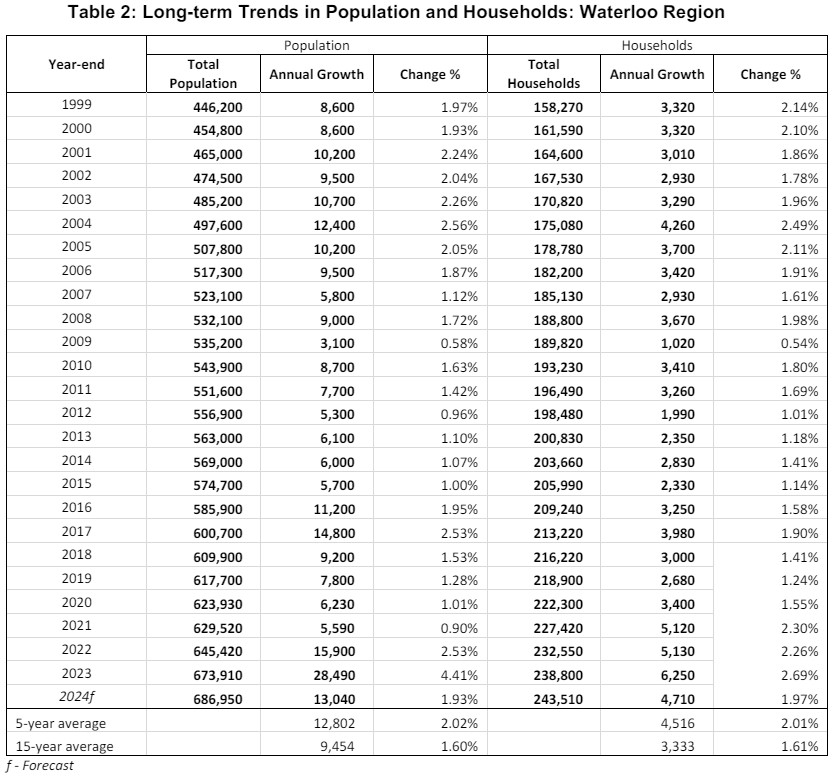
Overall population growth of 28,490 people represents a growth rate of 4.4 per cent
Bill Jackson May 2, 2024
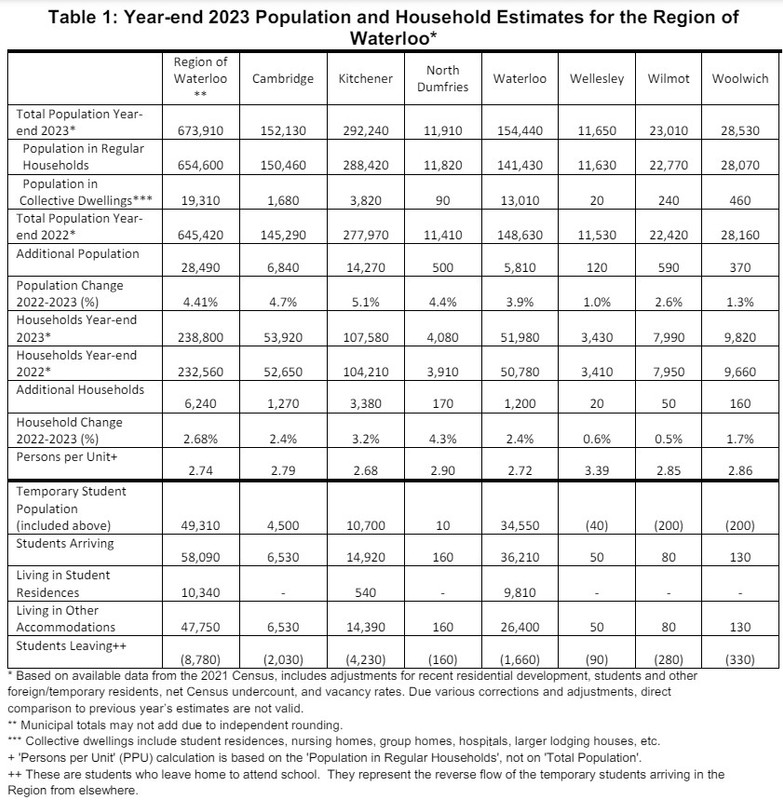
Waterloo Region’s population at the end of 2023 is estimated at 673,910 people, including university and college students temporarily residing here, according to a staff report going to the region’s planning and public works committee on Tuesday.

“The growth of 28,490 people in 2023 significantly outpaces the region’s five-year average annual population growth of 12,802,” it says.

The year-end growth and household estimates prepared by planners and data analysts are based on population and dwelling counts produced by Statistics Canada from the census, but also include students who are living in the region while they study at post-secondary institutions.

Roughly half (51 per cent) of the growth in 2023 is a direct result of an increase in international student enrolment at local institutions, the report says. The remaining growth is largely driven by both intra-provincial and international migration.

As of November 2023, there were 90,800 post-secondary students enrolled in full-time programs at Conestoga College, the University of Waterloo and Wilfrid Laurier University, on campuses that are located in Waterloo Region...
https://pub-regionofwaterloo.escribemeetings.com/filestream.ashx?DocumentId=7748
PDL-CPL-24-004, Year-End 2023 Population and Household Estimates for Waterloo

2024-May7-2023-POPULATION-AND-HOUSEHOLDS-ESTIMATES-FOR-WATERLOO-REGION-Table-1.jpg


2024-May7-2023-POPULATION-AND-HOUSEHOLDS-ESTIMATES-FOR-WATERLOO-REGION-Table-2.jpg
 
Interesting to see Waterloo region at close to 700,000.

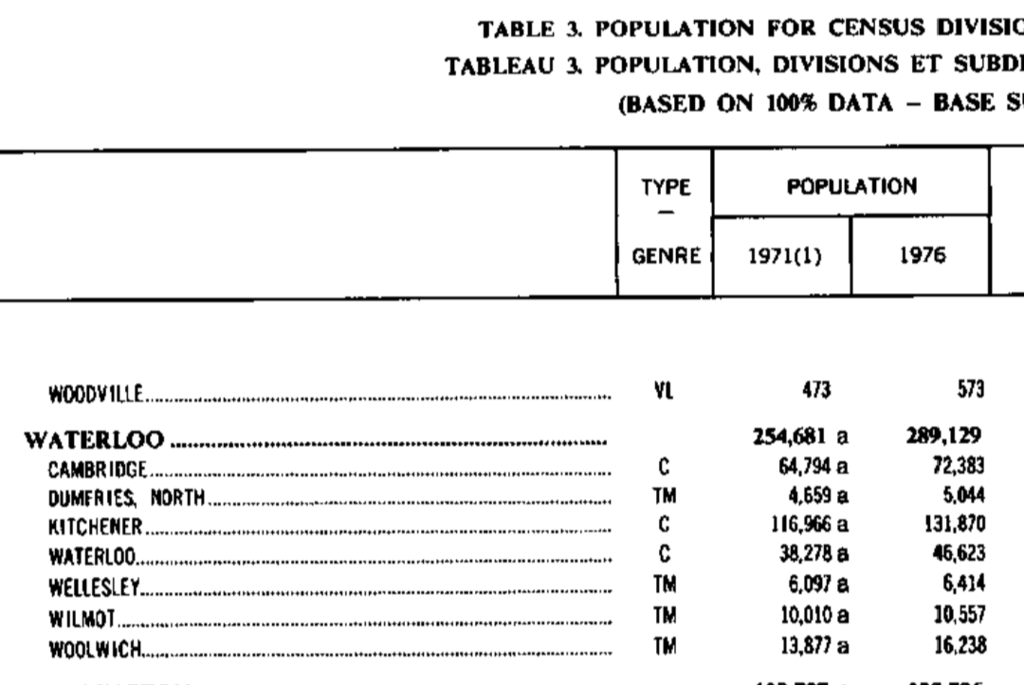
If I'm not mistaken a few decades ago err 30-40 years ago it was smaller than both London and Niagara.
 
Interesting to see Waterloo region at close to 700,000.

If I'm not mistaken a few decades ago err 30-40 years ago it was smaller than both London and Niagara.

Smaller than London, certainly. I think locals are still wrapping heads around the idea that metro Kitchener is now larger than metro London.
 
Smaller than London, certainly. I think locals are still wrapping heads around the idea that metro Kitchener is now larger than metro London.

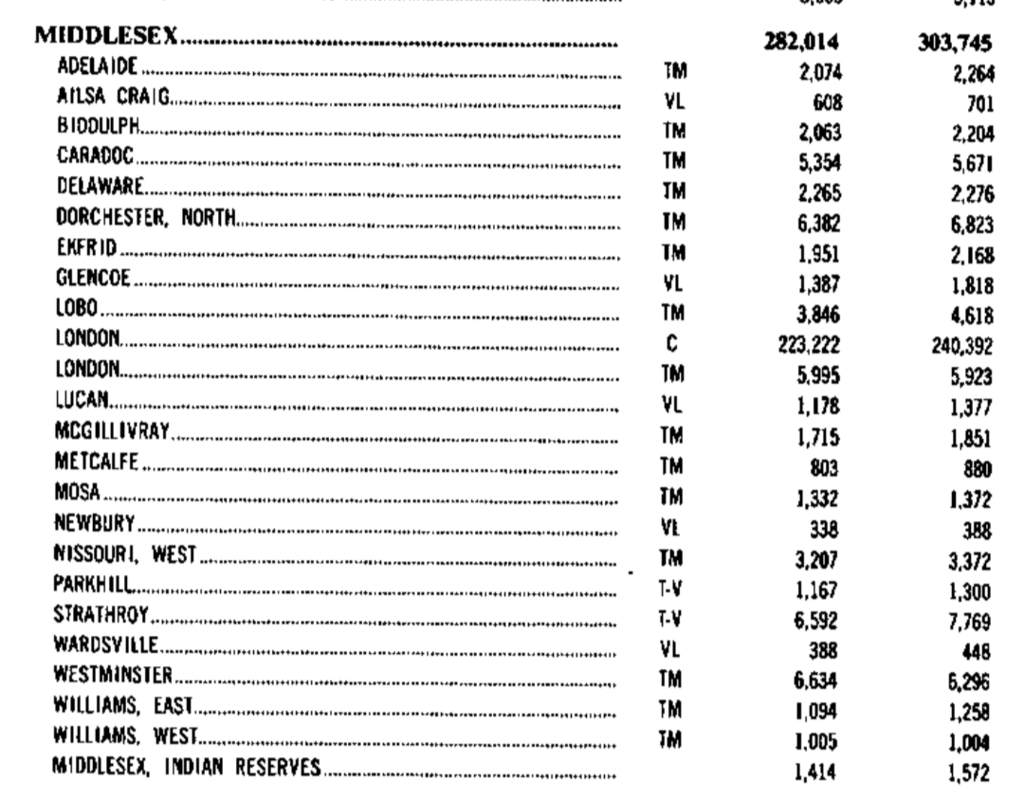
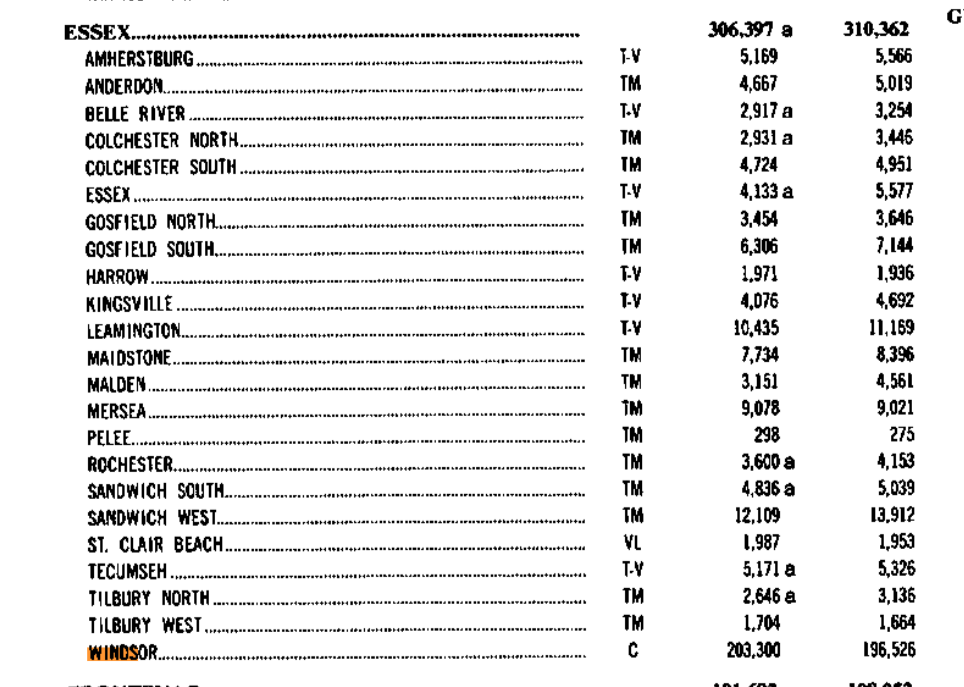
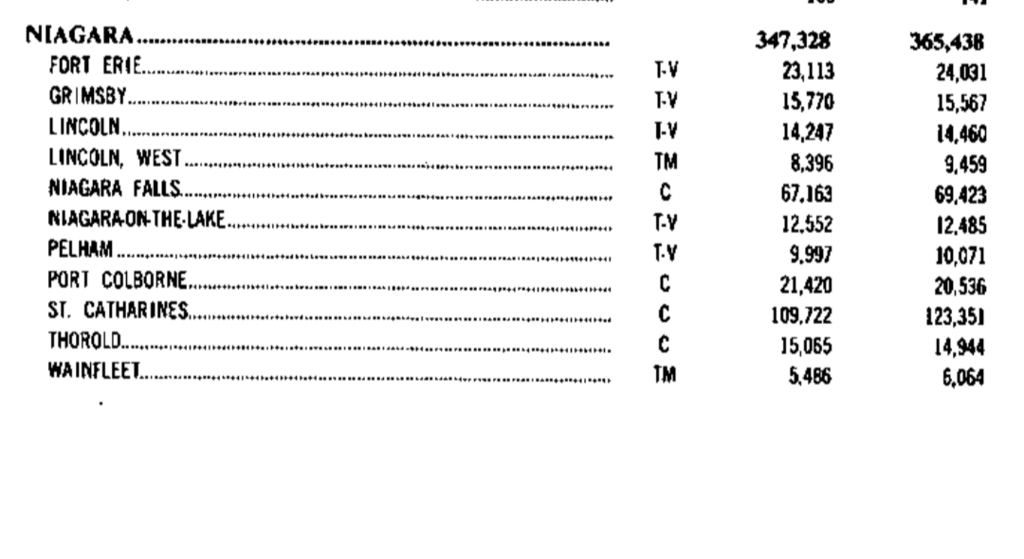
I found the 1976 census data incl 1971
Screenshot-20240503-201201-134.png


Screenshot-20240503-201232-173.png


Screenshot-20240504-131315-629.png


Screenshot-20240503-201248-859.png

https://publications.gc.ca/site/eng/9.836486/publication.html
- London (city) was almost double the size of Kitchener
- St. Catharines wasn't much smaller than Kitchener back then
- Cambridge and Niagara Falls were almost the same size
- Waterloo (46k) wasn't much bigger than Welland (45k) at the time :D but Waterloo was already on a rapid upward trajectory
 
Last edited:
For Windsor/Essex our population was 306,397K in 1971 and 310,362 in 1976. Interesting that it was larger than both London and Waterloo region back then.
 
I've always thought Windsor was a good sized region. Now both it and Niagara look like small potatoes compared to the wild growth of Waterloo Region at almost 700,000.
Even London was left in the dust and they're building a lot of high-rises in that city.


Back
Top