Quote:
Originally Posted by Ziobrop

The old pier 2/3 next to the casino were not merged into the naval dockyard until the 60's, so it's likely the north street staion could have survived.
|
Right you are. The railway lands between the dockyard and Barrington Street remained largely intact until being paved over in the early 70's.
Of course we are overlooking that the site of the former station, at the northeast corner of Barrington and North, was occupied by a bridge pier when the Macdonald bridge rose over the site starting in 1952. It's also true that the King Edward Hotel, built on the opposite side of Barrington Street, was taken over by the Navy in WWII and demolished by them in 1946.
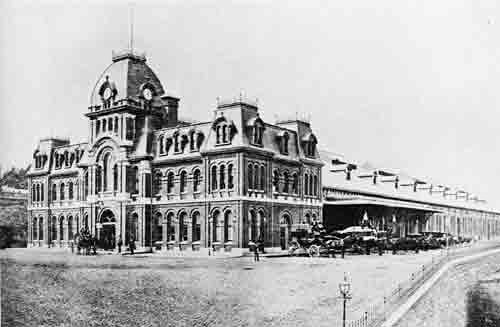
The photo is from an 1897 book called "Halifax of Today" by W.H. Howard. It shows both the Second Empire style head house and the massive glass-roofed train shed that collapsed with such deadly effect in the Explosion.
The photo predates the construction of the King Edward Hotel in 1903, and the covered stairway that joined it to the station on the west (left) side of the station. Both are visible in the postcard view that is perhaps the best-known image of the station. The hotel survived both the Explosion and an earlier 1911 fire.
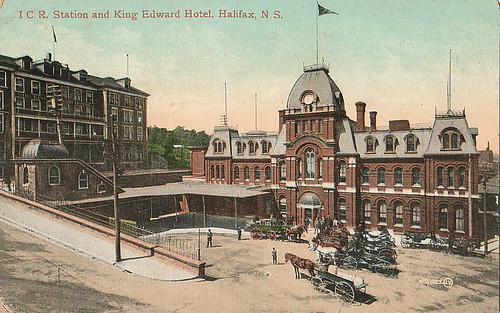
It's also interesting to reflect on
curnhalio's assertion that, "the Explosion unfortunately laid waste to most of the grand buildings that were built here in that era."
While buildings all over the city were damaged in the disaster, the worst destruction was in the so-called "devastated area", including the Richmond district north of North Street. The mostly working-class area lost factories, churches, schools and homes. Many were interesting structures to be sure, but I don't think most would be described as "grand" in the architectural sense, excepting the ICR terminal.
Anyone with more historical knowledge of the area have other examples of lost "grand" structures in Richmond?