Winnipeg | Downtown Developments & Discussions


A New View, Same Commitment to Downtown
Fillmore Riley is part of the growing momentum of Portage and Main

fillmore-riley-leadership.jpg

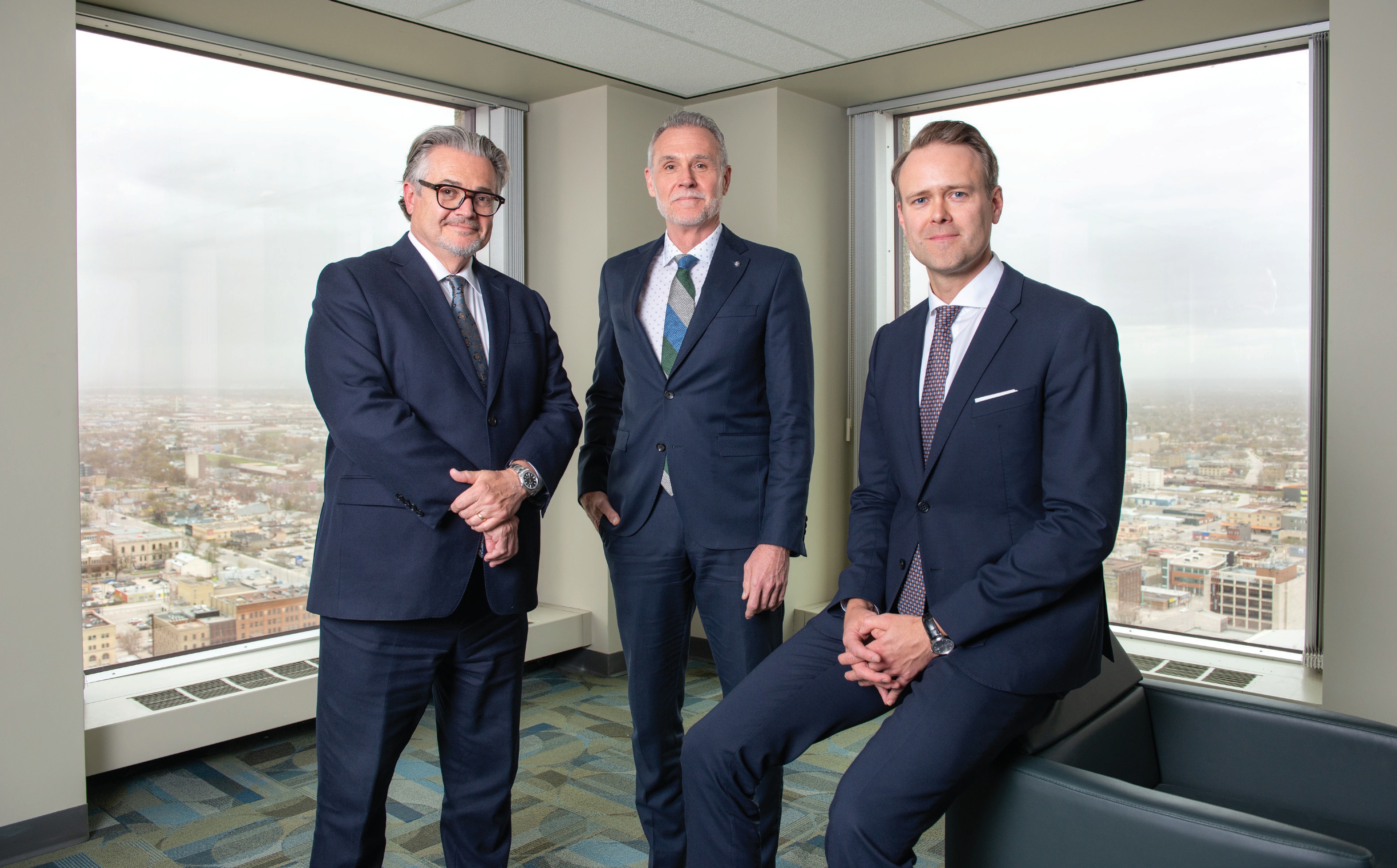
From left, Stuart Blake, Jody Langhan and Thor Richardson, president of James Richardson & Sons, Limited.
Photo by Thomas Fricke


LAWYERS at Fillmore Riley LLP who went on vacation in early July could be excused for any temporary confusion when they returned to the office.

That’s because the Winnipeg-based law firm may have executed the fastest-ever corporate relocation across Winnipeg’s most famous intersection when it shut down its office at 360 Main at noon on Friday, July 17.

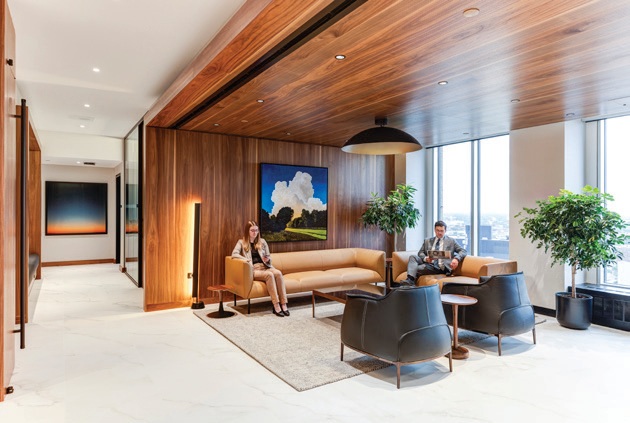
Less than 72 hours later, Fillmore Riley was up and fully operational on the 17th, 18th and 19th floors of the Richardson Building.

The move was two years in the making as the firm’s brain trust started looking at a variety of real estate options for when its lease expired this year. But when it came down to it, the choice was obvious for a number of reasons.

“We wanted to be downtown. We think it’s important that we still have our offices at Portage and Main,” says Stuart Blake, the firm’s chief executive officer and managing partner.

The growing momentum at Portage and Main — including the multi-million-dollar renovation of the Fairmont Hotel, the overhaul of the former Bank of Montreal building by the Manitoba Métis Federation, not to mention last year’s reopening of the intersection to pedestrian traffic — played a role, too, says Jody Langhan, the firm’s executive chair.

“We see ourselves as a regional, full-service Manitoba firm committed to the Manitoba market,” he says. “It’s very exciting to be part of what is hopefully a renewal of our downtown post-COVID. I think IG Wealth Management’s recent announcement to relocate headquarters to 360 Main Street is great. The more bodies we can have at Portage and Main, the better. It brings more people downtown and hopefully that will benefit all the small business owners in the area.”

It certainly helped that one of the not-so-small businesses in the neighbourhood — James Richardson & Sons, Limited, one of Canada’s largest and oldest family-owned private corporations — is one of Fillmore Riley’s longtime clients.

“It made so much sense,” Blake says. “We do a lot of work for them in a variety of areas and they happened to have space.”

FILLMORE Riley is far from the only tenant in the building to have a relationship with JRSL. Its operating company, Richardson International, and subsidiaries Richardson Pioneer Limited, Tundra Oil and Gas and Richardson Wealth as well as its insurance company Wynward Insurance and its banker, CIBC, all call the 34-storey skyscraper home. Fillmore Riley has the second-biggest tenant footprint in the building.

“They’re filling their building with a group of their businesses and strategic partners, and we really appreciate being a part of that group,” Langhan says.

Fillmore Riley has been in business since 1883, making it one of the longest serving law firms in Manitoba. It has about 80 lawyers, including 36 partners.

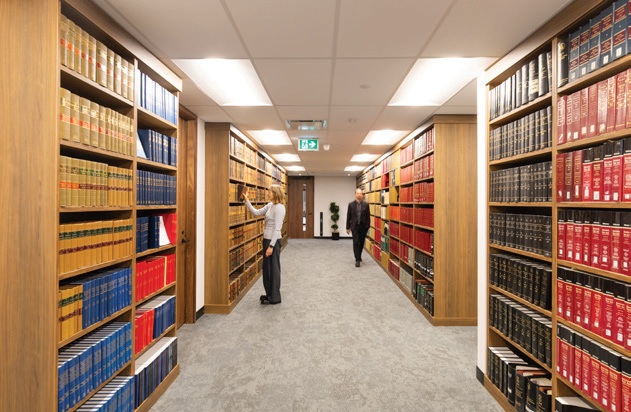
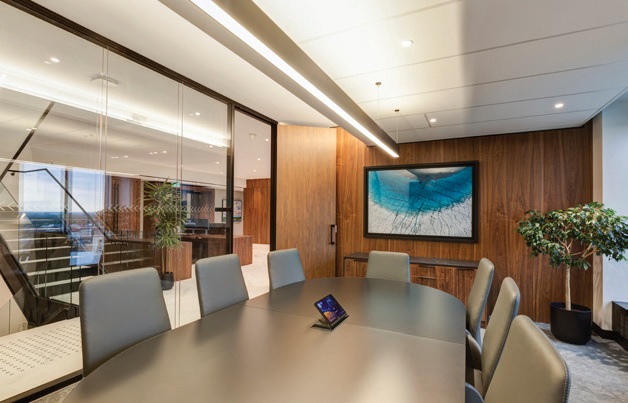
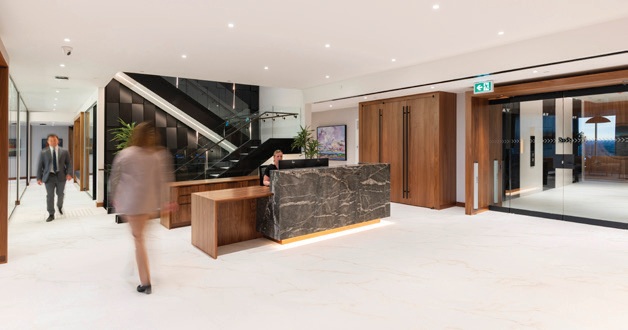
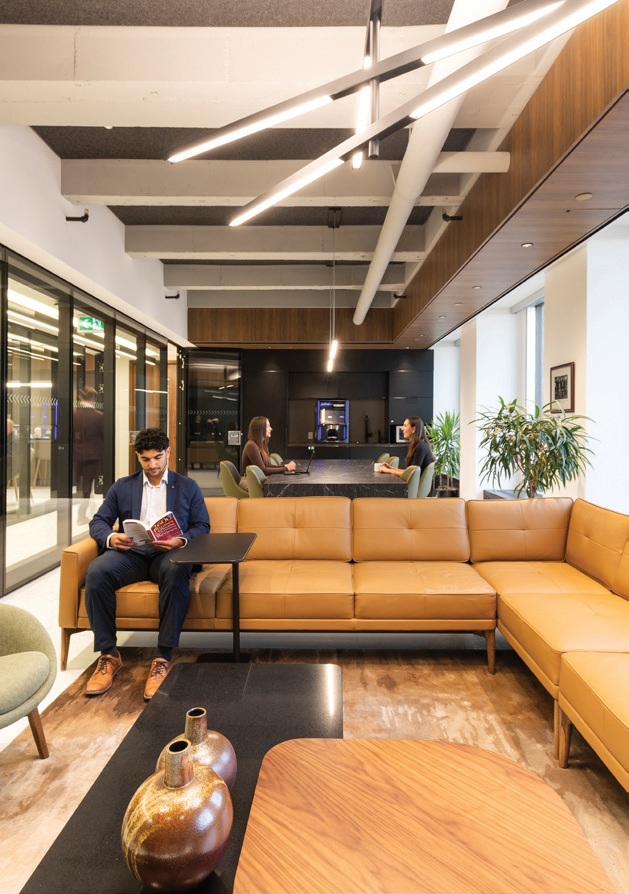
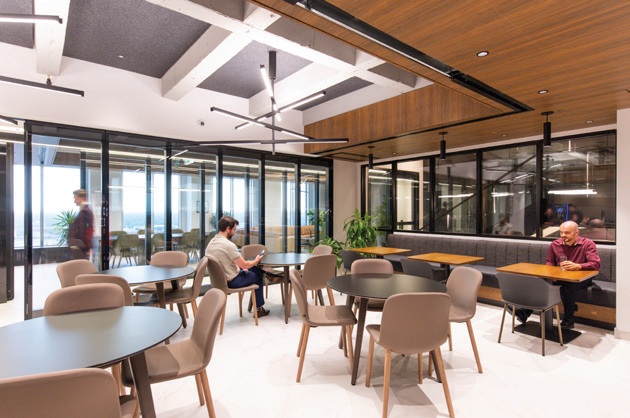
The new 39,000-square-foot space, which was stripped down to the concrete before the renovations began, is much more efficient as the firm now has 18 additional lawyer offices in the same square footage as its previous space.

“Our focus has never been to have a certain number of lawyers,” Blake says. “Our goal is always to provide exceptional legal services and to meet the needs of our clients. As those needs expand and get more sophisticated, we want to make sure we can deliver. The new office supports this goal.”

The move across the street wasn’t done without serious consideration.

“This was a significant, long-term investment and the client relationship added a layer of complexity,” says Langhan. “At the same time, we’ve worked with them for decades and there was a mutual trust and respect that went back and forth, so the process went very smoothly.”

It’s a homecoming of sorts for Fillmore Riley as the firm operated out of the Richardson Building for a decade before moving into what was then called the Trizec Building when it was christened in 1981. (It was named 360 Main in 2010.)

FILLMORE Riley focuses on high-end corporate commercial work and litigation. Langhan says the firm differentiates itself from the competition with its entrepreneurial spirit.

“We minimize bureaucracy and let our lawyers practise law,” he says.

Blake adds that if you look at the firm’s practices, you’ll find lawyers widely regarded as regional leaders in their fields. Their knowledge is being passed down to the up-and-coming lawyers, ensuring continuity of client service.

Fillmore Riley will continue to be a regional powerhouse in business law and complex litigation, but the firm’s also known for its strength across sectors such as agribusiness, manufacturing and transportation.

Fillmore Riley is also doing an increasing amount of Indigenous work, particularly on the economic development side, for the likes of the Manitoba Métis Federation, Treaty One Nations Inc. and the Swampy Cree Tribal Council.

“We’re partnering (with First Nations and Indigenous organizations) to create companies and build employment, capacity and economic wealth. It’s absolutely been identified as a growth area. It’s important work. There have been so many decades of oppression to overcome. Seeing First Nations and Indigenous organizations gain some economic sway and to meaningfully participate in a substantial way in the renewal and development of downtown Winnipeg and across our province is exciting. It’s an honour to play a role in that,” Langhan says.

Fillmore Riley is well-positioned to support that growth, right from the corner where it all started.

fillmore-riley-library.jpg

fillmore-riley-meeting-room.jpg

fillmore-riley-reception.jpg

fillmore-riley-office-lounge.jpg

fillmore-riley-seating-area.jpg

fillmore-riley-shared-space.jpg

Fillmore Riley
  • Founded in 1883 as Richards & Coutlee, the firm was renamed Fillmore & Riley around the time it moved into the Richardson Building in 1971.
  • Fillmore & Riley had 10 lawyers and 10 support staff in 1971. Today, Fillmore Riley LLP has 180 employees, including 80 lawyers.
  • Fillmore Riley is active with charities in the community, including CancerCare Manitoba, FortWhyte Alive and the United Way.
  • Twenty-three of its lawyers were named to the 2027 edition of the Best Lawyers in Canada.
  • The firm was named one of the Top Western Law Firms of 2025-26 by Canadian Lawyer magazine and it was recognized by the Globe and Mail in its annual list of Canada’s Best Law Firms for 2026.
Manitoba Inc.
 
The Marlborough Hotel has received it's construction permit to begin the conversion to residential.

26-233429 DP-2026-10-29, Alterations. Housing Affordability Fund - Development permit for a change of use to establish an approximately 173,519.78 sq. ft. (2224.9 Sq meters 9 storey) 307 unit multi family dwelling in an existing multi storey multi tenant building.

26-248929 MU-2026-10-29, Interior and Exterior Alterations. Optional Professional Certification Program Permit. Affordable Housing Support Converting existing hotel rooms and offices/ garment showrooms into furnished residential suites (48 residential units per floor 3rd -8th and 16 units on 10th floor, total 307 dwelling units). Phase 1, primarily the residential portions of the building.
 
Will they keep the beautiful meeting spaces and ballrooms for events?
That was the plan originally. Dining options and at the very least, The Skyview Ballroom open for public and ballroom for events.
I hope more details will emerge as we know, there are other meeting rooms and spaces that are beautiful as well.
I would have preferred it remain a hotel, but saving thru a residential conversion is better than what happened to other hotels.
At least the historic building survives.
 
The Marlborough Hotel has received it's construction permit to begin the conversion to residential.

26-233429 DP-2026-10-29, Alterations. Housing Affordability Fund - Development permit for a change of use to establish an approximately 173,519.78 sq. ft. (2224.9 Sq meters 9 storey) 307 unit multi family dwelling in an existing multi storey multi tenant building.

26-248929 MU-2026-10-29, Interior and Exterior Alterations. Optional Professional Certification Program Permit. Affordable Housing Support Converting existing hotel rooms and offices/ garment showrooms into furnished residential suites (48 residential units per floor 3rd -8th and 16 units on 10th floor, total 307 dwelling units). Phase 1, primarily the residential portions of the building.
So glad this is going forward. I would have hated to see this storied edifice destroyed.
Is the 10th floor hidden from view?
 
Building a downtown that thrives
CentreVenture’s new strategic plan puts housing at the centre of downtown Winnipeg’s revival

By Brook Thalgott

p25-image-01.jpg

Photo supplied by Rochelle Squires.

“If we succeed, downtown will be a thriving hub with shops, venues and people.

It will have that ‘game-night’ vibe all the time. People will feel safe and at home downtown, 24 hours a day, seven days a week.” — Rochelle Squires, CEO of CentreVenture Development Corp., says adding more residents is key to creating a vibrant downtown Winnipeg.

ON a Jets game night, when fans stream toward Canada Life Centre and restaurants and sidewalks fill before puck drop, Winnipeg’s core feels busy, energetic and alive.

CentreVenture Development Corporation wants downtown to feel that way more often—and not only when a game or concert draws thousands of people into the area.

Its new strategic plan sets an ambitious goal: increase downtown Winnipeg’s population from approximately 18,500 today to 36,000 by 2050. That target was developed through research, consultation and discussions with stakeholders, architects, urban-density experts and academics at the University of Manitoba.

“If we succeed, downtown will be a thriving hub with shops, venues and people,” says Rochelle Squires, CEO of CentreVenture. “It will have that ‘game-night’ vibe all the time. People will feel safe and at home downtown, 24 hours a day, seven days a week.”

Squires says 36,000 residents would provide the population needed to create a consistently vibrant, walkable and safe downtown. The goal is not simply to fill residential buildings, but to rebalance a city centre that has historically depended heavily on office workers and visitors.

From office district to neighbourhood​

Before the COVID-19 pandemic, approximately 80,000 people travelled downtown for work each day, sustaining restaurants, shops and services. When offices emptied, the vulnerability of that model became impossible to ignore.

CentreVenture is now working toward a downtown supported by the people who live there as well as those who commute into the city centre. More residents create a steady customer base for grocery stores, restaurants, cafés, retailers and personal services. They also bring activity to sidewalks and public spaces outside conventional office hours.

As Squires puts it, “retail follows rooftops.”

The opening of a Red River Co-op grocery store at the Portage Place redevelopment in 2029 will help address one of downtown’s most important amenity gaps. Expansions by Red River College Polytechnic and the University of Winnipeg, together with additional student housing, will also bring more students and residents into the area.

A downtown where people can live, learn, work and play is better positioned to sustain businesses and attract companies looking for a lively, amenity-rich place to establish or expand.

“It’s all hands-on deck,” Squires says.

Making difficult projects possible​

CentreVenture will not build all the homes needed to reach the population target. Its role is to create conditions that enable private, non-profit and Indigenous developers to build them. CentreVenture’s strategic plan calls for residential incentives, renewed financing tools and targeted support for vacant or underused properties.

One current initiative is the Downtown Heritage Residential Conversion Grant Pilot Program, a collaboration involving CentreVenture, the City of Winnipeg and funding delivered through the federal National Housing Strategy.

The program helps property owners convert vacant or underused heritage buildings into housing. The opportunity is significant in Winnipeg, which has one of Canada’s largest historic districts. CentreVenture estimates approximately 10 per cent of its buildings are vacant or underused.

The Millennium Centre illustrates the potential. Its first floor and mezzanine are in use, but its upper floors remain vacant. Finding new or expanded uses for buildings like it could preserve Winnipeg’s heritage architecture while adding homes and street-level activity.

CentreVenture points to its record as evidence that targeted public support can unlock larger investments. According to the plan, approximately $26 million in City of Winnipeg funding over 26 years enabled CentreVenture to make $84 million in direct investments and helped leverage $1.8 billion in private-sector and community capital. Of the 8,329 downtown homes built, underway or projected between 2003 and 2028, 6,004 are associated with projects that received incentives.

Building a complete community​

Reaching the population target will require adding the right housing mix. Most homes being built downtown are one- and two-bedroom units suited to single residents, couples and small households. Some family-sized homes are being developed, but Squires acknowledges that additional amenities will be needed before downtown attracts a significant number of families with children.

CentreVenture wants downtown to include people at every income level and stage of life: students, newcomers, young professionals, single parents, families, retirees, empty nesters and seniors. That will require market, affordable and mixed-income housing.

Squires points to Osborne Village as an example of the social mix CentreVenture would like to encourage—a neighbourhood where different ages, incomes and household types live alongside one another.

“Everybody is welcome,” she says.

Parking also remains a challenge. Downtown has parking, but it is not always free, convenient or easily accessible. At the same time, a denser, more walkable community should allow more residents to complete daily errands without driving.

Creating activity and safety​

CentreVenture sees greater residential density and mixed-use development as part of improving downtown safety. More residents mean more people using sidewalks, businesses and public spaces at different hours. A downtown that remains active after offices close can feel safer than one marked by vacant storefronts and empty streets.

Development alone cannot resolve homelessness, addictions, mental-health challenges or poverty. Those issues require coordinated responses from governments, Indigenous organizations, law enforcement, health and social-service providers and community agencies.

CentreVenture’s role is to encourage occupied buildings, active storefronts and a larger permanent population, creating conditions that can support broader safety and social initiatives.

Reimagining Graham Avenue​

Graham Avenue is one place where CentreVenture hopes to turn its strategy into visible change.

The avenue lost much of its activity when transit service moved away from the former bus mall. Since then, pilot projects are introducing new planters, lighting, seating, markets and public events. Public-works improvements have also been undertaken.

The newly announced $1.4 million Storefront Success Program will assist with eligible capital improvements, including façades, lighting, signage, windows, entrances, patios, canopies, accessibility upgrades and landscaping. Funding may also support interior improvements visible from the street and professional design services.

Rather than relying on a single transformative project, CentreVenture is trying to build momentum through overlapping residential, commercial and public investments. Its plan ultimately envisions Graham Avenue as a signature corridor and downtown destination.

Restoring the everyday city​

Downtown Winnipeg already shows it can attract people. Concerts, festivals, sporting events and cultural institutions regularly bring energy into the core. The challenge is turning that episodic activity into everyday life.

CentreVenture is betting that people are the foundation of a more resilient downtown: enough people, living in enough different kinds of homes, to turn the city centre into a complete community. If the strategy works, downtown’s most energetic evenings will no longer feel exceptional, but a regular day in the life of the city.
Manitoba Inc.
 
The Marlborough Hotel has received it's construction permit to begin the conversion to residential.

26-233429 DP-2026-10-29, Alterations. Housing Affordability Fund - Development permit for a change of use to establish an approximately 173,519.78 sq. ft. (2224.9 Sq meters 9 storey) 307 unit multi family dwelling in an existing multi storey multi tenant building.

26-248929 MU-2026-10-29, Interior and Exterior Alterations. Optional Professional Certification Program Permit. Affordable Housing Support Converting existing hotel rooms and offices/ garment showrooms into furnished residential suites (48 residential units per floor 3rd -8th and 16 units on 10th floor, total 307 dwelling units). Phase 1, primarily the residential portions of the building.
Amazing news! Huge piece of the downtown resurrection puzzle!


Back
Top